

and (g) (all deacylations) are enantioselective. The above results demonstrate that
“the enantioselection is governed by the deacylation step”. Of the four steps, only
step (b) was allowed to give D,D-dimer. The EM formation, via steps (a) and (e), was
possible, however, from all alkyl (primary and secondary) D- and L-lactate
monomers.
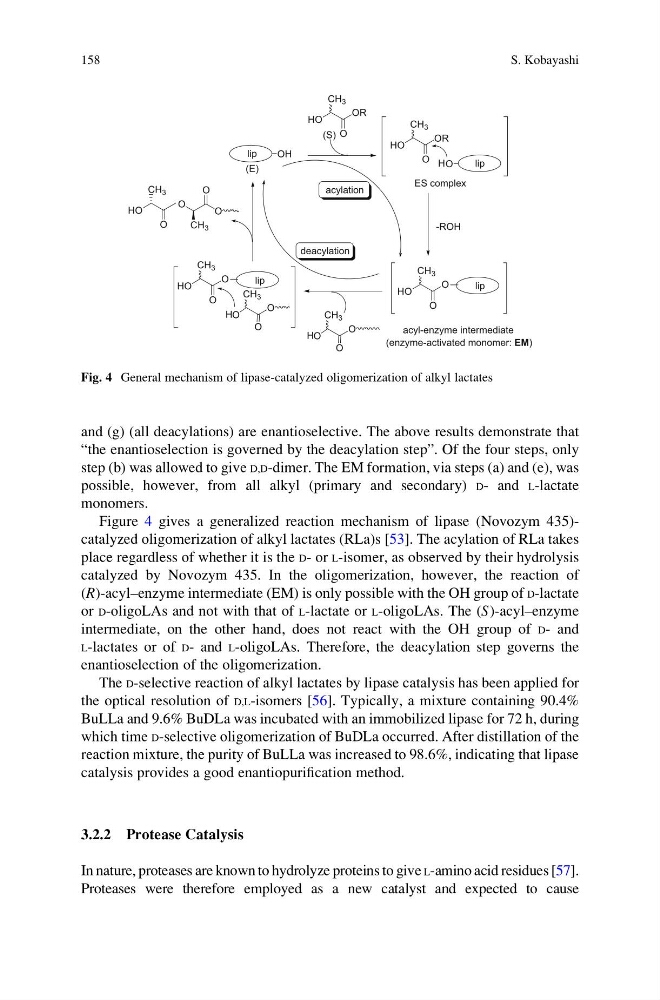
Figure 4 gives a generalized reaction mechanism of lipase (Novozym 435)catalyzed oligomerization of alkyl lactates (RLa)s [53]. The acylation of RLa takes
place regardless of whether it is the D- or L-isomer, as observed by their hydrolysis
catalyzed by Novozym 435. In the oligomerization, however, the reaction of
(R)-acyl–enzyme intermediate (EM) is only possible with the OH group of D-lactate
or D-oligoLAs and not with that of L-lactate or L-oligoLAs. The (S)-acyl–enzyme
intermediate, on the other hand, does not react with the OH group of D- and
L-lactates or of D- and L-oligoLAs. Therefore, the deacylation step governs the
enantioselection of the oligomerization.
The D-selective reaction of alkyl lactates by lipase catalysis has been applied for
the optical resolution of D,L-isomers [56]. Typically, a mixture containing 90.4%
BuLLa and 9.6% BuDLa was incubated with an immobilized lipase for 72 h, during
which time D-selective oligomerization of BuDLa occurred. After distillation of the
reaction mixture, the purity of BuLLa was increased to 98.6%, indicating that lipase
catalysis provides a good enantiopurification method.
3.2.2 Protease Catalysis
In nature, proteases are known to hydrolyze proteins to give L-amino acid residues [57].
Proteases were therefore employed as a new catalyst and expected to cause
HO
O
CH 3
O
HO
O
CH 3
O
HO
O
CH 3
O
HO
O
CH 3
O
O
O
O
CH 3
HO
O
CH 3
OH
HO
OR
CH 3
O
(S)
HO
OR
CH 3
O
lip
lip
(E)
acyl-enzyme intermediate
lip
(enzyme-activated monomer: EM)
acylation
deacylation
ES complex
-ROH
lip
O
H
Fig. 4 General mechanism of lipase-catalyzed oligomerization of alkyl lactates
158
S. Kobayashi
“the enantioselection is governed by the deacylation step”. Of the four steps, only
step (b) was allowed to give D,D-dimer. The EM formation, via steps (a) and (e), was
possible, however, from all alkyl (primary and secondary) D- and L-lactate
monomers.
Figure 4 gives a generalized reaction mechanism of lipase (Novozym 435)catalyzed oligomerization of alkyl lactates (RLa)s [53]. The acylation of RLa takes
place regardless of whether it is the D- or L-isomer, as observed by their hydrolysis
catalyzed by Novozym 435. In the oligomerization, however, the reaction of
(R)-acyl–enzyme intermediate (EM) is only possible with the OH group of D-lactate
or D-oligoLAs and not with that of L-lactate or L-oligoLAs. The (S)-acyl–enzyme
intermediate, on the other hand, does not react with the OH group of D- and
L-lactates or of D- and L-oligoLAs. Therefore, the deacylation step governs the
enantioselection of the oligomerization.
The D-selective reaction of alkyl lactates by lipase catalysis has been applied for
the optical resolution of D,L-isomers [56]. Typically, a mixture containing 90.4%
BuLLa and 9.6% BuDLa was incubated with an immobilized lipase for 72 h, during
which time D-selective oligomerization of BuDLa occurred. After distillation of the
reaction mixture, the purity of BuLLa was increased to 98.6%, indicating that lipase
catalysis provides a good enantiopurification method.
3.2.2 Protease Catalysis
In nature, proteases are known to hydrolyze proteins to give L-amino acid residues [57].
Proteases were therefore employed as a new catalyst and expected to cause
HO
O
CH 3
O
HO
O
CH 3
O
HO
O
CH 3
O
HO
O
CH 3
O
O
O
O
CH 3
HO
O
CH 3
OH
HO
OR
CH 3
O
(S)
HO
OR
CH 3
O
lip
lip
(E)
acyl-enzyme intermediate
lip
(enzyme-activated monomer: EM)
acylation
deacylation
ES complex
-ROH
lip
O
H
Fig. 4 General mechanism of lipase-catalyzed oligomerization of alkyl lactates
158
S. Kobayashi