

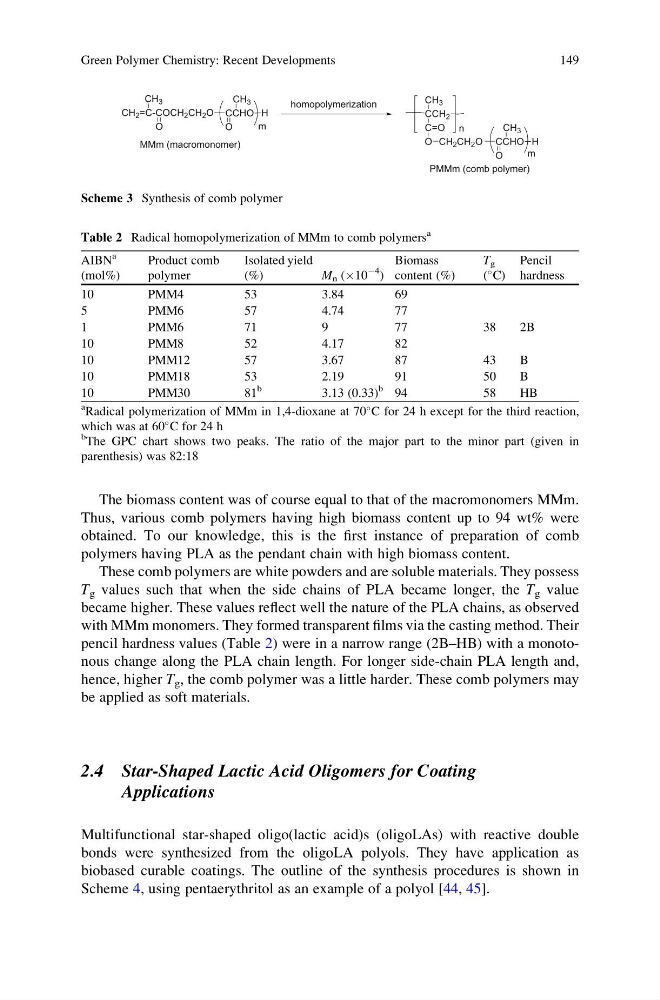
The biomass content was of course equal to that of the macromonomers MMm.
Thus, various comb polymers having high biomass content up to 94 wt% were
obtained. To our knowledge, this is the first instance of preparation of comb
polymers having PLA as the pendant chain with high biomass content.
These comb polymers are white powders and are soluble materials. They possess
T g values such that when the side chains of PLA became longer, the T g value
became higher. These values reflect well the nature of the PLA chains, as observed
with MMm monomers. They formed transparent films via the casting method. Their
pencil hardness values (Table 2) were in a narrow range (2B–HB) with a monotonous change along the PLA chain length. For longer side-chain PLA length and,
hence, higher T g , the comb polymer was a little harder. These comb polymers may
be applied as soft materials.
2.4 Star-Shaped Lactic Acid Oligomers for Coating
Applications
Multifunctional star-shaped oligo(lactic acid)s (oligoLAs) with reactive double
bonds were synthesized from the oligoLA polyols. They have application as
biobased curable coatings. The outline of the synthesis procedures is shown in
Scheme 4, using pentaerythritol as an example of a polyol [44, 45].
CCH 2
CH 3
C=O
O CH 2 CH 2 O CCHO
O
CH 3
H
CH 2 =C-COCH 2 CH 2 O
CH 3
O
CCHO
O
CH 3
H
m
homopolymerization
m
n
PMMm (comb polymer)
MMm (macromonomer)
Scheme 3 Synthesis of comb polymer
Table 2 Radical homopolymerization of MMm to comb polymers
a
AIBN
a
(mol%)
Product comb
polymer
Isolated yield
(%)
M n (Â10
À4
)
Biomass
content (%)
T g
(
C)
Pencil
hardness
10
PMM4
53
3.84
69
5
PMM6
57
4.74
77
1
PMM6
71
9
77
38
2B
10
PMM8
52
4.17
82
10
PMM12
57
3.67
87
43
B
10
PMM18
53
2.19
91
50
B
10
PMM30
81
b
3.13 (0.33)
b 94
58
HB
a
Radical polymerization of MMm in 1,4-dioxane at 70
C for 24 h except for the third reaction,
which was at 60
C for 24 h
b
The GPC chart shows two peaks. The ratio of the major part to the minor part (given in
parenthesis) was 82:18
Green Polymer Chemistry: Recent Developments
149
Thus, various comb polymers having high biomass content up to 94 wt% were
obtained. To our knowledge, this is the first instance of preparation of comb
polymers having PLA as the pendant chain with high biomass content.
These comb polymers are white powders and are soluble materials. They possess
T g values such that when the side chains of PLA became longer, the T g value
became higher. These values reflect well the nature of the PLA chains, as observed
with MMm monomers. They formed transparent films via the casting method. Their
pencil hardness values (Table 2) were in a narrow range (2B–HB) with a monotonous change along the PLA chain length. For longer side-chain PLA length and,
hence, higher T g , the comb polymer was a little harder. These comb polymers may
be applied as soft materials.
2.4 Star-Shaped Lactic Acid Oligomers for Coating
Applications
Multifunctional star-shaped oligo(lactic acid)s (oligoLAs) with reactive double
bonds were synthesized from the oligoLA polyols. They have application as
biobased curable coatings. The outline of the synthesis procedures is shown in
Scheme 4, using pentaerythritol as an example of a polyol [44, 45].
CCH 2
CH 3
C=O
O CH 2 CH 2 O CCHO
O
CH 3
H
CH 2 =C-COCH 2 CH 2 O
CH 3
O
CCHO
O
CH 3
H
m
homopolymerization
m
n
PMMm (comb polymer)
MMm (macromonomer)
Scheme 3 Synthesis of comb polymer
Table 2 Radical homopolymerization of MMm to comb polymers
a
AIBN
a
(mol%)
Product comb
polymer
Isolated yield
(%)
M n (Â10
À4
)
Biomass
content (%)
T g
(
C)
Pencil
hardness
10
PMM4
53
3.84
69
5
PMM6
57
4.74
77
1
PMM6
71
9
77
38
2B
10
PMM8
52
4.17
82
10
PMM12
57
3.67
87
43
B
10
PMM18
53
2.19
91
50
B
10
PMM30
81
b
3.13 (0.33)
b 94
58
HB
a
Radical polymerization of MMm in 1,4-dioxane at 70
C for 24 h except for the third reaction,
which was at 60
C for 24 h
b
The GPC chart shows two peaks. The ratio of the major part to the minor part (given in
parenthesis) was 82:18
Green Polymer Chemistry: Recent Developments
149