

with metal salts, when poly-(R)-3 and poly-(S)-3 [containing (R)- and (S)-MTPA
amide pendants, respectively] were prepared [21] and tested with a selection of
mono- and divalent metal cations, no HPMC formation was detected. As the only
difference between MTPA and MPA is the presence of the CF 3 group, either steric
and/or inductive effects (i.e. on the donor capacity of the oxygen atoms) are
probably responsible for this outcome.
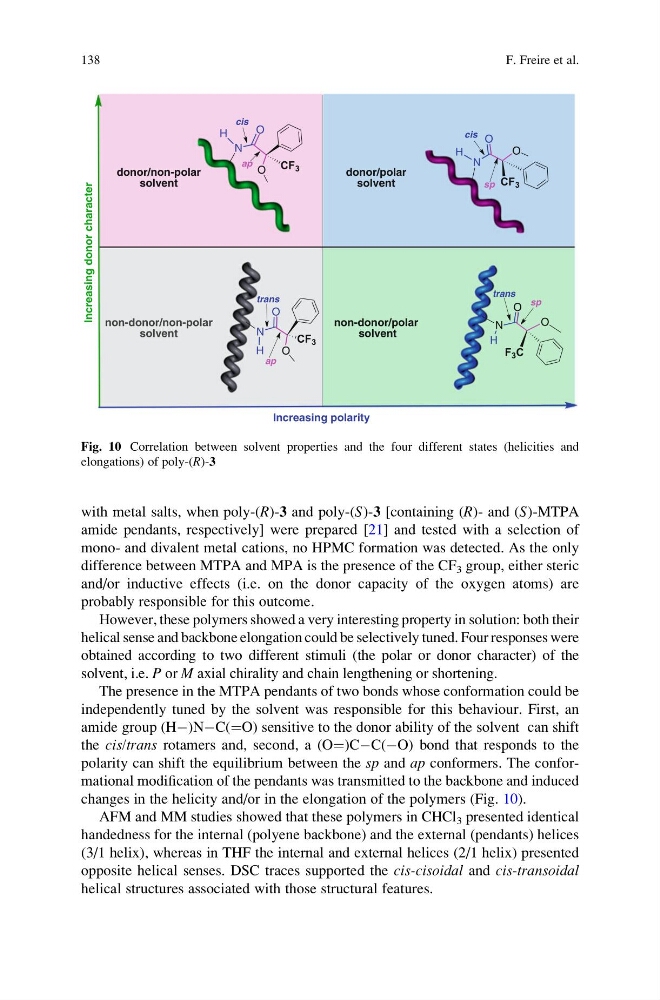
However, these polymers showed a very interesting property in solution: both their
helical sense and backbone elongation could be selectively tuned. Four responses were
obtained according to two different stimuli (the polar or donor character) of the
solvent, i.e. P or M axial chirality and chain lengthening or shortening.
The presence in the MTPA pendants of two bonds whose conformation could be
independently tuned by the solvent was responsible for this behaviour. First, an
amide group (HÀ)NÀC(¼O) sensitive to the donor ability of the solvent can shift
the cis/trans rotamers and, second, a (O¼)CÀC(ÀO) bond that responds to the
polarity can shift the equilibrium between the sp and ap conformers. The conformational modification of the pendants was transmitted to the backbone and induced
changes in the helicity and/or in the elongation of the polymers (Fig. 10).
AFM and MM studies showed that these polymers in CHCl 3 presented identical
handedness for the internal (polyene backbone) and the external (pendants) helices
(3/1 helix), whereas in THF the internal and external helices (2/1 helix) presented
opposite helical senses. DSC traces supported the cis-cisoidal and cis-transoidal
helical structures associated with those structural features.
N
O
O
H
F 3 C
donor/non-polar
solvent
non-donor/non-polar
solvent
non-donor/polar
solvent
N
O
O
H
CF 3
donor/polar
solvent
Increasing polarity
Increasing donor character
N
O
O
CF 3
H
N
O
O CF 3
H
cis
ap
cis
sp
ap
sp
trans
trans
Fig. 10 Correlation between solvent properties and the four different states (helicities and
elongations) of poly-(R)-3
138
F. Freire et al.
amide pendants, respectively] were prepared [21] and tested with a selection of
mono- and divalent metal cations, no HPMC formation was detected. As the only
difference between MTPA and MPA is the presence of the CF 3 group, either steric
and/or inductive effects (i.e. on the donor capacity of the oxygen atoms) are
probably responsible for this outcome.
However, these polymers showed a very interesting property in solution: both their
helical sense and backbone elongation could be selectively tuned. Four responses were
obtained according to two different stimuli (the polar or donor character) of the
solvent, i.e. P or M axial chirality and chain lengthening or shortening.
The presence in the MTPA pendants of two bonds whose conformation could be
independently tuned by the solvent was responsible for this behaviour. First, an
amide group (HÀ)NÀC(¼O) sensitive to the donor ability of the solvent can shift
the cis/trans rotamers and, second, a (O¼)CÀC(ÀO) bond that responds to the
polarity can shift the equilibrium between the sp and ap conformers. The conformational modification of the pendants was transmitted to the backbone and induced
changes in the helicity and/or in the elongation of the polymers (Fig. 10).
AFM and MM studies showed that these polymers in CHCl 3 presented identical
handedness for the internal (polyene backbone) and the external (pendants) helices
(3/1 helix), whereas in THF the internal and external helices (2/1 helix) presented
opposite helical senses. DSC traces supported the cis-cisoidal and cis-transoidal
helical structures associated with those structural features.
N
O
O
H
F 3 C
donor/non-polar
solvent
non-donor/non-polar
solvent
non-donor/polar
solvent
N
O
O
H
CF 3
donor/polar
solvent
Increasing polarity
Increasing donor character
N
O
O
CF 3
H
N
O
O CF 3
H
cis
ap
cis
sp
ap
sp
trans
trans
Fig. 10 Correlation between solvent properties and the four different states (helicities and
elongations) of poly-(R)-3
138
F. Freire et al.