

Nobel Prize for his work in organic chemistry earlier than he received it for
macromolecular chemistry, just like his former student from Karlsruhe and Zu ¨rich,
Leopold Ruzicka, who received it in 1939.
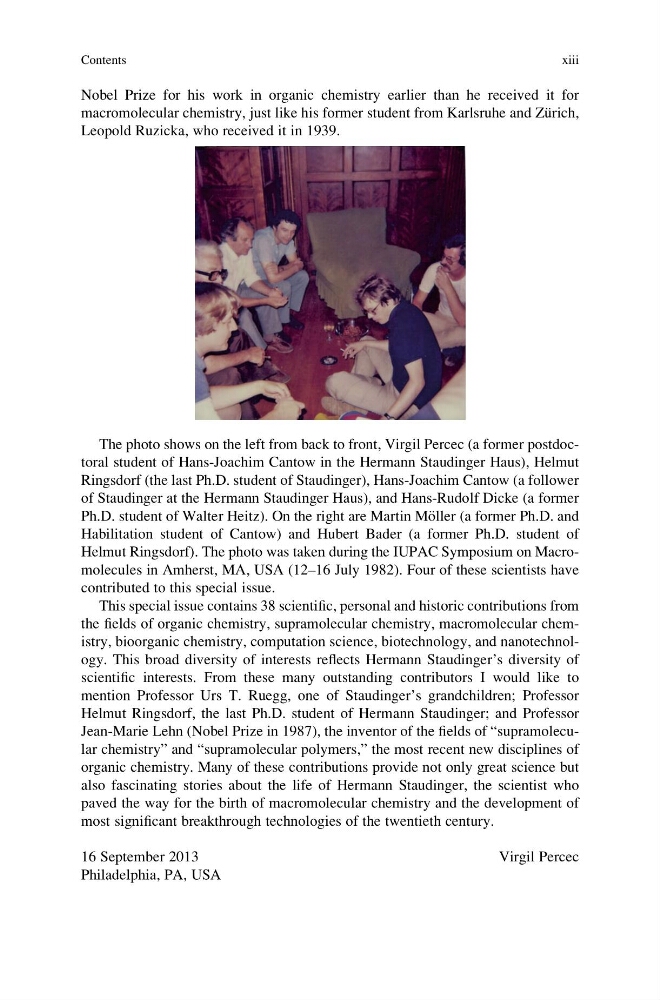
The photo shows on the left from back to front, Virgil Percec (a former postdoctoral student of Hans-Joachim Cantow in the Hermann Staudinger Haus), Helmut
Ringsdorf (the last Ph.D. student of Staudinger), Hans-Joachim Cantow (a follower
of Staudinger at the Hermann Staudinger Haus), and Hans-Rudolf Dicke (a former
Ph.D. student of Walter Heitz). On the right are Martin Mo ¨ller (a former Ph.D. and
Habilitation student of Cantow) and Hubert Bader (a former Ph.D. student of
Helmut Ringsdorf). The photo was taken during the IUPAC Symposium on Macromolecules in Amherst, MA, USA (12–16 July 1982). Four of these scientists have
contributed to this special issue.
This special issue contains 38 scientific, personal and historic contributions from
the fields of organic chemistry, supramolecular chemistry, macromolecular chemistry, bioorganic chemistry, computation science, biotechnology, and nanotechnology. This broad diversity of interests reflects Hermann Staudinger’s diversity of
scientific interests. From these many outstanding contributors I would like to
mention Professor Urs T. Ruegg, one of Staudinger’s grandchildren; Professor
Helmut Ringsdorf, the last Ph.D. student of Hermann Staudinger; and Professor
Jean-Marie Lehn (Nobel Prize in 1987), the inventor of the fields of “supramolecular chemistry” and “supramolecular polymers,” the most recent new disciplines of
organic chemistry. Many of these contributions provide not only great science but
also fascinating stories about the life of Hermann Staudinger, the scientist who
paved the way for the birth of macromolecular chemistry and the development of
most significant breakthrough technologies of the twentieth century.
16 September 2013
Virgil Percec
Philadelphia, PA, USA
Contents
xiii
macromolecular chemistry, just like his former student from Karlsruhe and Zu ¨rich,
Leopold Ruzicka, who received it in 1939.
The photo shows on the left from back to front, Virgil Percec (a former postdoctoral student of Hans-Joachim Cantow in the Hermann Staudinger Haus), Helmut
Ringsdorf (the last Ph.D. student of Staudinger), Hans-Joachim Cantow (a follower
of Staudinger at the Hermann Staudinger Haus), and Hans-Rudolf Dicke (a former
Ph.D. student of Walter Heitz). On the right are Martin Mo ¨ller (a former Ph.D. and
Habilitation student of Cantow) and Hubert Bader (a former Ph.D. student of
Helmut Ringsdorf). The photo was taken during the IUPAC Symposium on Macromolecules in Amherst, MA, USA (12–16 July 1982). Four of these scientists have
contributed to this special issue.
This special issue contains 38 scientific, personal and historic contributions from
the fields of organic chemistry, supramolecular chemistry, macromolecular chemistry, bioorganic chemistry, computation science, biotechnology, and nanotechnology. This broad diversity of interests reflects Hermann Staudinger’s diversity of
scientific interests. From these many outstanding contributors I would like to
mention Professor Urs T. Ruegg, one of Staudinger’s grandchildren; Professor
Helmut Ringsdorf, the last Ph.D. student of Hermann Staudinger; and Professor
Jean-Marie Lehn (Nobel Prize in 1987), the inventor of the fields of “supramolecular chemistry” and “supramolecular polymers,” the most recent new disciplines of
organic chemistry. Many of these contributions provide not only great science but
also fascinating stories about the life of Hermann Staudinger, the scientist who
paved the way for the birth of macromolecular chemistry and the development of
most significant breakthrough technologies of the twentieth century.
16 September 2013
Virgil Percec
Philadelphia, PA, USA
Contents
xiii