

The latter option seemed very appealing, particularly if we focus on some of the
most successful auxiliary reagents for assignment of absolute configurations by
NMR [7, 8], known as chiral derivatising agents (CDAs). Their commercial
availability, their functionality that allows the easy incorporation into an
ethynylbenzene group for polymerisation, their small size and known conformational response to solvent polarity, temperature and complexation are among their
potential advantages.
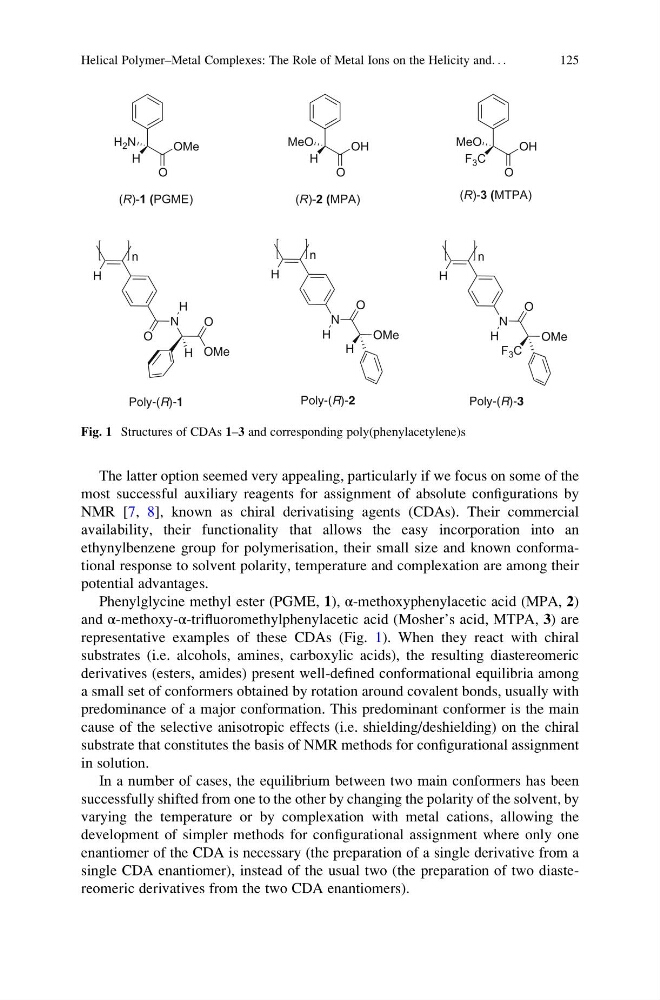
Phenylglycine methyl ester (PGME, 1), α-methoxyphenylacetic acid (MPA, 2)
and α-methoxy-α-trifluoromethylphenylacetic acid (Mosher’s acid, MTPA, 3) are
representative examples of these CDAs (Fig. 1). When they react with chiral
substrates (i.e. alcohols, amines, carboxylic acids), the resulting diastereomeric
derivatives (esters, amides) present well-defined conformational equilibria among
a small set of conformers obtained by rotation around covalent bonds, usually with
predominance of a major conformation. This predominant conformer is the main
cause of the selective anisotropic effects (i.e. shielding/deshielding) on the chiral
substrate that constitutes the basis of NMR methods for configurational assignment
in solution.
In a number of cases, the equilibrium between two main conformers has been
successfully shifted from one to the other by changing the polarity of the solvent, by
varying the temperature or by complexation with metal cations, allowing the
development of simpler methods for configurational assignment where only one
enantiomer of the CDA is necessary (the preparation of a single derivative from a
single CDA enantiomer), instead of the usual two (the preparation of two diastereomeric derivatives from the two CDA enantiomers).
N
O
OMe
H
H
O
H
n
O
OH
H
MeO
O
OH
F 3 C
F 3 C
MeO
O
OMe
H
H 2 N
(R)-1 (PGME)
(R)-2 (MPA)
(R)-3 (MTPA)
OMe
H
N
H
H
n
Poly-(R)-3
Poly-(R)-2
Poly-(R)-1
O
OMe
N
H
H
n
O
Fig. 1 Structures of CDAs 1–3 and corresponding poly(phenylacetylene)s
Helical Polymer–Metal Complexes: The Role of Metal Ions on the Helicity and. . .
125
most successful auxiliary reagents for assignment of absolute configurations by
NMR [7, 8], known as chiral derivatising agents (CDAs). Their commercial
availability, their functionality that allows the easy incorporation into an
ethynylbenzene group for polymerisation, their small size and known conformational response to solvent polarity, temperature and complexation are among their
potential advantages.
Phenylglycine methyl ester (PGME, 1), α-methoxyphenylacetic acid (MPA, 2)
and α-methoxy-α-trifluoromethylphenylacetic acid (Mosher’s acid, MTPA, 3) are
representative examples of these CDAs (Fig. 1). When they react with chiral
substrates (i.e. alcohols, amines, carboxylic acids), the resulting diastereomeric
derivatives (esters, amides) present well-defined conformational equilibria among
a small set of conformers obtained by rotation around covalent bonds, usually with
predominance of a major conformation. This predominant conformer is the main
cause of the selective anisotropic effects (i.e. shielding/deshielding) on the chiral
substrate that constitutes the basis of NMR methods for configurational assignment
in solution.
In a number of cases, the equilibrium between two main conformers has been
successfully shifted from one to the other by changing the polarity of the solvent, by
varying the temperature or by complexation with metal cations, allowing the
development of simpler methods for configurational assignment where only one
enantiomer of the CDA is necessary (the preparation of a single derivative from a
single CDA enantiomer), instead of the usual two (the preparation of two diastereomeric derivatives from the two CDA enantiomers).
N
O
OMe
H
H
O
H
n
O
OH
H
MeO
O
OH
F 3 C
F 3 C
MeO
O
OMe
H
H 2 N
(R)-1 (PGME)
(R)-2 (MPA)
(R)-3 (MTPA)
OMe
H
N
H
H
n
Poly-(R)-3
Poly-(R)-2
Poly-(R)-1
O
OMe
N
H
H
n
O
Fig. 1 Structures of CDAs 1–3 and corresponding poly(phenylacetylene)s
Helical Polymer–Metal Complexes: The Role of Metal Ions on the Helicity and. . .
125