

Time Scales and Physical Scales in Sedimentation
Time-+1<1
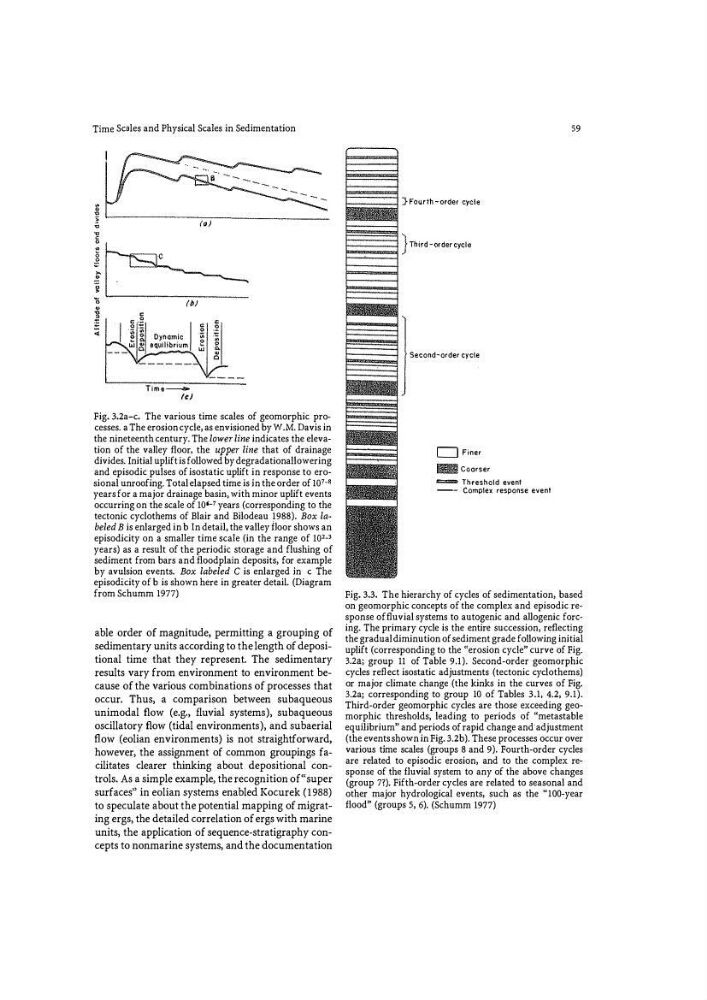
Fig. 3.2a-c. The various time scales of geomorphic processes. a The erosion cycle, as envisioned by W .M. Davis in
the nineteenth century. The lower line indicates the elevation of the valley floor, the upper line that of drainage
divides. Initial uplift is followed by degradationallowering
and episodic pulses of isostatic uplift in response to erosional unroofing. Total elapsed time is in the order of 107-s
years for a major drainage basin, with minor uplift events
occurring on the scale of 106-7 years (corresponding to the
tectonic cyclothems of Blair and Bilodeau 1988). Box labeled B is enlarged in b In detail, the valley floor shows an
episodicity on a smaller time scale (in the range of 102-3
years) as a result of the periodic storage and flushing of
sediment from bars and floodplain deposits, for example
by avulsion events. Box labeled C is enlarged in c The
episodicity of b is shown here in greater detail. (Diagram
from Schumm 1977)
able order of magnitude, permitting a grouping of
sedimentary units according to the length of depositional time that they represent. The sedimentary
results vary from environment to environment because of the various combinations of processes that
occur. Thus, a comparison between subaqueous
unimodal flow (e.g., fluvial systems), subaqueous
oscillatory flow (tidal environments), and subaerial
flow (eolian environments) is not straightforward,
however, the assignment of common groupings facilitates clearer thinking about depositional controls. As a simple example, the recognition of"super
surfaces>' in eolian systems enabled Kocurek (1988)
to speculate about the potential mapping of migrating ergs, the detailed correlation of ergs with marine
units, the application of sequence-stratigraphy concepts to nonmarine systems, and the documentation
Second-order cycle
CJ Finer
Ifill Coarser
-=== Threshold event
-- Complex response event
59
Fig. 3.3. The hierarchy of cycles of sedimentation, based
on geomorphic concepts of the complex and episodic response of fluvial systems to autogenic and allogenic fore�
ing. The primary cycle is the entire succession, reflecting
the gradual diminution of sediment grade following initial
uplift (corresponding to the "erosion cycle" curve of Fig.
3.2a; group 11 of Table 9.1). Second-order geomorphic
cycles reflect isostatic adjustments (tectonic cyclothems)
or major climate change (the kinks in the curves of Fig.
3.2a; corresponding to group 10 of Tables 3.1, 4.2, 9.1).
Third-order geomorphic cycles are -those exceeding geomorphic thresholds, leading to periods of "metastable
equilibrium" and periods of rapid change and· adjustment
(the events shown in Fig. 3.2b). These processes occur over
various time scales (groups 8 and 9). Fourth-order cycles
are related to episodic erosion, and to the complex response of the fluvial system to any of the above changes
(group 7?). Fifth-order cycles are related to seasonal and
other major hydrological events, such as the "100-year
flood" (groups 5, 6). (Schumm 1977)
Time-+1<1
Fig. 3.2a-c. The various time scales of geomorphic processes. a The erosion cycle, as envisioned by W .M. Davis in
the nineteenth century. The lower line indicates the elevation of the valley floor, the upper line that of drainage
divides. Initial uplift is followed by degradationallowering
and episodic pulses of isostatic uplift in response to erosional unroofing. Total elapsed time is in the order of 107-s
years for a major drainage basin, with minor uplift events
occurring on the scale of 106-7 years (corresponding to the
tectonic cyclothems of Blair and Bilodeau 1988). Box labeled B is enlarged in b In detail, the valley floor shows an
episodicity on a smaller time scale (in the range of 102-3
years) as a result of the periodic storage and flushing of
sediment from bars and floodplain deposits, for example
by avulsion events. Box labeled C is enlarged in c The
episodicity of b is shown here in greater detail. (Diagram
from Schumm 1977)
able order of magnitude, permitting a grouping of
sedimentary units according to the length of depositional time that they represent. The sedimentary
results vary from environment to environment because of the various combinations of processes that
occur. Thus, a comparison between subaqueous
unimodal flow (e.g., fluvial systems), subaqueous
oscillatory flow (tidal environments), and subaerial
flow (eolian environments) is not straightforward,
however, the assignment of common groupings facilitates clearer thinking about depositional controls. As a simple example, the recognition of"super
surfaces>' in eolian systems enabled Kocurek (1988)
to speculate about the potential mapping of migrating ergs, the detailed correlation of ergs with marine
units, the application of sequence-stratigraphy concepts to nonmarine systems, and the documentation
Second-order cycle
CJ Finer
Ifill Coarser
-=== Threshold event
-- Complex response event
59
Fig. 3.3. The hierarchy of cycles of sedimentation, based
on geomorphic concepts of the complex and episodic response of fluvial systems to autogenic and allogenic fore�
ing. The primary cycle is the entire succession, reflecting
the gradual diminution of sediment grade following initial
uplift (corresponding to the "erosion cycle" curve of Fig.
3.2a; group 11 of Table 9.1). Second-order geomorphic
cycles reflect isostatic adjustments (tectonic cyclothems)
or major climate change (the kinks in the curves of Fig.
3.2a; corresponding to group 10 of Tables 3.1, 4.2, 9.1).
Third-order geomorphic cycles are -those exceeding geomorphic thresholds, leading to periods of "metastable
equilibrium" and periods of rapid change and· adjustment
(the events shown in Fig. 3.2b). These processes occur over
various time scales (groups 8 and 9). Fourth-order cycles
are related to episodic erosion, and to the complex response of the fluvial system to any of the above changes
(group 7?). Fifth-order cycles are related to seasonal and
other major hydrological events, such as the "100-year
flood" (groups 5, 6). (Schumm 1977)