

52
channels. Bristow's (1987) main contribution was to
document the growth of the large bar forms
(macroforms), both bank-attached, lateral and point
bars, and midchannel bars. Lateral and downstream
accretion was demonstrated to be of considerable
importance. He also demonstrated that the giant
"sand waves" described by Coleman (1969) have
downstream accretion faces that dip at only 4°. They
are 1 therefore, not the simple avalanche�face bedforms that many authors have assumed them to be,
but are probably complex macro fo rms, comparable
to the downstream-accretion deposits described in
Chap. 6.
The first attempts at a systematic documentation
of the architectural details of a sandstone succession
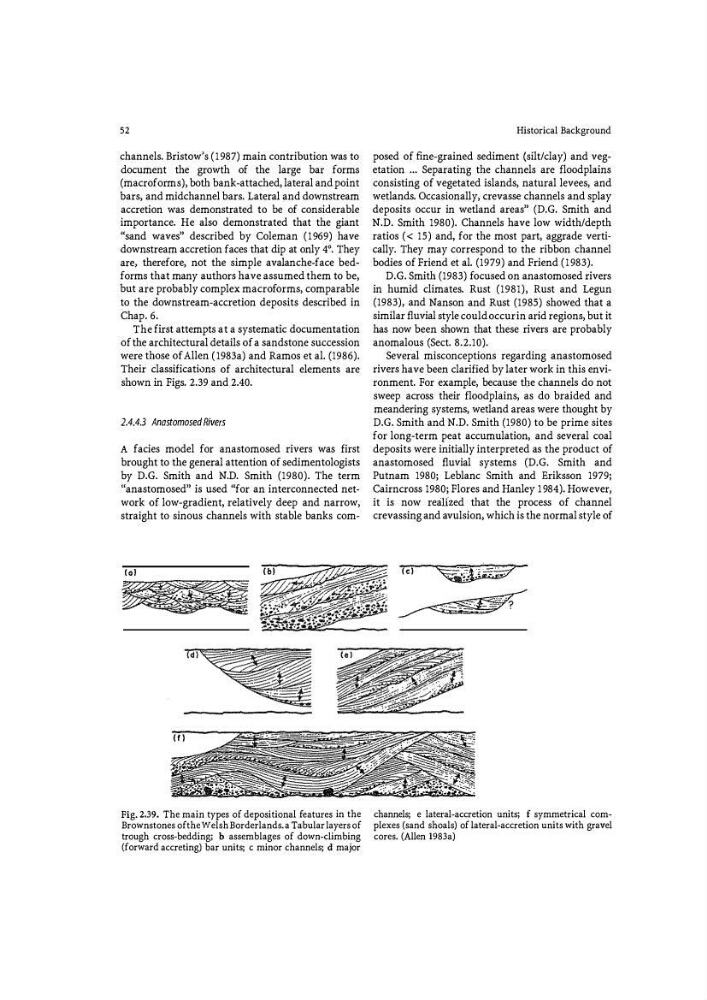
were those of Allen (1983a) and Ramos et al. (1986).
Their classificativns of architectural elements are
shown in Figs. 2.39 and 2.40.
2.4.4.3 Anastomosed Rivers
A facies model for anastomosed rivers was first
brought to the general attention of sedimentologists
by D.G. Smith and N.D. Smith (1980). The term
('anastomosed" is used "for an interconnected net�
work of low-gradient, relatively deep and narrow,
straight to sinous channels with stable banks com(a)
� �
.. .
Fig. 2.39. The main types of depositional fe atures in the
Brownstones of the Welsh Borderlands. a Tabular layers of
trough cross�bedding; b assemblages of down-climbing
(forward accreting) bar units; c minor channels; d major
Historical Background
posed of fine-grained sediment (silt/clay) and vegetation ... Separating the channels are floodplains
consisting of vegetated islands, natural levees, and
wetlands. Occasionally, crevasse channels and splay
deposits occur in wetland areas" (D.G. Smith and
N.D. Smith 1980). Channels have low width/depth
ratios ( < 15) and, for the most part, aggrade vertically. They may correspond to the ribbon channel
bodies of Friend et al. (1979) and Friend (1983).
D.G. Smith (1983) fo cused on anastomosed rivers
in humid climates. Rust (1981), Rust and Legun
(1983), and Nanson and Rust (1985) showed that a
similar fl uvial style could occur in arid regions, but it
has now been shown that these rivers are probably
anomalous (Sect. 8.2.10).
Several misconceptions regarding anastomosed
rivers have been clarified by later work in this environment. For example, because tl;t e channels do not
sweep across their floodplains, as do braided and
meandering systems, wetland areas were thought by
D.G. Smith and N.D. Smith (1980) to be prime sites
for long-term peat accumulation, and several coal
deposits were initially interpreted as the product of
anastomosed fl uvial systems (D.G. Smith and
Putnam 1980; Leblanc Smith and Eriksson 1979;
Cairncross 1980; Flores and Hanley 1984). However,
it is now rea]lzed that the process of channel
crevassing and avulsion, which is the normal style of
(c)
�
�
�
channels; e lateral-accretion units; f symmetrical complexes (sand shoals) of lateral�accretion units with gravel
cores. (Allen 1983a)
channels. Bristow's (1987) main contribution was to
document the growth of the large bar forms
(macroforms), both bank-attached, lateral and point
bars, and midchannel bars. Lateral and downstream
accretion was demonstrated to be of considerable
importance. He also demonstrated that the giant
"sand waves" described by Coleman (1969) have
downstream accretion faces that dip at only 4°. They
are 1 therefore, not the simple avalanche�face bedforms that many authors have assumed them to be,
but are probably complex macro fo rms, comparable
to the downstream-accretion deposits described in
Chap. 6.
The first attempts at a systematic documentation
of the architectural details of a sandstone succession
were those of Allen (1983a) and Ramos et al. (1986).
Their classificativns of architectural elements are
shown in Figs. 2.39 and 2.40.
2.4.4.3 Anastomosed Rivers
A facies model for anastomosed rivers was first
brought to the general attention of sedimentologists
by D.G. Smith and N.D. Smith (1980). The term
('anastomosed" is used "for an interconnected net�
work of low-gradient, relatively deep and narrow,
straight to sinous channels with stable banks com(a)
� �
.. .
Fig. 2.39. The main types of depositional fe atures in the
Brownstones of the Welsh Borderlands. a Tabular layers of
trough cross�bedding; b assemblages of down-climbing
(forward accreting) bar units; c minor channels; d major
Historical Background
posed of fine-grained sediment (silt/clay) and vegetation ... Separating the channels are floodplains
consisting of vegetated islands, natural levees, and
wetlands. Occasionally, crevasse channels and splay
deposits occur in wetland areas" (D.G. Smith and
N.D. Smith 1980). Channels have low width/depth
ratios ( < 15) and, for the most part, aggrade vertically. They may correspond to the ribbon channel
bodies of Friend et al. (1979) and Friend (1983).
D.G. Smith (1983) fo cused on anastomosed rivers
in humid climates. Rust (1981), Rust and Legun
(1983), and Nanson and Rust (1985) showed that a
similar fl uvial style could occur in arid regions, but it
has now been shown that these rivers are probably
anomalous (Sect. 8.2.10).
Several misconceptions regarding anastomosed
rivers have been clarified by later work in this environment. For example, because tl;t e channels do not
sweep across their floodplains, as do braided and
meandering systems, wetland areas were thought by
D.G. Smith and N.D. Smith (1980) to be prime sites
for long-term peat accumulation, and several coal
deposits were initially interpreted as the product of
anastomosed fl uvial systems (D.G. Smith and
Putnam 1980; Leblanc Smith and Eriksson 1979;
Cairncross 1980; Flores and Hanley 1984). However,
it is now rea]lzed that the process of channel
crevassing and avulsion, which is the normal style of
(c)
�
�
�
channels; e lateral-accretion units; f symmetrical complexes (sand shoals) of lateral�accretion units with gravel
cores. (Allen 1983a)