

Growth of Present-Day Concepts, 1978-1988
book also includes a major review of paleo hydraulic
methodologies by Ethridge and Schumm (1978).
This collection of papers appears to have brought the
subject of paleohydraulics to some kind of plateau.
Very little has been published in this area since the
late 1970s, perhaps because the review by Ethridge
and Schumm (1978) revealed the weaknesses and
inadequacies of existing paleohydraulic methods.
Recent research has taken a quite different form,
that of computer modeling of fluvial systems, as
discussed in Sect. 10.4.
2.4 Growth of Present-Day Concepts,
1978-1988
The decade 1978-1988 included two fluvial symposia, that at Keele in 1981 (Collinson and Lewin 1983),
and the third symposium, at Fort Collins, in 1985
(Ethridge et al. 1987). This period marked the culmination of efforts to define fluvial styles from vertical
profiles alone, and the growth of formal architectural methods for lithesome description. Section 2.4
is adapted and expanded from Miall (1980) and the
review prepared by Miall (1987) for the Fort Collins
A
-
flow
1:;:: '::::1 high speed region
liJ.II low speed region
37
meeting. Some post-1988 developments are referred
to for the sake of completeness) but the details of
most modern studies are given in the appropriate
descriptive chapters later in this book.
2.4.1 Bedforms and Sedimental)l St10ctures
During this period, the definitive compilation of
bedforms and sedimentary structures by J.R.L. Allen
was published. This first appeared as a two-volume
work in 1982, and was republished as a single-volume edition 2 years later (Allen 1984). The book
contains an exhaustive literature review, and a
wealth of data dealing with the experimental production of bedforms in flumes.
Advances in the understanding of the fluid dynamics of bedform generation were discussed by
Jackson (1976c), Allen (1983b, 1984), and Leeder
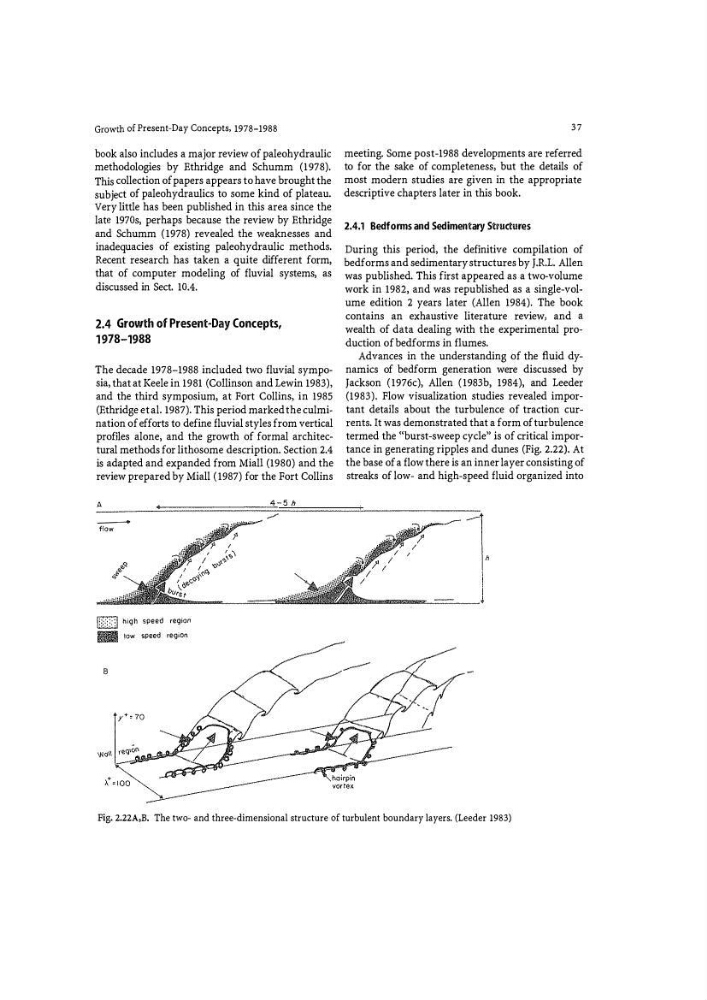
(1983). Flow visualization studies revealed important details about the turbulence of traction currents. It was demonstrated that a form of turbulence
termed the <
streaks of low- and high-speed fluid organized into
Fig. 2.22A,B. The twoM and three�dimensional structure of turbulent boundary layers. (Leeder 1983)
book also includes a major review of paleo hydraulic
methodologies by Ethridge and Schumm (1978).
This collection of papers appears to have brought the
subject of paleohydraulics to some kind of plateau.
Very little has been published in this area since the
late 1970s, perhaps because the review by Ethridge
and Schumm (1978) revealed the weaknesses and
inadequacies of existing paleohydraulic methods.
Recent research has taken a quite different form,
that of computer modeling of fluvial systems, as
discussed in Sect. 10.4.
2.4 Growth of Present-Day Concepts,
1978-1988
The decade 1978-1988 included two fluvial symposia, that at Keele in 1981 (Collinson and Lewin 1983),
and the third symposium, at Fort Collins, in 1985
(Ethridge et al. 1987). This period marked the culmination of efforts to define fluvial styles from vertical
profiles alone, and the growth of formal architectural methods for lithesome description. Section 2.4
is adapted and expanded from Miall (1980) and the
review prepared by Miall (1987) for the Fort Collins
A
-
flow
1:;:: '::::1 high speed region
liJ.II low speed region
37
meeting. Some post-1988 developments are referred
to for the sake of completeness) but the details of
most modern studies are given in the appropriate
descriptive chapters later in this book.
2.4.1 Bedforms and Sedimental)l St10ctures
During this period, the definitive compilation of
bedforms and sedimentary structures by J.R.L. Allen
was published. This first appeared as a two-volume
work in 1982, and was republished as a single-volume edition 2 years later (Allen 1984). The book
contains an exhaustive literature review, and a
wealth of data dealing with the experimental production of bedforms in flumes.
Advances in the understanding of the fluid dynamics of bedform generation were discussed by
Jackson (1976c), Allen (1983b, 1984), and Leeder
(1983). Flow visualization studies revealed important details about the turbulence of traction currents. It was demonstrated that a form of turbulence
termed the <
streaks of low- and high-speed fluid organized into
Fig. 2.22A,B. The twoM and three�dimensional structure of turbulent boundary layers. (Leeder 1983)