

Channel-and-Bar Reservoirs {CB Type)
519
1!25E.
!
i
J: •lo
'o
J:!<(
<((<
1-:0
,!__,
j o
i: t)
'I
l
i
I
!
,i ,,
'I
i
I
'
I! 25£,
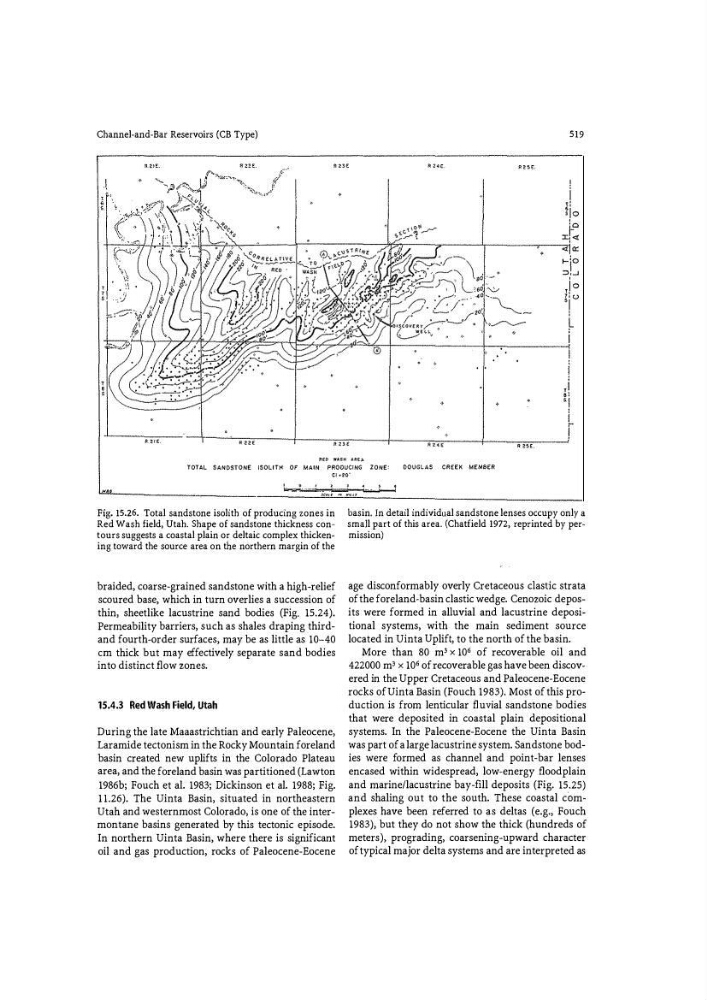
TOTAL SANDSTONE ISOLITH OF MAIN
PROOUC!NG
ZONE:
DOUGLAS
CREEK MEMSER
Cl •20'
Fig. 15.26. Total sandstone isolith of producing zones in
Red Wash field, Utah. Shape of sandstone thickness contours suggests a coastal plain or deltaic complex thickening toward the source area on the northern margin of the
braided, coarse-grained sandstone with a high-relief
scoured base, which in turn overlies a succession of
thin, sheetlike lacustrine sand bodies (Fig. 15.24).
Permeability barriers, such as shales draping thirdand fourth-order surfaces, may be as little as 10-40
em thick but may effectively separate sand bodies
into distinct flow zones.
15.4.3 Red Wash Field, Utah
During the late Maaastrichtian and early Paleocene,
Laramide tectonism in the Rocky Mountain foreland
basin created new uplifts in the Colorado Plateau
area, and the foreland basin was partitioned (Lawton
1986b; Fouch et a!. 1983; Dickinson et a!. 1988; Fig.
11.26). The Uinta Basin, situated in northeastern
Utah and westernmost Colorado, is one of the intermontane basins generated by this tectonic episode.
In northern Uinta Basin, where there is significant
oil and gas production, rocks of Paleocene-Eocene
basin. In detail individual sandstone lenses occupy only a
small part of this area. {Chatfield 1972, reprinted by per�
mission)
age disconformably overly Cretaceous clastic strata
of the foreland�basin clastic wedge. Cenozoic deposits were formed in alluvial and lacustrine depositional systems, with the main sediment source
located in Uinta Uplift, to the north of the basin.
More than 80 m:> x 106 of recoverable oil and
422000 m3 x 106 of recoverable gas have been discovered in the Upper Cretaceous and Paleocene-Eocene
rocks of Uinta Basin (Fouch 1983). Most of this production is from lenticular fl uvial sandstone bodies
that were deposited in coastal plain depositional
systems. In the Paleocene-Eocene the Uinta Basin
was part of a large lacustrine system. Sandstone bodies were fo rmed as channel and point-bar lenses
encased within widespread, low-energy fl oodplain
and marine/lacustrine bay-fill deposits (Fig. 15.25)
and shaling out to the south. These coastal cOmplexes have been referred to as deltas (e.g., Fouch
1983), but they do not show the thick (hundreds of
meters), prograding, coarsening-upward character
of typical major delta systems and are interpreted as