

Sheet Reservoirs (SH Type)
A
0
TRUNCATION OF
STATFJORO FM.
Miles
C.I."' 200 Feet
Rift faulting began in the Early Cretaceous, as
evidenced by basin�fill sediments of that age, which
consist of poorly sorted nonmarine sandstones and
siltstones. This succession is overlain by the Sarir
Sandstone, a clean fluvial sandstone deposited by
northwardwflowing river systems. The beds were
tilted and partially eroded during an episode of
intracratonic tectonism in the midwCretaceous; then
the basin subsided once again, and a marine transw
gression from Tethys, to the north, led to the deposition of evaporites, shales, and carbonates of Upper
Cretaceous to Miocene age. Tilting of the area
occurred during later extensional tectonism in the
Tertiary (Clifford et a!. 1980).
In the Messla field area the result of this basin
evolution was the development of an east-dipping
wedge of Sarir Sandstone, overlain and truncated to
the west by Upper Cretaceous shales. In the field area
the beds dip northeast at less than 1°, Faulting within
the field area is minimal, except at the southern end,
where the field . is truncated by extensional faults,
with downthrows to the south (Fig. 15.13).
The Messla Sandstone includes two sandstone
members, separated by an extensive tight unit
named the Red Shale. The upper sandstone, called
511
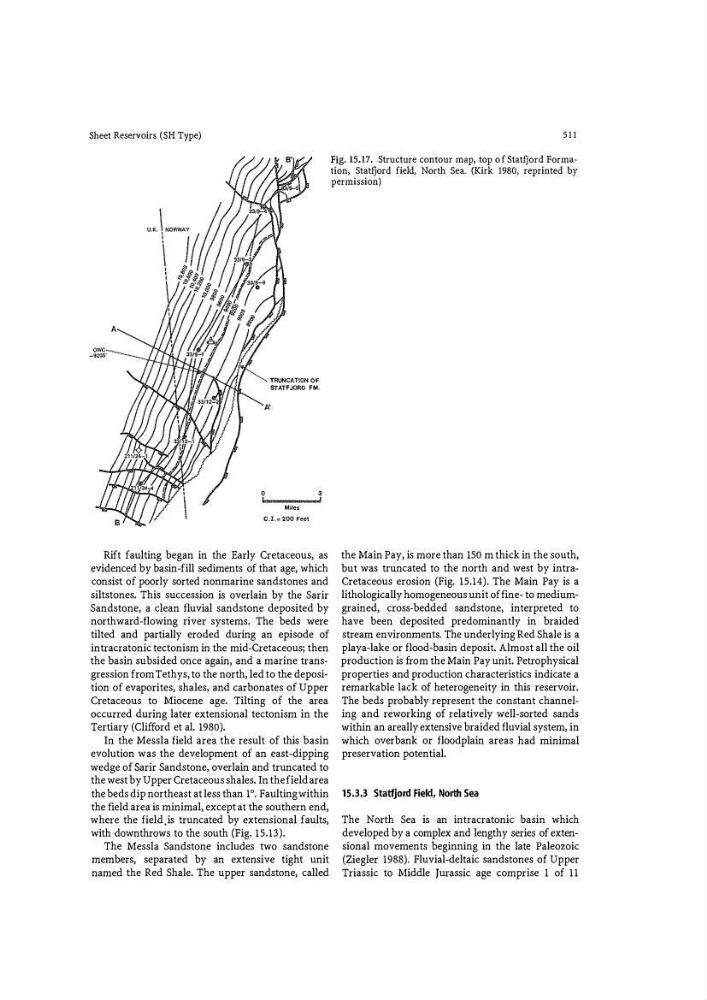
Fig. 15.17. Structure contour map, top of Statfjord Forma�
tion, Statfjord field, North Sea. (Kirk 1980, reprinted by
permission}
the Main Pay, is more than 150 m thick in the south,
but was truncated to the north and west by intraCretaceous erosion (Fig. 15.14). The Main Pay is a
lithologically homogeneous unit of fine- to mediumgrained, crosswbedded sandstone, interpreted to
have been deposited predominantly in braided
stream environments. The underlying Red Shale is a
playa-lake or flood-basin deposit. Almost all the oil
production is from the Main Pay unit. Petrophysical
properties and production characteristics indicate a
remarkable lack of heterogeneity in this reservoir.
The beds probably represent the constant channeling and reworking of relatively well-sorted sands
within an areally extensive braided fluvial system, in
which overbank or floodplain areas had minimal
preservation potential.
15.3.3 Statfjord Field, North Sea
The North Sea is an intracratonic basin which
developed by a complex and lengthy series of extensional movements beginning in the late Paleozoic
(Ziegler 1988). Fluvial-deltaic sandstones of Upper
Triassic to Middle Jurassic age comprise 1 of 11