

476
Sequence Stratigraphy
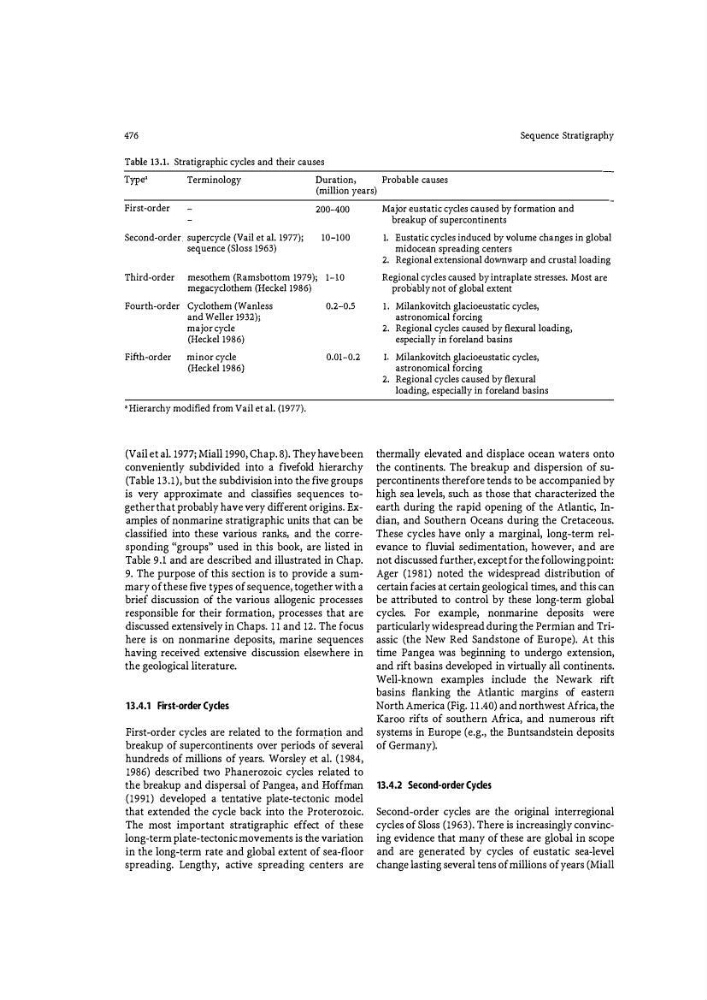
Table 13.1. Stratigraphic cycles and their causes
Terminology
Duration,
Probable causes
(million years)
FirstMorder
200-400
SecondMorder , supercyde (Vail et al. l977);
10-100
sequence (Sloss 1963)
Third-order mesothem (Ramsbottom 1979); 1-10
megacyclothem (Heckel 1986)
Fourth-order Cyclothem (Wanless
and Weller 1932);
major cycle
(Heckel 1986)
Fifth-order
minor cycle
(Heckel 1986)
a Hierarchy modified from Vail et al. (1977).
0.2-0.5
0.01-0.2
(Vail et al. 1977; Miall 1990, Chap. 8). They have been
conveniently subdivided into a fivefold hierarchy
(Table 13.1), but the subdivision into the five groups
is very approximate and classifies sequences together that probably have very different origins. Examples of nonmarine stratigraphic units that can be
classified into these various ranks, and the corre�
sponding ((groups" used in this book, are listed in
Table 9.1 and are described and illustrated in Chap.
9. The purpose of this section is to provide a summary of these five types of sequence, together with a
brief discussion of the various allogenic processes
responsible for their fo rmation, processes that are
discussed extensively in Chaps. 11 and 12. The focus
here is on nonmarine deposits, marine sequences
having received extensive discussion elsewhere in
the geological literature.
13.4.1 First-order Cycles
First-order cycles are related to the fo rma�ion and
breakup of supercontinents over periods- of several
hundreds of millions of years. Worsley et a!. (1984,
1986) described two Phanerozoic cycles related to
the breakup and dispersal of Pangea, and Hoffman
(1991) developed a tentative plate-tectonic model
that extended the cycle back into the Proterozoic.
The most important stratigraphic effect of these
long-term plate-tectonic movements is the variation
in the long-term rate and global extent of sea-floor
spreading. Lengthy, active spreading centers are
Major eustatic cycles caused by formation and
breakup of supercontinents
1. Eustatic cycles induced by volume changes in global
midocea:n spreading centers
2. Regional extensional dovmwarp and crustal loading
Regional cycles caused by intraplate stresses. Most are
prohably not of global extent
1. Milankovitch glacioeustatic cycles,
astronomical forcing
2. Regional cycles caused by flexural loading,
especially in foreland basins
I. Milankovitch glacioeustatic cycles,
astronomical fo rcing
2. Regional cycles caused by fl exural
loading, especially in foreland basins
thermally elevated and displace ocean waters onto
the continents. The breakup and dispersion of supercontinents therefore tends to be accompanied by
high sea levels, such as those that characterized the
earth during the rapid opening of the Atlantic, Indian, and Southern Oceans during the Cretaceous.
These cycles have only a marginal, long-term relevance to fluvial sedimentation, however, and are
not discussed further, except for the following point:
Ager (1981) noted the widespread distribution of
certain facies at certain geological times, and this can
be attributed to control by these long-term global
cycles. For example, nonmarine deposits were
particularly widespread during the Permian and Triassic (the New Red Sandstone of Europe). At this
time Pangea was beginning to undergo extension,
and rift basins developed in virtually all continents.
Well-known examples include the Newark rift
basins flanking the Atlantic margins of eastern
North America (Fig. 11.40) and northwest Africa, the
Karoo rifts of southern Africa, and numerous rift
systems in Europe (e.g., the Buntsandstein deposits
of Germany).
13.4.2 Second-order Cycles
Second-order cycles are the original interregional
cycles of Sloss (1963). There is increasingly convincing evidence that many of these are global in scope
and are generated by cycles of eustatic sea-level
change lasting several tens of millions of years (Mia!!
Sequence Stratigraphy
Table 13.1. Stratigraphic cycles and their causes
Terminology
Duration,
Probable causes
(million years)
FirstMorder
200-400
SecondMorder , supercyde (Vail et al. l977);
10-100
sequence (Sloss 1963)
Third-order mesothem (Ramsbottom 1979); 1-10
megacyclothem (Heckel 1986)
Fourth-order Cyclothem (Wanless
and Weller 1932);
major cycle
(Heckel 1986)
Fifth-order
minor cycle
(Heckel 1986)
a Hierarchy modified from Vail et al. (1977).
0.2-0.5
0.01-0.2
(Vail et al. 1977; Miall 1990, Chap. 8). They have been
conveniently subdivided into a fivefold hierarchy
(Table 13.1), but the subdivision into the five groups
is very approximate and classifies sequences together that probably have very different origins. Examples of nonmarine stratigraphic units that can be
classified into these various ranks, and the corre�
sponding ((groups" used in this book, are listed in
Table 9.1 and are described and illustrated in Chap.
9. The purpose of this section is to provide a summary of these five types of sequence, together with a
brief discussion of the various allogenic processes
responsible for their fo rmation, processes that are
discussed extensively in Chaps. 11 and 12. The focus
here is on nonmarine deposits, marine sequences
having received extensive discussion elsewhere in
the geological literature.
13.4.1 First-order Cycles
First-order cycles are related to the fo rma�ion and
breakup of supercontinents over periods- of several
hundreds of millions of years. Worsley et a!. (1984,
1986) described two Phanerozoic cycles related to
the breakup and dispersal of Pangea, and Hoffman
(1991) developed a tentative plate-tectonic model
that extended the cycle back into the Proterozoic.
The most important stratigraphic effect of these
long-term plate-tectonic movements is the variation
in the long-term rate and global extent of sea-floor
spreading. Lengthy, active spreading centers are
Major eustatic cycles caused by formation and
breakup of supercontinents
1. Eustatic cycles induced by volume changes in global
midocea:n spreading centers
2. Regional extensional dovmwarp and crustal loading
Regional cycles caused by intraplate stresses. Most are
prohably not of global extent
1. Milankovitch glacioeustatic cycles,
astronomical forcing
2. Regional cycles caused by flexural loading,
especially in foreland basins
I. Milankovitch glacioeustatic cycles,
astronomical fo rcing
2. Regional cycles caused by fl exural
loading, especially in foreland basins
thermally elevated and displace ocean waters onto
the continents. The breakup and dispersion of supercontinents therefore tends to be accompanied by
high sea levels, such as those that characterized the
earth during the rapid opening of the Atlantic, Indian, and Southern Oceans during the Cretaceous.
These cycles have only a marginal, long-term relevance to fluvial sedimentation, however, and are
not discussed further, except for the following point:
Ager (1981) noted the widespread distribution of
certain facies at certain geological times, and this can
be attributed to control by these long-term global
cycles. For example, nonmarine deposits were
particularly widespread during the Permian and Triassic (the New Red Sandstone of Europe). At this
time Pangea was beginning to undergo extension,
and rift basins developed in virtually all continents.
Well-known examples include the Newark rift
basins flanking the Atlantic margins of eastern
North America (Fig. 11.40) and northwest Africa, the
Karoo rifts of southern Africa, and numerous rift
systems in Europe (e.g., the Buntsandstein deposits
of Germany).
13.4.2 Second-order Cycles
Second-order cycles are the original interregional
cycles of Sloss (1963). There is increasingly convincing evidence that many of these are global in scope
and are generated by cycles of eustatic sea-level
change lasting several tens of millions of years (Mia!!