

464
length of time in the context of high-frequency
cycles, such as those generated by glacioeustasy. The
response of fluvial systems to tectonic and climatic
changes of all kinds may be characterized by a significant lag time (Shanley and McCabe 1994), which
is likely to increase with distance from the source of
the change and may therefore introduce significant
complexities in the regional correlation of non�
marine sequences.
Within successions that are entirely nonmarine,
especially within inland basins, where correlation
with marine units cannot be attempted, the definition of sequences and the recognition of sequence
boundaries may be a challenging task. The response
of fluvial systems to tectonic and climatic changes is
complex, and the resulting sequences may not display the simple succession of depositional-systems
tracts that are now becoming familiar and perhaps
even standardized features of the shallow-marine
sedimentary record. The following examples of
nonmarine sequence boundaries illustrate this
point.
The adjustment of longitudinal fluvial profiles to
tectonic and climatic change may not be complete if
the ability of the system to respond to change is
outpaced by the rate of change. The existence of river
terraces flanking major alluvial valleys is a good
example of this. Terrace complexes are present in
most modern river valleys and have commonly been
attributed to base-level changes following the last ice
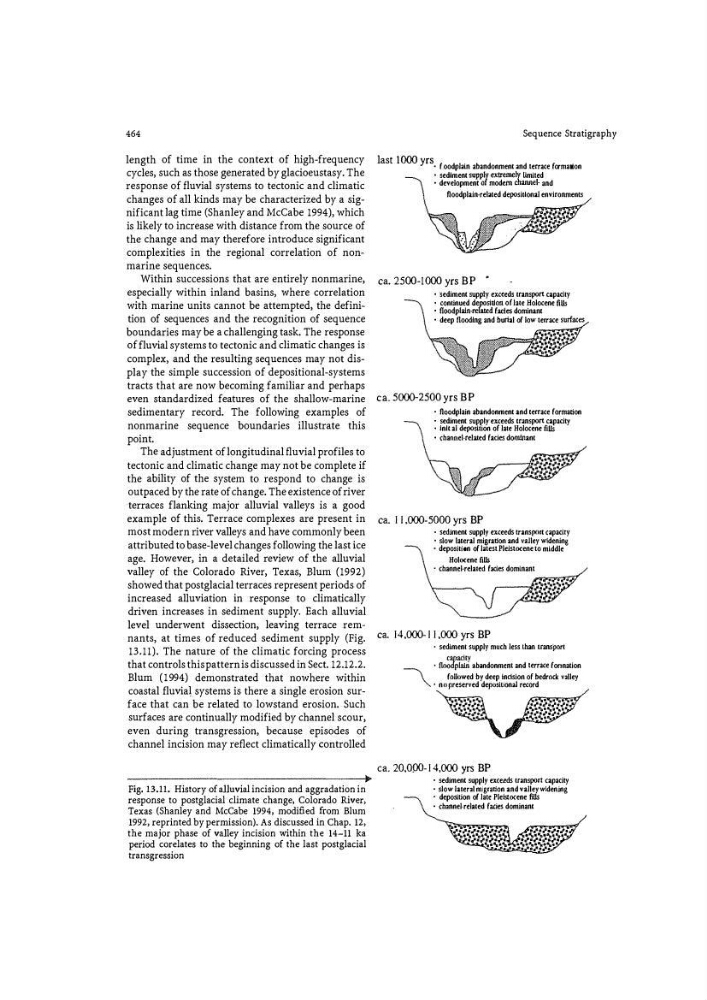
age. However, in a detailed review of the alluvial
valley of the Colorado River, Texas, Blum (1992)
showed that postglacial terraces represent periods of
increased alluviation in response to climatically
driven increases in s · ediment supply. Each alluvial
level underwent dissection, leaving terrace rem�
nants, at times of reduced sediment supply (Fig.
13.11). The nature of the climatic forcing process
that controls this pattern is discussed in Sect. 12.12.2.
Blum (1994) demonstrated that nowhere within
coastal fluvia� systems is there a single erosion surface that can be related to lowstand erosion. Such
surfaces are continually modified by channel scour,
even during transgression, because episodes of
channel incision may reflect climatically controlled
last 1000 yrs
Sequence Stratigraphy
• floodplain abandonment and terrace formation
• sediment supply extremely limited
• development of modem channel- and
floodplain-related depositional environments
ca. 2500-l 000 yrs BP •
• sediment supply excteds transpon capactty
• continued deposition of late Holocene fills
• lloodplain-rel:ued fades dominant
• deep flooding and burial of low terrace
=mtf
ca. 5000 -2500 yrs BP
• floodplain abandonment and terrace formation
• sediment suppty· exceeds transpon capacity
• Initial deposition of late Holocene fills
• charutel-rel.ated facies do!'l'llJl ant
ca. 1 1.000 -5000 yrs BP
• sediment supply exceeds transport capacity
• slow lateral migration and v:illey widening
• depositiDn of latest Pleistocene to middle
Holocene fills
• channel-related facies dominant
ca. 14,000 -1 1 ,000 yrs BP
• sediment supply much less lhan ttansj>ort
'"'"'''
• floodplain 2handonment and terrace fonnation
\
followed by deep lndsion of bedrock valley
\..._ • nu preserved deposition"! record
ca. 20,0()0- 14,000 yrs BP
---- -- -- -- -- -- -- -- -- -. .. .• sediment supply exce.eds transport capacity
Fig. 13.11. History of alluvial incision and aggradation in
response to postglacial climate change, Colorado River,
Texas (Shanley and McCabe 1994, modified from Blum
1992, reprinted by permission). As discussed in Chap. 12,
the major phase of valley incision within the 14-11 ka
period corelates to the beginning of the last postglacial
transgression
• slow lateral migration and valley widening
• deposition of late Plelstocene fills
• channel-rel.ated fades dominant
length of time in the context of high-frequency
cycles, such as those generated by glacioeustasy. The
response of fluvial systems to tectonic and climatic
changes of all kinds may be characterized by a significant lag time (Shanley and McCabe 1994), which
is likely to increase with distance from the source of
the change and may therefore introduce significant
complexities in the regional correlation of non�
marine sequences.
Within successions that are entirely nonmarine,
especially within inland basins, where correlation
with marine units cannot be attempted, the definition of sequences and the recognition of sequence
boundaries may be a challenging task. The response
of fluvial systems to tectonic and climatic changes is
complex, and the resulting sequences may not display the simple succession of depositional-systems
tracts that are now becoming familiar and perhaps
even standardized features of the shallow-marine
sedimentary record. The following examples of
nonmarine sequence boundaries illustrate this
point.
The adjustment of longitudinal fluvial profiles to
tectonic and climatic change may not be complete if
the ability of the system to respond to change is
outpaced by the rate of change. The existence of river
terraces flanking major alluvial valleys is a good
example of this. Terrace complexes are present in
most modern river valleys and have commonly been
attributed to base-level changes following the last ice
age. However, in a detailed review of the alluvial
valley of the Colorado River, Texas, Blum (1992)
showed that postglacial terraces represent periods of
increased alluviation in response to climatically
driven increases in s · ediment supply. Each alluvial
level underwent dissection, leaving terrace rem�
nants, at times of reduced sediment supply (Fig.
13.11). The nature of the climatic forcing process
that controls this pattern is discussed in Sect. 12.12.2.
Blum (1994) demonstrated that nowhere within
coastal fluvia� systems is there a single erosion surface that can be related to lowstand erosion. Such
surfaces are continually modified by channel scour,
even during transgression, because episodes of
channel incision may reflect climatically controlled
last 1000 yrs
Sequence Stratigraphy
• floodplain abandonment and terrace formation
• sediment supply extremely limited
• development of modem channel- and
floodplain-related depositional environments
ca. 2500-l 000 yrs BP •
• sediment supply excteds transpon capactty
• continued deposition of late Holocene fills
• lloodplain-rel:ued fades dominant
• deep flooding and burial of low terrace
=mtf
ca. 5000 -2500 yrs BP
• floodplain abandonment and terrace formation
• sediment suppty· exceeds transpon capacity
• Initial deposition of late Holocene fills
• charutel-rel.ated facies do!'l'llJl ant
ca. 1 1.000 -5000 yrs BP
• sediment supply exceeds transport capacity
• slow lateral migration and v:illey widening
• depositiDn of latest Pleistocene to middle
Holocene fills
• channel-related facies dominant
ca. 14,000 -1 1 ,000 yrs BP
• sediment supply much less lhan ttansj>ort
'"'"'''
• floodplain 2handonment and terrace fonnation
\
followed by deep lndsion of bedrock valley
\..._ • nu preserved deposition"! record
ca. 20,0()0- 14,000 yrs BP
---- -- -- -- -- -- -- -- -- -. .. .• sediment supply exce.eds transport capacity
Fig. 13.11. History of alluvial incision and aggradation in
response to postglacial climate change, Colorado River,
Texas (Shanley and McCabe 1994, modified from Blum
1992, reprinted by permission). As discussed in Chap. 12,
the major phase of valley incision within the 14-11 ka
period corelates to the beginning of the last postglacial
transgression
• slow lateral migration and valley widening
• deposition of late Plelstocene fills
• channel-rel.ated fades dominant