

Growih of Present-Day Concepts, up to 1977
RANK I.
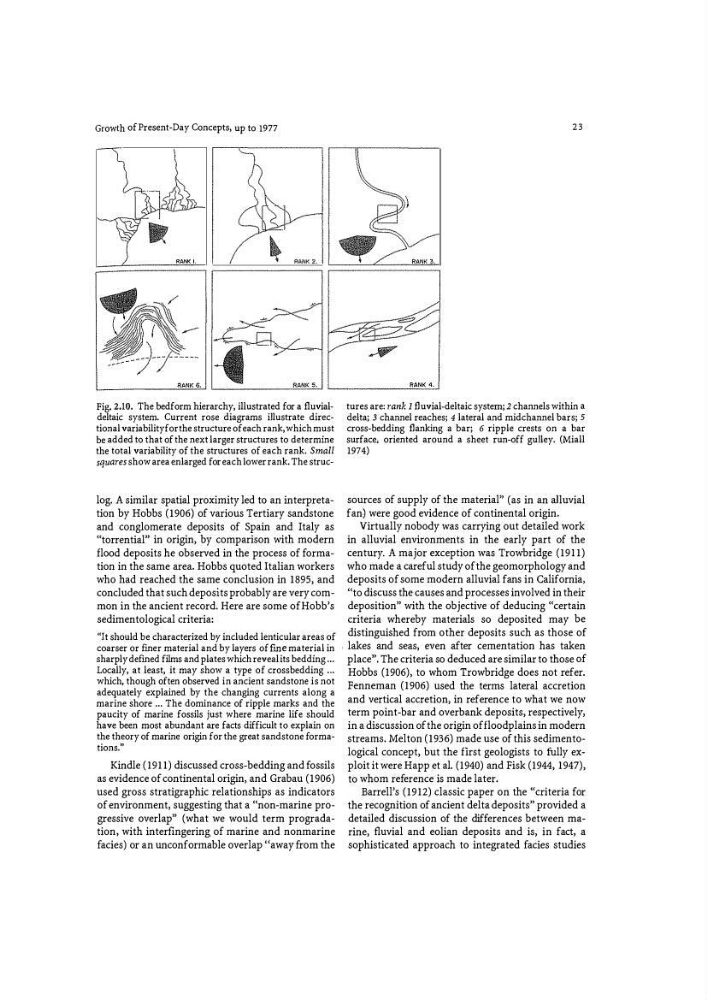
Fig. 2.10. The bedform hierarchy, illustrated for a fluvialdeltaic system. Current rose diagrams illustrate directional variability for the structure of each rank, which must
be added to that of the next larger structures to determine
the total variability of the structures of each rank. Small
squares show area enlarged for each lower rank. The struclog. A similar spatial proximity led to an interpretation by Hobbs (1906) of various Tertiary sandstone
and conglomerate deposits of Spain and Italy as
((torrential'
, in origin, by comparison with modern
flood deposits he observed in the process of fo rmation in the same area. Hobbs quoted Italian workers
who had reached the same conclusion in 1895, and
concluded that such deposits probably are very common in the ancient record. Here are some ofHobb's
sedimentological criteria:
"It should be characterized by included lenticular areas of
coarser or fm er material and by layers of flne material in
sharply defmed films and plates which reveal its bedding ...
Locally, at least, it may show a type of crossbedding ...
which, though often observed in ancient sandstone is not
adequately explained by the changing currents along a
marine shore ... The dominance of ripple marks and the
paucity of marine fossils just where marine life should
have been most abundant are facts difficult to explain on
the theory of marine origin for the great sandstone fo rmations."
Kindle ( 1911) discussed cross-bedding and fo ssils
as evidence of continental origin, and Grabau (1906)
used gross stratigraphic relationships as indicators
of environment, suggesting that a ((non-marine progressive overlap" (what we would term progradation, with interfingering. of marine and nonmarine
fa cies) or an unconformable overlap <(away fr om the
23
tures are: rank 1 fluvial-deltaic system; 2 channels within a
delta; 3 channel reaches; 4 lateral and midchannel bars; 5
cross-bedding fl anking a bar; 6 ripple crests on a bar
surface, oriented around a sheet run-off gulley. (Miall
1974)
sources of supply of the material' 1 (as in an alluvial
fan) were good evidence of continental origin.
Virtually nobody was carrying out detailed work
in alluvial environments in the early part of the
century. A major exception was Trowbridge (1911)
who made a careful study of the geomorphology and
deposits of some modern alluvial fans in California 1
((to discuss the causes and processes involved in their
deposition" with the objective of deducing ((certain
criteria whereby materials so deposited may be
distinguished from other deposits such as those of
. lakes and seas, even after cementation has taken
place' 1 • The criteria so deduced are similar to those of
Hobbs (1906), to whom Trowbridge does not refer.
Fenneman (1906) used the terms lateral accretion
and vertical accretion, in reference to what we now
term point-bar and overbank deposits, respectively )
in a discussion of the origin of floodplains in modern
streams. Melton ( 1936) made use of this sedimentological concept, but the first geologists to fully exploit it were Happ et al. (1940) and Fisk (1944, 1947),
to whom reference is made later.
Barrell's (1912) classic paper on the «criteria for
the recognition of ancient delta deposits" provided a
detailed discussion of the differences between marine, fluvial and eolian deposits and is, in fact, a
sophisticated approach to integrated fa cies studies
RANK I.
Fig. 2.10. The bedform hierarchy, illustrated for a fluvialdeltaic system. Current rose diagrams illustrate directional variability for the structure of each rank, which must
be added to that of the next larger structures to determine
the total variability of the structures of each rank. Small
squares show area enlarged for each lower rank. The struclog. A similar spatial proximity led to an interpretation by Hobbs (1906) of various Tertiary sandstone
and conglomerate deposits of Spain and Italy as
((torrential'
, in origin, by comparison with modern
flood deposits he observed in the process of fo rmation in the same area. Hobbs quoted Italian workers
who had reached the same conclusion in 1895, and
concluded that such deposits probably are very common in the ancient record. Here are some ofHobb's
sedimentological criteria:
"It should be characterized by included lenticular areas of
coarser or fm er material and by layers of flne material in
sharply defmed films and plates which reveal its bedding ...
Locally, at least, it may show a type of crossbedding ...
which, though often observed in ancient sandstone is not
adequately explained by the changing currents along a
marine shore ... The dominance of ripple marks and the
paucity of marine fossils just where marine life should
have been most abundant are facts difficult to explain on
the theory of marine origin for the great sandstone fo rmations."
Kindle ( 1911) discussed cross-bedding and fo ssils
as evidence of continental origin, and Grabau (1906)
used gross stratigraphic relationships as indicators
of environment, suggesting that a ((non-marine progressive overlap" (what we would term progradation, with interfingering. of marine and nonmarine
fa cies) or an unconformable overlap <(away fr om the
23
tures are: rank 1 fluvial-deltaic system; 2 channels within a
delta; 3 channel reaches; 4 lateral and midchannel bars; 5
cross-bedding fl anking a bar; 6 ripple crests on a bar
surface, oriented around a sheet run-off gulley. (Miall
1974)
sources of supply of the material' 1 (as in an alluvial
fan) were good evidence of continental origin.
Virtually nobody was carrying out detailed work
in alluvial environments in the early part of the
century. A major exception was Trowbridge (1911)
who made a careful study of the geomorphology and
deposits of some modern alluvial fans in California 1
((to discuss the causes and processes involved in their
deposition" with the objective of deducing ((certain
criteria whereby materials so deposited may be
distinguished from other deposits such as those of
. lakes and seas, even after cementation has taken
place' 1 • The criteria so deduced are similar to those of
Hobbs (1906), to whom Trowbridge does not refer.
Fenneman (1906) used the terms lateral accretion
and vertical accretion, in reference to what we now
term point-bar and overbank deposits, respectively )
in a discussion of the origin of floodplains in modern
streams. Melton ( 1936) made use of this sedimentological concept, but the first geologists to fully exploit it were Happ et al. (1940) and Fisk (1944, 1947),
to whom reference is made later.
Barrell's (1912) classic paper on the «criteria for
the recognition of ancient delta deposits" provided a
detailed discussion of the differences between marine, fluvial and eolian deposits and is, in fact, a
sophisticated approach to integrated fa cies studies