

Tectonic Control of Basin Style and Basin-Scale Fluvial Patterns
371
The important contribution which Cloetingh et
a!. (1985) made was to demonstrate by numerical
modeling that horizontal stresses modify the effects
of existing, known, vertical stresses on sedimentary
basins (thermal and flexural subsidence, sediment
loading), enlarging or reducing the amplitude of the
resulting flexural deformation. They demonstrated
that a horizontal stress of 1-2 kbar, well within the
range of calculated and observed stresses resulting
from plate motions, may result in a local uplift or
subsidence of up to 100 m, at a rate of up to 0.1 m/ka.
Compressional stresses generate uplift of the flanks
of a sedimentary basin and increased subsidence at
the center. Extensional stresses have the reverse effect. The magnitude of the effect varies with the
flexural age (rigidity) of the crust, as well as with the
magnitude of the stress itself.
It now seems likely that intraplate stresses may be
transmitted for thousands of kilometers across oceanic and continental plate interiors, causing enhanced or subdued uplift and subsidence of cratonic
and orogenic features. Regional tilts generated by
this effect may have important consequences for sea
level and sediment supply. For example, Kominz and
Bond (1991) attributed a widespread mid-Paleozoic
sea-level rise in cratonic North America to intraplate
stresses a
'
ssociated with the assembly of the Pangea
supercontinent and depression of the North-American continent. Embry (1990a, 1991) attributed the
transgressive-regressive cyclicity of Mesozoic deposits in Sverdrup Basin to intraplate stresses associated with the breakup of Pangea, including changes
in regional sediment dispersal patterns brought
about by regional tilting. Heller et a!. (1993) suggested that subtle warping of the Rocky Mountain
foreland region during the Late Jurassic to Middle
Cretaceous resulted from changing intraplate stress
fields throughout this time period. Peper et al. ( 1992)
suggested that intraplate stresses generated by flexural loads in response to episodic shortening on
fold-thrust belts could generate tectonic cyclicity on
a scale as short as 10' years, a proposal developed by
Yoshida et al. (in press) in their study of the
Castlegate Sandstone of Utah (see Sect. 13.4.4).
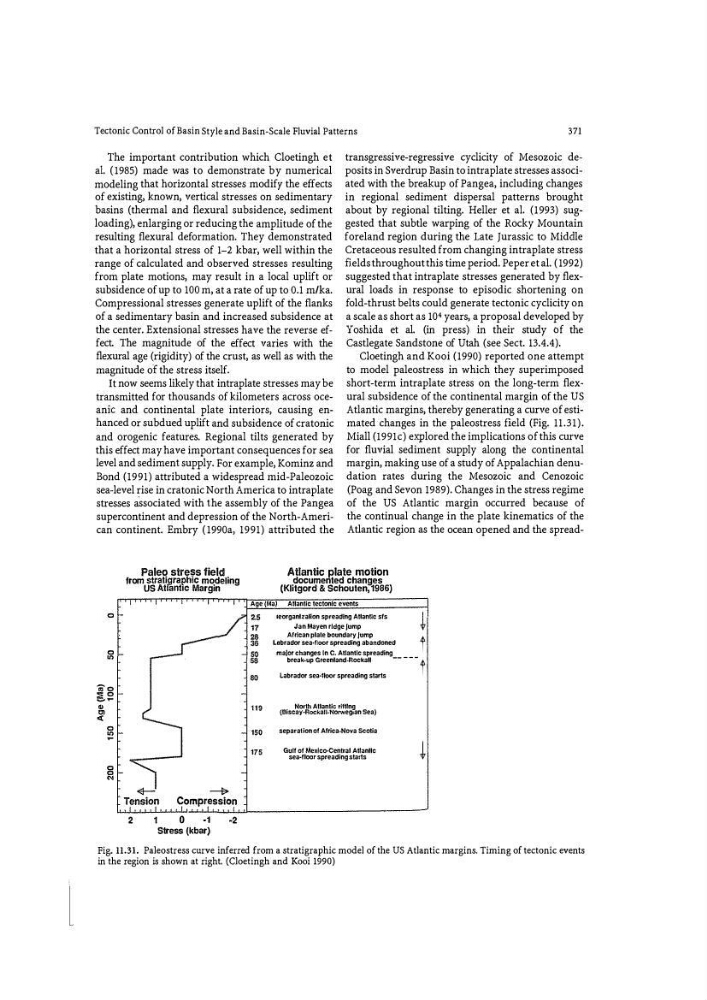
Cloetingh and Kooi (1990) reported one attempt
to model paleostress in which they superimposed
short-term intraplate stress on the long-term flexural subsidence of the continental margin of the US
Atlantic margins, thereby generating a curve of estimated changes in the paleostress field (Fig. 11.31).
Miall (1991c) explored the implications of this curve
for fluvial sediment supply along the continental
margin, making use of a study of Appalachian denudation rates during the Mesozoic and Cenozoic
(Poag and Sevon 1989). Changes in the stress regime
of the US Atlantic margin occurred because of
the continual change in the plate kinematics of the
Atlantic region as the ocean opened and the spreadPaleo stress field
from stratigraphic modeling
US Atlantic Margin
Atlantic plate motion
documented changes
(Kiitgord & Schouten, 1986)
0
0
"'
-�
�
"'
" 0
"'
�
0
0
"'
2
-
Compression
1
0
-1
-2
Stress {kbar)
Age {Ma)
Atlantic tectonic events
�·
17
28
36
gg
119
150
17S
reorganlzallon spreading Atlantic sfs
I
Jan Mayen ridge jump
W
African plate boundary Jump
Labrador sea· floor spreading abandoned
t
major changes In C. Al!anl!c spreading
break-up Greenland-Rockall
-- --t
labrador sea·floor spreading starts
North Atlantic riiUng
{Biscay-RockaU·Norweg1an sea)
separation of Africa-Nova SCotia
Gulf of Me:dco·Central AUanllc
sea-floor spreading starts
Fig. 11.31. Paleostress curve inferred from a stratigraphic model of the US Atlantic margins. Timing of tectonic events
in the region is shown at right. (Cloetingh and Kooi 1990)
371
The important contribution which Cloetingh et
a!. (1985) made was to demonstrate by numerical
modeling that horizontal stresses modify the effects
of existing, known, vertical stresses on sedimentary
basins (thermal and flexural subsidence, sediment
loading), enlarging or reducing the amplitude of the
resulting flexural deformation. They demonstrated
that a horizontal stress of 1-2 kbar, well within the
range of calculated and observed stresses resulting
from plate motions, may result in a local uplift or
subsidence of up to 100 m, at a rate of up to 0.1 m/ka.
Compressional stresses generate uplift of the flanks
of a sedimentary basin and increased subsidence at
the center. Extensional stresses have the reverse effect. The magnitude of the effect varies with the
flexural age (rigidity) of the crust, as well as with the
magnitude of the stress itself.
It now seems likely that intraplate stresses may be
transmitted for thousands of kilometers across oceanic and continental plate interiors, causing enhanced or subdued uplift and subsidence of cratonic
and orogenic features. Regional tilts generated by
this effect may have important consequences for sea
level and sediment supply. For example, Kominz and
Bond (1991) attributed a widespread mid-Paleozoic
sea-level rise in cratonic North America to intraplate
stresses a
'
ssociated with the assembly of the Pangea
supercontinent and depression of the North-American continent. Embry (1990a, 1991) attributed the
transgressive-regressive cyclicity of Mesozoic deposits in Sverdrup Basin to intraplate stresses associated with the breakup of Pangea, including changes
in regional sediment dispersal patterns brought
about by regional tilting. Heller et a!. (1993) suggested that subtle warping of the Rocky Mountain
foreland region during the Late Jurassic to Middle
Cretaceous resulted from changing intraplate stress
fields throughout this time period. Peper et al. ( 1992)
suggested that intraplate stresses generated by flexural loads in response to episodic shortening on
fold-thrust belts could generate tectonic cyclicity on
a scale as short as 10' years, a proposal developed by
Yoshida et al. (in press) in their study of the
Castlegate Sandstone of Utah (see Sect. 13.4.4).
Cloetingh and Kooi (1990) reported one attempt
to model paleostress in which they superimposed
short-term intraplate stress on the long-term flexural subsidence of the continental margin of the US
Atlantic margins, thereby generating a curve of estimated changes in the paleostress field (Fig. 11.31).
Miall (1991c) explored the implications of this curve
for fluvial sediment supply along the continental
margin, making use of a study of Appalachian denudation rates during the Mesozoic and Cenozoic
(Poag and Sevon 1989). Changes in the stress regime
of the US Atlantic margin occurred because of
the continual change in the plate kinematics of the
Atlantic region as the ocean opened and the spreadPaleo stress field
from stratigraphic modeling
US Atlantic Margin
Atlantic plate motion
documented changes
(Kiitgord & Schouten, 1986)
0
0
"'
-�
�
"'
" 0
"'
�
0
0
"'
2
-
Compression
1
0
-1
-2
Stress {kbar)
Age {Ma)
Atlantic tectonic events
�·
17
28
36
gg
119
150
17S
reorganlzallon spreading Atlantic sfs
I
Jan Mayen ridge jump
W
African plate boundary Jump
Labrador sea· floor spreading abandoned
t
major changes In C. Al!anl!c spreading
break-up Greenland-Rockall
-- --t
labrador sea·floor spreading starts
North Atlantic riiUng
{Biscay-RockaU·Norweg1an sea)
separation of Africa-Nova SCotia
Gulf of Me:dco·Central AUanllc
sea-floor spreading starts
Fig. 11.31. Paleostress curve inferred from a stratigraphic model of the US Atlantic margins. Timing of tectonic events
in the region is shown at right. (Cloetingh and Kooi 1990)