

Tectonic Control of Basin Style and Basin-Scale Fluvial Patterns
4111 Morine shale tongue
V
Oeep-woter we
DEPOSITIONAL
EPISODES and
OEPOCENTERS
TECTONIC
EVENTS
Aeee!eroted
8osio and Range
oxt
;
�oi�
leMotor reor �nlzOhon
formohon -Rio
. . . [ Active 9raben
of E. Pocol1c
Grande Rift
! spreading
sy�tem
t
ReQiot!
J ReQiomtl rhyolitic
stress field
b
volcanism'
-s. Roc�y mtn.
�· 'tJ:!'J:���
rl)orgonizotion jl o.Chihuohuo
Flattening of
subdvcle
l
Faro!lon plate
l Major N-S
I , , , .. . " '"'"
DecoupliniJ of
Colorado
PIOII'IOU I
Major NE:- SW
Lorom1dO puh1e
I
--Inner coastal plain unconformity
-RG+Comporotivll moQnituda and depOC(Intor
of conliMilfOI mor11in prOIJrodotion
OCEANOGRAPHY I
EUSTATIC
CLIMATE
CURVE
•
.
"
Abrupt 0 increase
+-Proposed m iedicms
369
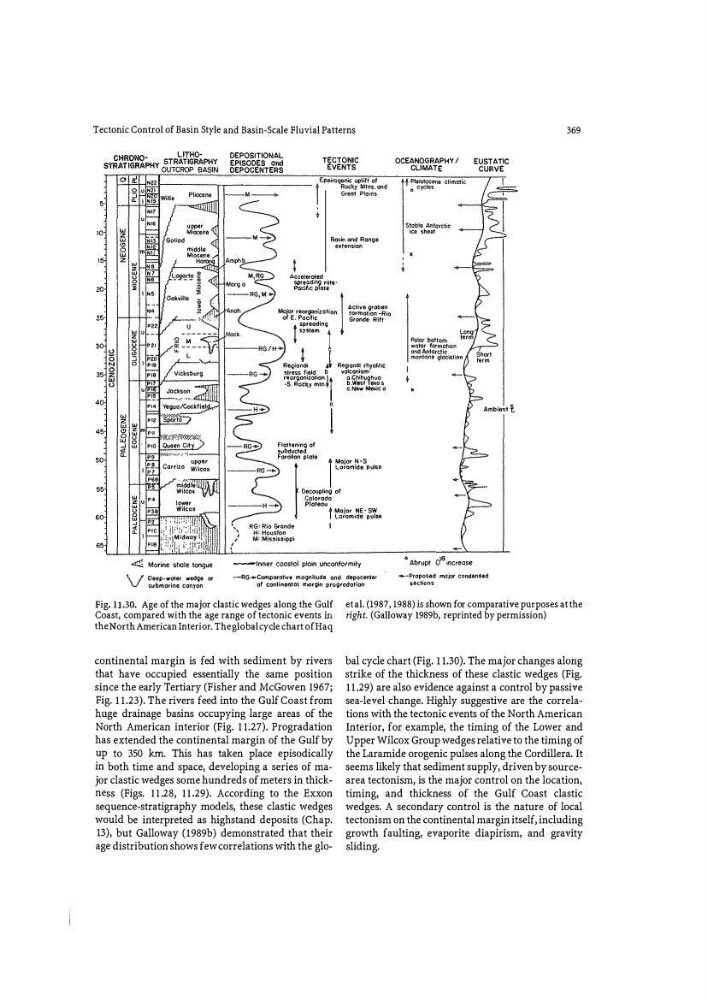
Fig. 11.30. Age of the major clastic wedges along the Gulf
Coast, compared with the age range of tectonic events in
the North American Interior. The global cycle chart ofHaq
et al. (1987, 1988) is shown for comparative purposes at the
righ t. (Galloway 1989b, reprinted by permission)
continental margin is fed with sediment by rivers
that have occupied essentially the same position
since the early Tertiary (Fisher and McGowen 1967;
Fig. 11.23). The rivers feed into the Gulf Coast from
huge drainage basins occupying large areas of the
North American interior (Fig. 11.27). Progradation
has extended the continental margin of the Gulf by
up to 350 km. This has taken place episodically
in both time and space, developing a series of major clastic wedges some hundreds of meters in thickness (Figs. 11.28, 11.29). According to the Exxon
sequence-stratigraphy models, these clastic wedges
would be interpreted as highstand deposits (Chap.
13), but Galloway (1989b) demonstrated that their
age distribution shows few correlations with the global cycle chart (Fig. 11.30). The major changes along
strike of the thickness of these clastic wedges (Fig.
11.29) are also evidence against a control by passive
sea-level change. Highly suggestive are the correlations with the tectonic events of the North American
Interior, for example, the timing of the Lower and
Upper Wilcox Group wedges relative to the timing of
the Laramide orogenic pulses along the Cordillera. It
seems likely that sediment supply, driven by sourcearea tectonism, is the major control on the location,
timing, and thickness of the Gulf Coast clastic
wedges. A secondary control is the nature of local
tectonism on the continental margin itself, including
growth faulting, evaporite diapirism, and gravity
sliding.
4111 Morine shale tongue
V
Oeep-woter we
DEPOSITIONAL
EPISODES and
OEPOCENTERS
TECTONIC
EVENTS
Aeee!eroted
8osio and Range
oxt
;
�oi�
leMotor reor �nlzOhon
formohon -Rio
. . . [ Active 9raben
of E. Pocol1c
Grande Rift
! spreading
sy�tem
t
ReQiot!
J ReQiomtl rhyolitic
stress field
b
volcanism'
-s. Roc�y mtn.
�· 'tJ:!'J:���
rl)orgonizotion jl o.Chihuohuo
Flattening of
subdvcle
l
Faro!lon plate
l Major N-S
I , , , .. . " '"'"
DecoupliniJ of
Colorado
PIOII'IOU I
Major NE:- SW
Lorom1dO puh1e
I
--Inner coastal plain unconformity
-RG+Comporotivll moQnituda and depOC(Intor
of conliMilfOI mor11in prOIJrodotion
OCEANOGRAPHY I
EUSTATIC
CLIMATE
CURVE
•
.
"
Abrupt 0 increase
+-Proposed m iedicms
369
Fig. 11.30. Age of the major clastic wedges along the Gulf
Coast, compared with the age range of tectonic events in
the North American Interior. The global cycle chart ofHaq
et al. (1987, 1988) is shown for comparative purposes at the
righ t. (Galloway 1989b, reprinted by permission)
continental margin is fed with sediment by rivers
that have occupied essentially the same position
since the early Tertiary (Fisher and McGowen 1967;
Fig. 11.23). The rivers feed into the Gulf Coast from
huge drainage basins occupying large areas of the
North American interior (Fig. 11.27). Progradation
has extended the continental margin of the Gulf by
up to 350 km. This has taken place episodically
in both time and space, developing a series of major clastic wedges some hundreds of meters in thickness (Figs. 11.28, 11.29). According to the Exxon
sequence-stratigraphy models, these clastic wedges
would be interpreted as highstand deposits (Chap.
13), but Galloway (1989b) demonstrated that their
age distribution shows few correlations with the global cycle chart (Fig. 11.30). The major changes along
strike of the thickness of these clastic wedges (Fig.
11.29) are also evidence against a control by passive
sea-level change. Highly suggestive are the correlations with the tectonic events of the North American
Interior, for example, the timing of the Lower and
Upper Wilcox Group wedges relative to the timing of
the Laramide orogenic pulses along the Cordillera. It
seems likely that sediment supply, driven by sourcearea tectonism, is the major control on the location,
timing, and thickness of the Gulf Coast clastic
wedges. A secondary control is the nature of local
tectonism on the continental margin itself, including
growth faulting, evaporite diapirism, and gravity
sliding.