

Tectonic Control of Basin Style and Basin-Scale Fluvial Patterns
367
from differential uplift of the marginal fold-thrust
belt and of the craton on the opposite side of the
basin.
11.3.4 Tectonism and Sediment Supply
Sediment supply is primarily driven by tectonism�
but in geologically simple areas sediment�supply
considerations are likely to be subordinate to basin
subsidence and eustasy as major controls of basin
architecture. Such is the case where the basin is fed
directly from the adjacent margins, and source-area
uplift is related to basin subsidence - for example1
through the yoking of subsidence to peripheral
upwarps or the fold-thrust belts marginal to foreland
basins. It is wh ere the basin is supplied by longdistance fluvial transportation that complications
are likely to arise.
Many sedimentary basins were filled by river
systems that have long since disappeared from the
continental surface, and it may take considerable
geological imagination to reconstruct their possible
COt.OAAOO
PLATEAU I
DRAINAGE BASINS
--- M!OCENE · IiOLOCENE
-- OI.. IGOCEI<£
- - L PALEOCENE • E EOCENE
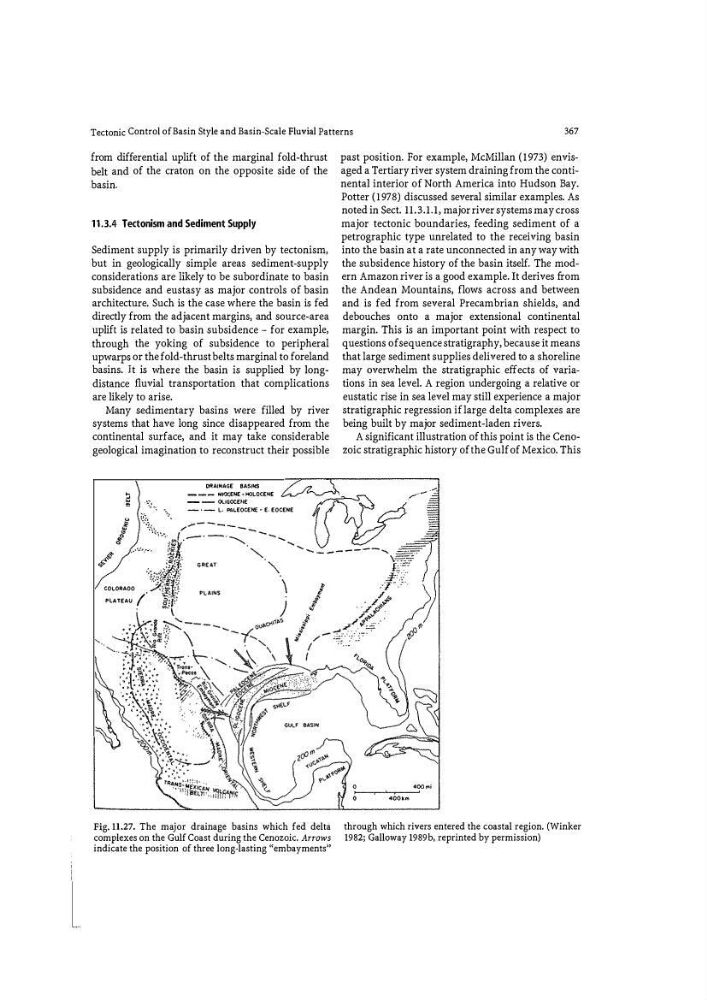
Fig. 11.27. The major drainage basins which fed delta
complexes on the Gulf Coast during the Cenozoic. Arrows
indicate the position of three long·lasting "embayments)'
past position. For example, McMillan (1973) envisaged a Tertiary river system draining from the continental interior of North America into Hudson Bay.
Potter (1978) discussed several similar examples. As
noted in Sect. 11.3.1.1, major river systems may cross
major tectonic boundaries1 fe eding sediment of a
petrographic type unrelated to the receiving basin
into the basin at a rate unconnected in any way with
the subsidence history of the basin itself. The modern Amazon river is a good example. It derives fr om
the Andean Mountains, flows across and between
and is fed from several Precambrian shields, and
debouches onto a major extensional continental
margin. This is an important point vvith respect to
questions of sequence stratigraphy, because it means
that large sediment supplies delivered to a shoreline
may overwhelm the stratigraphic effects of variations in sea level. A region undergoing a relative or
eustatic rise in sea level may still experience a major
stratigraphic regression if large delta complexes are
being built by major sediment-laden rivers.
A significant illustration of this point is the Cenozoic stratigraphic history of the Gulf of Mexico. This
.-<
through which rivers entered the coastal region. (Winker
1982; Galloway 1989b> reprinted by permission)
367
from differential uplift of the marginal fold-thrust
belt and of the craton on the opposite side of the
basin.
11.3.4 Tectonism and Sediment Supply
Sediment supply is primarily driven by tectonism�
but in geologically simple areas sediment�supply
considerations are likely to be subordinate to basin
subsidence and eustasy as major controls of basin
architecture. Such is the case where the basin is fed
directly from the adjacent margins, and source-area
uplift is related to basin subsidence - for example1
through the yoking of subsidence to peripheral
upwarps or the fold-thrust belts marginal to foreland
basins. It is wh ere the basin is supplied by longdistance fluvial transportation that complications
are likely to arise.
Many sedimentary basins were filled by river
systems that have long since disappeared from the
continental surface, and it may take considerable
geological imagination to reconstruct their possible
COt.OAAOO
PLATEAU I
DRAINAGE BASINS
--- M!OCENE · IiOLOCENE
-- OI.. IGOCEI<£
- - L PALEOCENE • E EOCENE
Fig. 11.27. The major drainage basins which fed delta
complexes on the Gulf Coast during the Cenozoic. Arrows
indicate the position of three long·lasting "embayments)'
past position. For example, McMillan (1973) envisaged a Tertiary river system draining from the continental interior of North America into Hudson Bay.
Potter (1978) discussed several similar examples. As
noted in Sect. 11.3.1.1, major river systems may cross
major tectonic boundaries1 fe eding sediment of a
petrographic type unrelated to the receiving basin
into the basin at a rate unconnected in any way with
the subsidence history of the basin itself. The modern Amazon river is a good example. It derives fr om
the Andean Mountains, flows across and between
and is fed from several Precambrian shields, and
debouches onto a major extensional continental
margin. This is an important point vvith respect to
questions of sequence stratigraphy, because it means
that large sediment supplies delivered to a shoreline
may overwhelm the stratigraphic effects of variations in sea level. A region undergoing a relative or
eustatic rise in sea level may still experience a major
stratigraphic regression if large delta complexes are
being built by major sediment-laden rivers.
A significant illustration of this point is the Cenozoic stratigraphic history of the Gulf of Mexico. This
.-<
through which rivers entered the coastal region. (Winker
1982; Galloway 1989b> reprinted by permission)