

20
flow velocities (or shallower depths) than any of the
other three.
The term dune was in use by Swiss workers before
the turn of the century, and had been proposed for
water-formed bedforms on the basis of their similarity to eolian dunes. The term was introduced to
American Workers by Gilbert ( 1914) in preference to
the term sand wave, also in current use (e.g., Hider
1882), and this started a nomenclature confusion
that is only now being resolved (Ashley 1990). The
term antidune was first coined by Gilbert ( 1914), and
the sequence dune, smooth bed, antidune, with increased flow velocity, was documented by Owens
(1908).
Gilbert's detailed fl ume experiments confirmed
the results of Sorbfs · pioneer work, and also reproduced the bedform sequence described by Owens
(1908). The mechanism of grain and water movement was observed in detail. It was recognized that
dune spacing depends on depth and velocity (Gilbert
quoted earlier workers who had made similar observations), and the significance of grain .size was tealized (although not explored in detail). Similar
experimental work was carried out by Hahmann
(1912) but has not been widely quoted by Englishspeaking workers.
Several detailed descriptive papers on cross-bedding structures appeared at about this time, most of
which attempted to develop criteria by which such
structures could be used as environmental indicators (Grabau 1907; King !9!6; Kindle 1917; Bucher
!919). Epry (1913) stated of ripple marks that "no
one seems until now, to have definitely ascertained
their causen, and .. ripple marks are the work of the
tide and of that alone", but he obviously had not
been keeping up with the literature. Bucher provided
data concerning wavelength, amplitude, "horizontal
form index'' («the degree of asymmetry may be ex. pressed by the ratio of the horizontal length of the
lee:.side to that of the stoss-side") and ''vertical form
index" (wavelength/amplitude). He proposed the
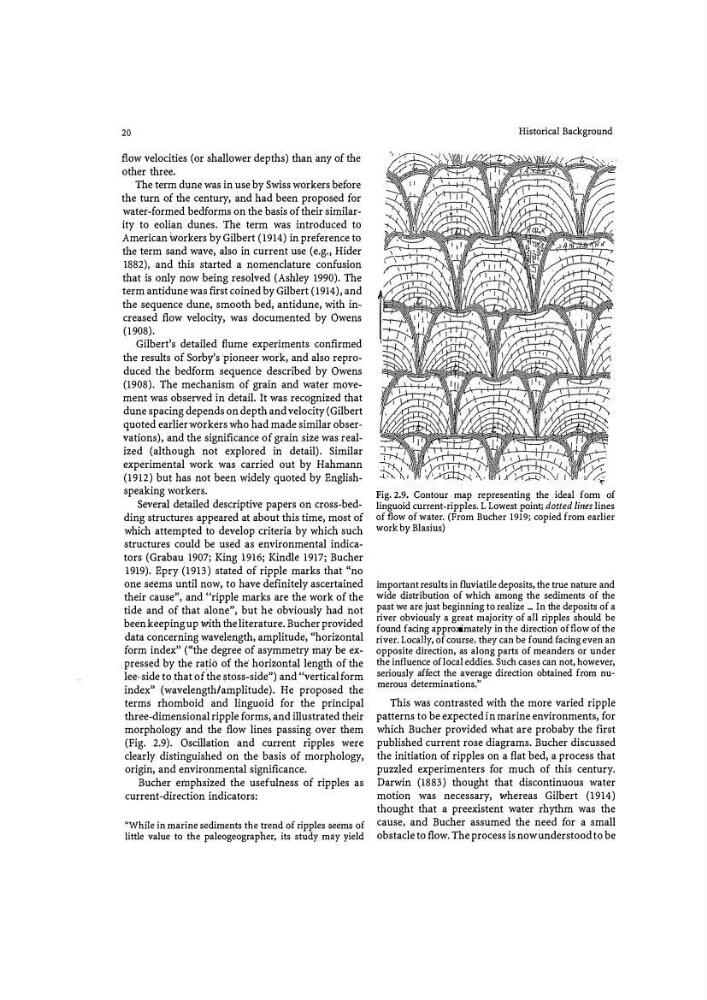
terms rhomboid and linguoid for the principal
three-dimensional ripple forms, and illustrated their
morphology and the flow lines passing over them
(Fig. 2.9). Oscillation and current ripples were
clearly distinguished on the basis of morphology,
origin, and environmental significance.
Bucher ernphsized the usefulness of ripples as
current-direction indicators:
"While in marine sediments the trend of ripples seems of
little value to the paleogeographer, its study may yield
Historical Background
;:;;:
I�
Fig. 2.9. Contour map representing the ideal form of
linguoid current-ripples. L Lowest point; dotted lines lines
of flow of water. (From Bucher 1919; copied from earlier
work by Blasius)
important results in fluviatile deposits, the true nature and
wide distribution of which among the sediments of the
past we are just beginning to realize ... In the deposits of a
river obviously a great majority of all ripples should be
found facing approximately in the direction of flow of the
river. Locally, of course, they can be found fa cing even an
Opposite direction, as along parts of meanders or under
the influence of local eddies. Stich cases can not, however,
seriously affect the average direction obtained from numerous determinations."
This was contrasted with the more varied ripple
patterns to be expected in marine environments, for
which Bucher provided what are probaby the first
published current rose diagrams. Bucher discussed
the initiation of ripples on a flat bed, a process that
puzzled experimenters for much of this century.
Darwin (1883) thought that discontinuous water
motion was necessary, whereas Gilbert (1914)
thought that a preexistent water rhythm was the
cause) and Bucher assumed the need for a small
obstacle to flow. The process is now understood to be
flow velocities (or shallower depths) than any of the
other three.
The term dune was in use by Swiss workers before
the turn of the century, and had been proposed for
water-formed bedforms on the basis of their similarity to eolian dunes. The term was introduced to
American Workers by Gilbert ( 1914) in preference to
the term sand wave, also in current use (e.g., Hider
1882), and this started a nomenclature confusion
that is only now being resolved (Ashley 1990). The
term antidune was first coined by Gilbert ( 1914), and
the sequence dune, smooth bed, antidune, with increased flow velocity, was documented by Owens
(1908).
Gilbert's detailed fl ume experiments confirmed
the results of Sorbfs · pioneer work, and also reproduced the bedform sequence described by Owens
(1908). The mechanism of grain and water movement was observed in detail. It was recognized that
dune spacing depends on depth and velocity (Gilbert
quoted earlier workers who had made similar observations), and the significance of grain .size was tealized (although not explored in detail). Similar
experimental work was carried out by Hahmann
(1912) but has not been widely quoted by Englishspeaking workers.
Several detailed descriptive papers on cross-bedding structures appeared at about this time, most of
which attempted to develop criteria by which such
structures could be used as environmental indicators (Grabau 1907; King !9!6; Kindle 1917; Bucher
!919). Epry (1913) stated of ripple marks that "no
one seems until now, to have definitely ascertained
their causen, and .. ripple marks are the work of the
tide and of that alone", but he obviously had not
been keeping up with the literature. Bucher provided
data concerning wavelength, amplitude, "horizontal
form index'' («the degree of asymmetry may be ex. pressed by the ratio of the horizontal length of the
lee:.side to that of the stoss-side") and ''vertical form
index" (wavelength/amplitude). He proposed the
terms rhomboid and linguoid for the principal
three-dimensional ripple forms, and illustrated their
morphology and the flow lines passing over them
(Fig. 2.9). Oscillation and current ripples were
clearly distinguished on the basis of morphology,
origin, and environmental significance.
Bucher ernphsized the usefulness of ripples as
current-direction indicators:
"While in marine sediments the trend of ripples seems of
little value to the paleogeographer, its study may yield
Historical Background
;:;;:
I�
Fig. 2.9. Contour map representing the ideal form of
linguoid current-ripples. L Lowest point; dotted lines lines
of flow of water. (From Bucher 1919; copied from earlier
work by Blasius)
important results in fluviatile deposits, the true nature and
wide distribution of which among the sediments of the
past we are just beginning to realize ... In the deposits of a
river obviously a great majority of all ripples should be
found facing approximately in the direction of flow of the
river. Locally, of course, they can be found fa cing even an
Opposite direction, as along parts of meanders or under
the influence of local eddies. Stich cases can not, however,
seriously affect the average direction obtained from numerous determinations."
This was contrasted with the more varied ripple
patterns to be expected in marine environments, for
which Bucher provided what are probaby the first
published current rose diagrams. Bucher discussed
the initiation of ripples on a flat bed, a process that
puzzled experimenters for much of this century.
Darwin (1883) thought that discontinuous water
motion was necessary, whereas Gilbert (1914)
thought that a preexistent water rhythm was the
cause) and Bucher assumed the need for a small
obstacle to flow. The process is now understood to be