

342
Fluvial Depositional Systems and Autogenic Sedimentary Controls
a
Wlnga
{overbanks)
b
c
�
�� ��·"
Cfavas$e channel
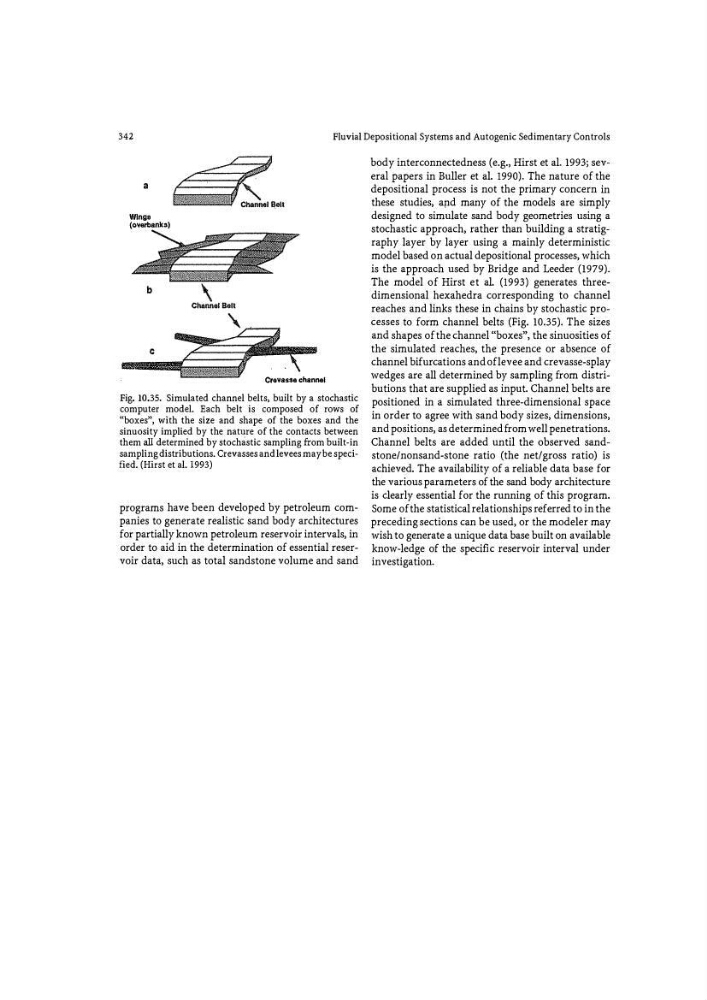
Fig. 10.35. Simulated channel belts, built by a stochastic
computer model. Each belt is composed of rows of
"boxes", with the size and shape of the boxes and the
sinuosity implied by the nat�re of the contacts between
them all determined by stochastic sampling from built-in
sampling distributions. Crevasses and levees may be specified. (Hirst et al. !993)
programs have been developed by petroleum companies to generate realistic sand body architectures
for partially known petroleum reservoir intervals, in
order to aid in the determination of essential reservoir data, such as total sandstone volume and sand
body interconnectedness (e.g., Hirst et al. 1993; sev�
era! papers in Buller et al. !990). The nature of the
depositional process is not the primary concern in
these studies, and many of the models are simply
designed to simulate sand body geometries using a
stochastic approach, rather than building a stratigraphy layer by layer using a mainly deterministic
model based on actual depositional processes, which
is the approach used by Bridge and Leeder (1979).
The model of Hirst et al. (!993) generates threedimensional hexahedra corresponding to channel
reaches and links these in chains by stochastic pro�
cesses to form channel belts (Fig. 10.35). The sizes
and shapes of the channel .. boxes", the sinuosities of
the simulated reaches, the presence or absence of
channel bifurcations and oflevee and crevasse-splay
wedges are all determined by sampling fr om distributions that are supplied as input. Channel belts are
positioned in a simulated three-dimensional space
in order to agree with sand body sizes, dimensions,
and positions, as determined fr om well penetrations.
Channel belts are added until the observed sandstone/nonsand-stone ratio (the net/gross ratio) is
achieved. The availability of a reliable data base for
the various parameters of the sand body architecture
is dearly essential for the running of this program.
Some of the statistical relationships referred to in the
preceding sections can be used, or the modeler may
wish to generate a unique data base built on available
know-ledge of the specifi c reservoir interval under
investigation.
Fluvial Depositional Systems and Autogenic Sedimentary Controls
a
Wlnga
{overbanks)
b
c
�
�� ��·"
Cfavas$e channel
Fig. 10.35. Simulated channel belts, built by a stochastic
computer model. Each belt is composed of rows of
"boxes", with the size and shape of the boxes and the
sinuosity implied by the nat�re of the contacts between
them all determined by stochastic sampling from built-in
sampling distributions. Crevasses and levees may be specified. (Hirst et al. !993)
programs have been developed by petroleum companies to generate realistic sand body architectures
for partially known petroleum reservoir intervals, in
order to aid in the determination of essential reservoir data, such as total sandstone volume and sand
body interconnectedness (e.g., Hirst et al. 1993; sev�
era! papers in Buller et al. !990). The nature of the
depositional process is not the primary concern in
these studies, and many of the models are simply
designed to simulate sand body geometries using a
stochastic approach, rather than building a stratigraphy layer by layer using a mainly deterministic
model based on actual depositional processes, which
is the approach used by Bridge and Leeder (1979).
The model of Hirst et al. (!993) generates threedimensional hexahedra corresponding to channel
reaches and links these in chains by stochastic pro�
cesses to form channel belts (Fig. 10.35). The sizes
and shapes of the channel .. boxes", the sinuosities of
the simulated reaches, the presence or absence of
channel bifurcations and oflevee and crevasse-splay
wedges are all determined by sampling fr om distributions that are supplied as input. Channel belts are
positioned in a simulated three-dimensional space
in order to agree with sand body sizes, dimensions,
and positions, as determined fr om well penetrations.
Channel belts are added until the observed sandstone/nonsand-stone ratio (the net/gross ratio) is
achieved. The availability of a reliable data base for
the various parameters of the sand body architecture
is dearly essential for the running of this program.
Some of the statistical relationships referred to in the
preceding sections can be used, or the modeler may
wish to generate a unique data base built on available
know-ledge of the specifi c reservoir interval under
investigation.