

Early Developments in the Study of Fluvial Sediments
curve "there is always a sand-bar, answering, in the
convexity of its form, the concavity of the bend", and
described the development of levees, which slope
back and become finer grained away from the channel.
Observations of many floods are quoted as testament to the power of rivers to erode and transport
large quantities of coarse debris (Playfair was aware
of this 30 years earlier), and historical evidence pertaining to the burial of Roman buildings and the
isolation of ancient potts far inland is used to demonstrate the fact that rivers can build up thick and
extensive alluvial tracts in a few hundred years. The
velocity gradient of river channels (slowest near the
bed) was already known, and some basic data on
sediment entrainment had been obtained:
A velocity of 3 in/s is ascertairied to be sufficient
to tear up fine clay; 6 in/s, fine sand; 12 in/s, fine
gravel; and 3 ft/s, stones of the size of an egg.
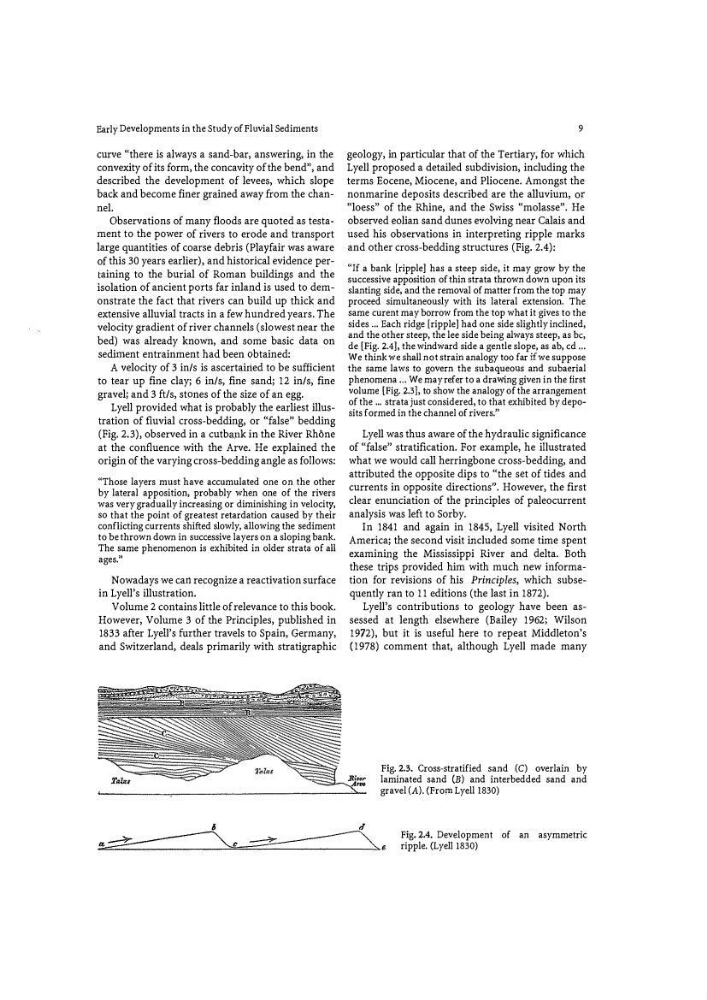
Lyell provided what is probably the earliest illustration of fl uvial cross-bedding, or «false" bedding
(Fig. 2.3), observed in a cutba)lk in the River Rh6ne
at the confluence with the Arve. He explained the
origin of the varying cross-bedding angle as follows:
"Those layers must have accumulated one on the other
by lateral apposition, probably when one of the rivers
was very gradually increasing or diminishing in velocit y ,
so that the point of greatest retardation caused by their
conflicting currents shifted slowly, allowing the sediment
to be thrown down in successive layers on a sloping bank.
The same phenomenon is exhibited in older strata. of all
ages."
Nowadays we cart recognize a reactivation surface
in Lyell's illustration.
Volume 2 contains little of relevance to this book.
However, Volume 3 of the Principles, published in
1833 after Lyell's further travels to Spain, Germany,
and Switzerland, deals primarily with stratigraphic
9
geology, in particular that of the Tertiary, for wh,ich
Lyell proposed a detailed subdivision, including the
terms Eocene, Miocene, and Pliocene. Amongst the
nonmarine deposits described are the alluvium, or
"loess'' of the Rhine, and the Swiss "molasse". He
observed eolian sand dunes evolving near Calais and
used his observations in interpreting ripple marks
and other cross-bedding structures (Fig. 2.4):
"If a bank [ripple] has a steep side, it may grow by the
successive apposition of thin strata thrown down upon its
slanting side, and the removal of matter from the top may
proceed simultaneously with its lateral extension. The
same curent may borrow from the top what it gives to the
sides ... Each ridge [ripple] had one side slightly inclined,
and the other steep, the lee side being always steep, as be,
de [Fig. 2.4], the windward side a gentle slope, as ab, cd ...
We think we shall not strain analogy too far if we suppose
the same laws to govern the subaqueoqs and subaerial
phenomena ... We may refer to a drawing given in the first
volume [Fig. 2.3], to show the analogy ofthe arrangement
of the ... strata just considered, to that exhibited by deposits formed in the channel of rivers."
Lyell was thus aware of the hydraulic signifi cance
of "false" stratification. For example, he illustrated
what we would call herringbone cross� bedding, and
attributed the opposite dips to "the set of tides and
currents in opposite directions". However, the first
clear enunciation of the principles of paleocurrent
analysis was left to Sorby.
In 1841 and again in 1845, Lyell visited North
America; the second visit included some time spent
examining the Mississippi River and delta. Both
these trips provided him with much new information for revisions of his Principles, which subsequently ran to 11 editions (the last in 1872).
Lyell's contributions to geology have been assessed at length elsewhere (Bailey 1962; Wilson
1972), but it is useful here to repeat Middleton's
(1978) comment that, although Lyell made many
Fig. 2.3. Cross-stratified sand (C) overlain by
laminated sand (B) and interbedded sand and
gravel (A). (From Lyelll8 30)
Fig. 2.4. Development of an asymmetric
ripple. (Lyel1 1830)
curve "there is always a sand-bar, answering, in the
convexity of its form, the concavity of the bend", and
described the development of levees, which slope
back and become finer grained away from the channel.
Observations of many floods are quoted as testament to the power of rivers to erode and transport
large quantities of coarse debris (Playfair was aware
of this 30 years earlier), and historical evidence pertaining to the burial of Roman buildings and the
isolation of ancient potts far inland is used to demonstrate the fact that rivers can build up thick and
extensive alluvial tracts in a few hundred years. The
velocity gradient of river channels (slowest near the
bed) was already known, and some basic data on
sediment entrainment had been obtained:
A velocity of 3 in/s is ascertairied to be sufficient
to tear up fine clay; 6 in/s, fine sand; 12 in/s, fine
gravel; and 3 ft/s, stones of the size of an egg.
Lyell provided what is probably the earliest illustration of fl uvial cross-bedding, or «false" bedding
(Fig. 2.3), observed in a cutba)lk in the River Rh6ne
at the confluence with the Arve. He explained the
origin of the varying cross-bedding angle as follows:
"Those layers must have accumulated one on the other
by lateral apposition, probably when one of the rivers
was very gradually increasing or diminishing in velocit y ,
so that the point of greatest retardation caused by their
conflicting currents shifted slowly, allowing the sediment
to be thrown down in successive layers on a sloping bank.
The same phenomenon is exhibited in older strata. of all
ages."
Nowadays we cart recognize a reactivation surface
in Lyell's illustration.
Volume 2 contains little of relevance to this book.
However, Volume 3 of the Principles, published in
1833 after Lyell's further travels to Spain, Germany,
and Switzerland, deals primarily with stratigraphic
9
geology, in particular that of the Tertiary, for wh,ich
Lyell proposed a detailed subdivision, including the
terms Eocene, Miocene, and Pliocene. Amongst the
nonmarine deposits described are the alluvium, or
"loess'' of the Rhine, and the Swiss "molasse". He
observed eolian sand dunes evolving near Calais and
used his observations in interpreting ripple marks
and other cross-bedding structures (Fig. 2.4):
"If a bank [ripple] has a steep side, it may grow by the
successive apposition of thin strata thrown down upon its
slanting side, and the removal of matter from the top may
proceed simultaneously with its lateral extension. The
same curent may borrow from the top what it gives to the
sides ... Each ridge [ripple] had one side slightly inclined,
and the other steep, the lee side being always steep, as be,
de [Fig. 2.4], the windward side a gentle slope, as ab, cd ...
We think we shall not strain analogy too far if we suppose
the same laws to govern the subaqueoqs and subaerial
phenomena ... We may refer to a drawing given in the first
volume [Fig. 2.3], to show the analogy ofthe arrangement
of the ... strata just considered, to that exhibited by deposits formed in the channel of rivers."
Lyell was thus aware of the hydraulic signifi cance
of "false" stratification. For example, he illustrated
what we would call herringbone cross� bedding, and
attributed the opposite dips to "the set of tides and
currents in opposite directions". However, the first
clear enunciation of the principles of paleocurrent
analysis was left to Sorby.
In 1841 and again in 1845, Lyell visited North
America; the second visit included some time spent
examining the Mississippi River and delta. Both
these trips provided him with much new information for revisions of his Principles, which subsequently ran to 11 editions (the last in 1872).
Lyell's contributions to geology have been assessed at length elsewhere (Bailey 1962; Wilson
1972), but it is useful here to repeat Middleton's
(1978) comment that, although Lyell made many
Fig. 2.3. Cross-stratified sand (C) overlain by
laminated sand (B) and interbedded sand and
gravel (A). (From Lyelll8 30)
Fig. 2.4. Development of an asymmetric
ripple. (Lyel1 1830)