

222
Fluvial Styles and Facies Models
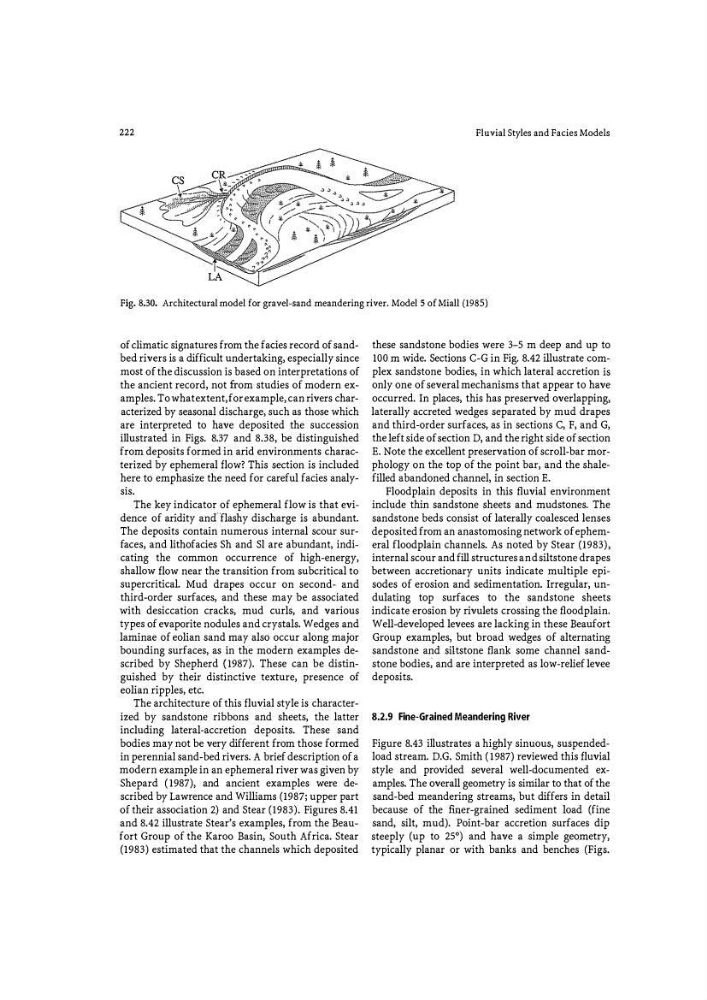
Fig. 8.30. Architectural model for gravel-sand meandering river. Model 5 of Miall (1985)
of climatic signatures from the fades record of sandbed rivers is a difficult undertaking, especially since
most of the discussion is based on interpretations of
the ancient record, not from studies of modern examples. To what extent, for example, can rivers characterized by seasonal discharge, such as those which
are interpreted to have deposited the succession
illustrated in Figs. 8.37 and 8.38, be distinguished
from deposits formed in arid environments characterized by ephemeral flow? This section is included
here to emphasize the need for careful facies analysis.
The key indicator of ephemeral flow is that evidence of aridity and flashy discharge is abundant.
The deposits contain numerous internal scour surfaces, and lithofacies Sh and Sl are abundant, indicating the common occurrence of high-energy,
shallow flow near the transition from subcritical to
supercritical. Mud drapes occur on second- and
third-order surfaces, and these may be associated
with desiccation cracks, mud curls, and various
types of evaporite nodules and crystals. Wedges and
laminae of eolian sand may also occur along major
bounding surfaces, as in the modern examples described by Shepherd (1987). These can be distinguished by their distinctive texture, presence of
eolian ripples, etc.
The architecture of this fluvial style is characterized by sandstone ribbons and sheets, the latter
including lateral-accretion deposits. These sand
bodies may not be very different from those formed
in perennial sand-bed rivers. A brief description of a
modern example in an ephemeral river was given by
Shepard (1987), and ancient examples were described by Lawrence and Williams (1987; upper part
of their association 2) and Stear (1983). Figures 8.41
and 8.42 illustrate Stear's examples, from the Beaufort Group of the Karoo Basin, South Africa. Stear
(1983) estimated that the channels which deposited
these sandstone bodies were 3-5 m deep and up to
100 m wide. Sections C-G in Fig. 8.42 illustrate complex sandstone bodies, in which lateral accretion is
only one of several mechanisms that appear to have
occurred. In places, this has preserved overlapping,
laterally accreted wedges separated by mud drapes
and third-order surfaces, as in sections C, F, and G,
the left side of section D, and the right side of section
E. Note the excellent preservation of scroll-bar morphology on the top of the point bar, and the shalefilled abandoned channel, in section E.
Floodplain deposits in this fluvial environment
include thin sandstone sheets and mudstones. The
sandstone beds consist of laterally coalesced lenses
deposited from an anastomosing network of ephemeral floodplain channels. As noted by Stear (1983),
internal scour and fill structures and siltstone drapes
between accretionary units indicate multiple episodes of erosion and sedimentation. Irregular, undulating top surfaces to the sandstone sheets
indicate erosion by rivulets crossing the floodplain.
Well-developed levees are lacking in these Beaufort
Group examples, but broad wedges of alternating
sandstone and siltstone flank some channel sand�
stone bodies ; and are interpreted as low-relief levee
deposits.
8.2.9 Fine-Grained Meandering River
Figure 8.43 illustrates a highly sinuous, suspendedload stream. D.G. Smith (1987) reviewed this fluvial
style and provided several well-documented examples. The overall geometry is similar to that of the
sand-bed meandering streams, but differs in detail
because of the fm er-grained sediment load (fine
sand, silt, mud). Point-bar accretion surfaces dip
steeply (up to 25') and have a simple geometry,
typically planar or with banks and benches (Figs.
Fluvial Styles and Facies Models
Fig. 8.30. Architectural model for gravel-sand meandering river. Model 5 of Miall (1985)
of climatic signatures from the fades record of sandbed rivers is a difficult undertaking, especially since
most of the discussion is based on interpretations of
the ancient record, not from studies of modern examples. To what extent, for example, can rivers characterized by seasonal discharge, such as those which
are interpreted to have deposited the succession
illustrated in Figs. 8.37 and 8.38, be distinguished
from deposits formed in arid environments characterized by ephemeral flow? This section is included
here to emphasize the need for careful facies analysis.
The key indicator of ephemeral flow is that evidence of aridity and flashy discharge is abundant.
The deposits contain numerous internal scour surfaces, and lithofacies Sh and Sl are abundant, indicating the common occurrence of high-energy,
shallow flow near the transition from subcritical to
supercritical. Mud drapes occur on second- and
third-order surfaces, and these may be associated
with desiccation cracks, mud curls, and various
types of evaporite nodules and crystals. Wedges and
laminae of eolian sand may also occur along major
bounding surfaces, as in the modern examples described by Shepherd (1987). These can be distinguished by their distinctive texture, presence of
eolian ripples, etc.
The architecture of this fluvial style is characterized by sandstone ribbons and sheets, the latter
including lateral-accretion deposits. These sand
bodies may not be very different from those formed
in perennial sand-bed rivers. A brief description of a
modern example in an ephemeral river was given by
Shepard (1987), and ancient examples were described by Lawrence and Williams (1987; upper part
of their association 2) and Stear (1983). Figures 8.41
and 8.42 illustrate Stear's examples, from the Beaufort Group of the Karoo Basin, South Africa. Stear
(1983) estimated that the channels which deposited
these sandstone bodies were 3-5 m deep and up to
100 m wide. Sections C-G in Fig. 8.42 illustrate complex sandstone bodies, in which lateral accretion is
only one of several mechanisms that appear to have
occurred. In places, this has preserved overlapping,
laterally accreted wedges separated by mud drapes
and third-order surfaces, as in sections C, F, and G,
the left side of section D, and the right side of section
E. Note the excellent preservation of scroll-bar morphology on the top of the point bar, and the shalefilled abandoned channel, in section E.
Floodplain deposits in this fluvial environment
include thin sandstone sheets and mudstones. The
sandstone beds consist of laterally coalesced lenses
deposited from an anastomosing network of ephemeral floodplain channels. As noted by Stear (1983),
internal scour and fill structures and siltstone drapes
between accretionary units indicate multiple episodes of erosion and sedimentation. Irregular, undulating top surfaces to the sandstone sheets
indicate erosion by rivulets crossing the floodplain.
Well-developed levees are lacking in these Beaufort
Group examples, but broad wedges of alternating
sandstone and siltstone flank some channel sand�
stone bodies ; and are interpreted as low-relief levee
deposits.
8.2.9 Fine-Grained Meandering River
Figure 8.43 illustrates a highly sinuous, suspendedload stream. D.G. Smith (1987) reviewed this fluvial
style and provided several well-documented examples. The overall geometry is similar to that of the
sand-bed meandering streams, but differs in detail
because of the fm er-grained sediment load (fine
sand, silt, mud). Point-bar accretion surfaces dip
steeply (up to 25') and have a simple geometry,
typically planar or with banks and benches (Figs.