

Facies Models
219
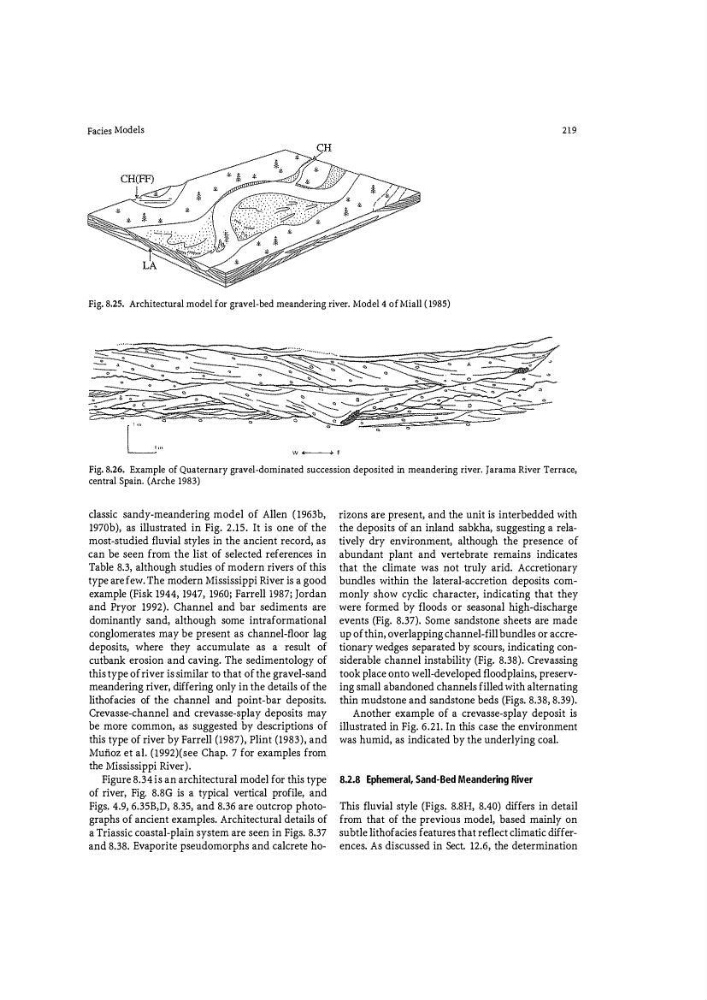
Fig. 8.25. Architectural model for gravel-bed meandering river. Model 4 of Miall (1985)
\V�f
Fig. 8.26. Example of Quaternary gravel-dominated succession deposited in meandering river. Jarama River Terrace,
central Spain. (Arche 1983)
classic sandy-meandering model of Allen (1963b,
1970b), as illustrated in Fig. 2.15. It is one of the
most-studied fluvial styles in the ancient record, as
can be seen from the list of selected references in
Table 8.3, although studies of modern rivers of this
type are few. The modern Mississippi River is a good
example (Fisk 1944, 1947, 1960; Farrell !987; jordan
and Pryor 1992). Channel and bar sediments are
dominantly sand, although some intraformational
conglomerates may be present as channel-floor lag
deposits, where they accumulate as a result of
cutbank erosion and caving. The sedimentology of
this type of river is-similar to that of the gravel-sand
meandering river, differing only in the details of the
lithofacies of the channel and point-bar deposits.
Crevasse-channel and crevasse-splay deposits may
be more common, as suggested by descriptions of
this type of river by Farrell (!987), Plint (1983), and
Munoz et a!. (1992)(see Chap. 7 for examples from
the Mississippi River).
Figure 8.34 is an architectural model for this type
of river, Fig. 8.8G is a typical vertical profile, and
Figs. 4.9, 6.35B,D, 8.35, and 8.36 are outcrop photographs of ancient examples. Architectural details of
a Triassic coastal-plain system are seen in Figs. 8.37
and 8.38. Evaporite pseudomorphs and calcrete horizons are present, and the unit is interbedded with
the deposits of an inland sabkha, suggesting a relatively dry environment, although the presence of
abundant plant and vertebrate remains indicates
that the climate was not truly arid. Accretionary
bundles within the lateral-accretion deposits commonly show cyclic character, indicating that they
were formed by floods or seasonal high-discharge
events (Fig. 8.37). Some sandstope sheets are made
up of thin, overlapping channel-fill bundles or accretionary wedges separated by scours, indicating considerable channel instability (Fig. 8.38). Crevassing
took place onto well-developed floodplains, preserving small abandoned channels filled with alternating
thin mudstone and sandstone beds (Figs. 8.38, 8.39).
Another example of a crevasse-splay deposit is
illustrated in Fig. 6.21. In this case the environment
was humid, as indicated by the underlying coal.
8.2.8 Ephemeral, Sand-Bed Meandering River
This fluvial style (Figs. 8.8!-l, 8.40) differs in detail
from that of the previous model, based mainly on
subtle lithofacies features that reflect climatic differences. As discussed in Sect. 12.6, the determination
219
Fig. 8.25. Architectural model for gravel-bed meandering river. Model 4 of Miall (1985)
\V�f
Fig. 8.26. Example of Quaternary gravel-dominated succession deposited in meandering river. Jarama River Terrace,
central Spain. (Arche 1983)
classic sandy-meandering model of Allen (1963b,
1970b), as illustrated in Fig. 2.15. It is one of the
most-studied fluvial styles in the ancient record, as
can be seen from the list of selected references in
Table 8.3, although studies of modern rivers of this
type are few. The modern Mississippi River is a good
example (Fisk 1944, 1947, 1960; Farrell !987; jordan
and Pryor 1992). Channel and bar sediments are
dominantly sand, although some intraformational
conglomerates may be present as channel-floor lag
deposits, where they accumulate as a result of
cutbank erosion and caving. The sedimentology of
this type of river is-similar to that of the gravel-sand
meandering river, differing only in the details of the
lithofacies of the channel and point-bar deposits.
Crevasse-channel and crevasse-splay deposits may
be more common, as suggested by descriptions of
this type of river by Farrell (!987), Plint (1983), and
Munoz et a!. (1992)(see Chap. 7 for examples from
the Mississippi River).
Figure 8.34 is an architectural model for this type
of river, Fig. 8.8G is a typical vertical profile, and
Figs. 4.9, 6.35B,D, 8.35, and 8.36 are outcrop photographs of ancient examples. Architectural details of
a Triassic coastal-plain system are seen in Figs. 8.37
and 8.38. Evaporite pseudomorphs and calcrete horizons are present, and the unit is interbedded with
the deposits of an inland sabkha, suggesting a relatively dry environment, although the presence of
abundant plant and vertebrate remains indicates
that the climate was not truly arid. Accretionary
bundles within the lateral-accretion deposits commonly show cyclic character, indicating that they
were formed by floods or seasonal high-discharge
events (Fig. 8.37). Some sandstope sheets are made
up of thin, overlapping channel-fill bundles or accretionary wedges separated by scours, indicating considerable channel instability (Fig. 8.38). Crevassing
took place onto well-developed floodplains, preserving small abandoned channels filled with alternating
thin mudstone and sandstone beds (Figs. 8.38, 8.39).
Another example of a crevasse-splay deposit is
illustrated in Fig. 6.21. In this case the environment
was humid, as indicated by the underlying coal.
8.2.8 Ephemeral, Sand-Bed Meandering River
This fluvial style (Figs. 8.8!-l, 8.40) differs in detail
from that of the previous model, based mainly on
subtle lithofacies features that reflect climatic differences. As discussed in Sect. 12.6, the determination