

Facies Models
Deep
perennial
braided
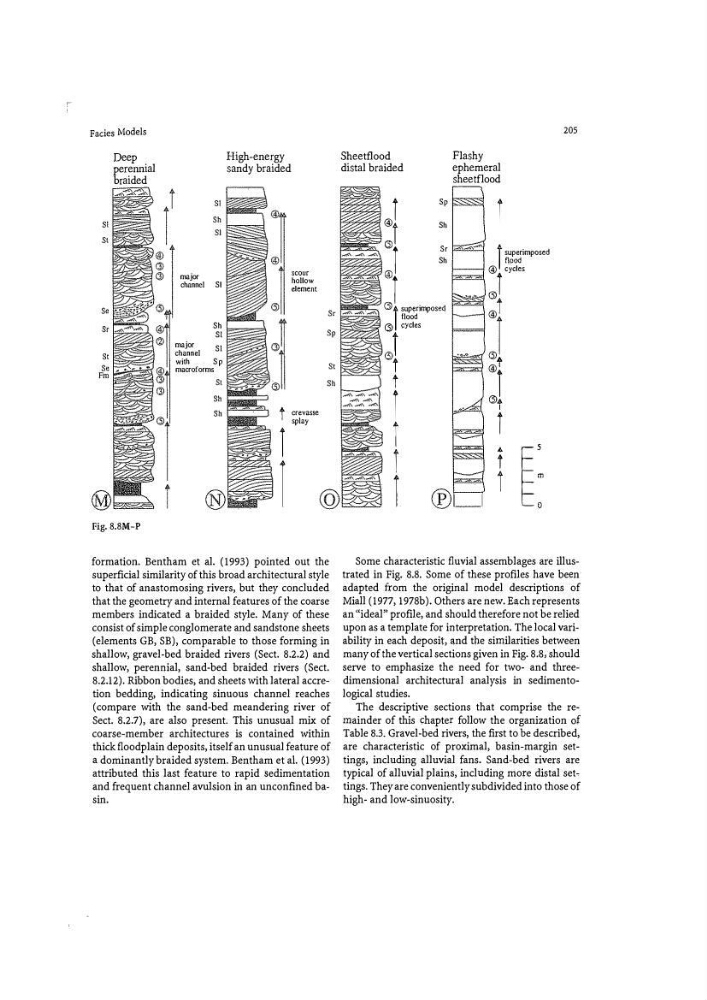
Fig. 8.8M-P
i
major
chnnncl
Sl
Sh
Si
major
Si
channel
with
Sp
macroforms
High-energy
sandy braided
scour
hollow
element
t crevasse
splay
1
r
formation. Bentham et al. (1993) pointed out the
superficial similarity of this broad architectural style
to that of anastomosing rivers, but they concluded
that the geometry and internal features of the coarse
members indicated a braided style. Many of these
consist of simple conglomerate and sandstone sheets
(elements GB, SB), comparable to those forming in
shallow, gravel-bed braided rivers (Sect. 8.2.2) and
shallow, perennial, sand-bed braided rivers (Sect.
8.2.12). Ribbon bodies, and sheets with lateral accretion bedding, indicating sinuous channel reaches
(compare with the sand-bed meandering river of
Sect. 8.2.7), are also present. This unusual mix of
coarse-member architectures is contained within
thick fl oodplain deposits, itself an unusual feature of
a dominantly braided system. Bentham et a!. (1993)
attributed this last feature to rapid sedimentation
and frequent channel avulsion in an unconfined ba�
sin.
205
Sheetflood
Flashy
distal braided
ephemeral
sheetf lood
@ i
Sh
I
Cll i
@i
s,
r superimposed
Sh
f!pod
@ cycles
i
()) i
<3li "perimpo"q
@t
flood
(j) cycles
J
@i
t
@ t
t
(l) I
I
I
i
i
i
A
[
t
I
i
Some characteristic fl uvial assemblages are illustrated in Fig. 8.8. Some of these profiles have been
adapted from the original model descriptions of
Miall (1977, 1978b). Others are new. Each represents
an «ideal" profile, and should therefore not be relied
upon as a template for interpretation. The local variability in each deposit, and the si:milarities between
many of the vertical sections given in Fig. 8.8, should
serve to emphasize the need for two- and threedimensional architectural analysis in sedimentological studies.
The descriptive sections that comprise the remainder of this c;:hapte.r follow the organization of
Table 8.3. Gravel-bed rivers, the first to be described,
are characteristic of proximal, basin-margin settings, including alluvial fans. Sand-bed rivers are
typical of alluvial plains, including more distal set.
tings. They are conveniently subdivided into those of
high- and low-sinuosity.
Deep
perennial
braided
Fig. 8.8M-P
i
major
chnnncl
Sl
Sh
Si
major
Si
channel
with
Sp
macroforms
High-energy
sandy braided
scour
hollow
element
t crevasse
splay
1
r
formation. Bentham et al. (1993) pointed out the
superficial similarity of this broad architectural style
to that of anastomosing rivers, but they concluded
that the geometry and internal features of the coarse
members indicated a braided style. Many of these
consist of simple conglomerate and sandstone sheets
(elements GB, SB), comparable to those forming in
shallow, gravel-bed braided rivers (Sect. 8.2.2) and
shallow, perennial, sand-bed braided rivers (Sect.
8.2.12). Ribbon bodies, and sheets with lateral accretion bedding, indicating sinuous channel reaches
(compare with the sand-bed meandering river of
Sect. 8.2.7), are also present. This unusual mix of
coarse-member architectures is contained within
thick fl oodplain deposits, itself an unusual feature of
a dominantly braided system. Bentham et a!. (1993)
attributed this last feature to rapid sedimentation
and frequent channel avulsion in an unconfined ba�
sin.
205
Sheetflood
Flashy
distal braided
ephemeral
sheetf lood
@ i
Sh
I
Cll i
@i
s,
r superimposed
Sh
f!pod
@ cycles
i
()) i
<3li "perimpo"q
@t
flood
(j) cycles
J
@i
t
@ t
t
(l) I
I
I
i
i
i
A
[
t
I
i
Some characteristic fl uvial assemblages are illustrated in Fig. 8.8. Some of these profiles have been
adapted from the original model descriptions of
Miall (1977, 1978b). Others are new. Each represents
an «ideal" profile, and should therefore not be relied
upon as a template for interpretation. The local variability in each deposit, and the si:milarities between
many of the vertical sections given in Fig. 8.8, should
serve to emphasize the need for two- and threedimensional architectural analysis in sedimentological studies.
The descriptive sections that comprise the remainder of this c;:hapte.r follow the organization of
Table 8.3. Gravel-bed rivers, the first to be described,
are characteristic of proximal, basin-margin settings, including alluvial fans. Sand-bed rivers are
typical of alluvial plains, including more distal set.
tings. They are conveniently subdivided into those of
high- and low-sinuosity.