

198
Fluvial Styles and Facies Models
Table 8.2. Classification of alluvial channels by geometric characteristics. (Rust 1978a)
Low sinuosity
(P < 1.5)
High sinuosity
(P > 1.5)
'·'
1!.2
"'
0
:::>
Z
L!
"'
Single�channel
Multichannel
(braiding parameter < 1)
(braiding parameter > 1)
Straight
Braided
Meandering
Anastomosing
BRAIDED
0
0o}--------o� . �.------�o� . �.------�, � . 2�------� , � .• �------� , �. o�
SLOPE(%)
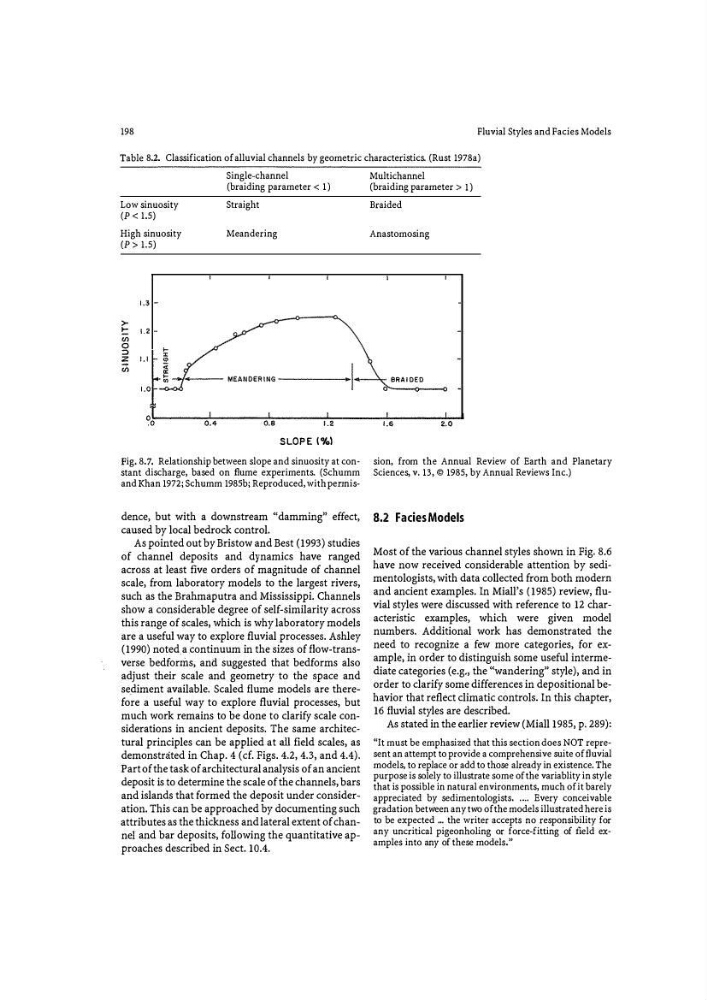
Fig. 8.7. Relationship between slope and sinuosity at constant discharge, based on flume experiments. (Schumm
and Khan 1972; Schumm 198Sb; Reproduced, with pennisdence, but with a downstream "damming" effect,
caused by local bedrock control.
As pointed out by Bristow and Best (1993) studies
of channel deposits and dynamics have ranged
across at least five orders of magnitude of channel
scale, from laboratory models to the largest rivers,
such as the Brahmaputra and Mississippi. Channels
show a considerable degree of self-similarity across
this range of scales, which is why laboratory models
are a useful way to explore fluvial processes. Ashley
(1990) noted.a . continuum in the sizes of flow-transverse bedforms, and suggested that bedforms also
adjust their scale and geometry to the space and
se. diment available. Scaled flume models are therefore a useful way to explore fluvial processes, but
much work remains to be done to clarify scale considerations in ancient deposits. The same architectural principles can be applied at all field scales, as
demonstrated in Chap. 4 ( cf. Figs. 4.2, 4.3, and 4.4).
Part of the task of architectural analysis of an ancient
deposit is to determine the scale of the channels, bars
and islands that formed the deposit under consideration. This can be approached by documenting such
attributes as the thickness and lateral extent of channel and bar deposits, following the quantitative approaches described in Sect. 10.4.
sion, from the Annual Review of Earth and Planetary
Sciences, v. 13, © 1985, by Annual Reviews Inc.)
8.2 Facies Models
Most of the various channel styles shown in Fig. 8.6
have now received considerable attention by sedimentologists, with data collected from both modern
and ancient examples. In Miall's (1985) review, fluvial styles were discussed with reference to 12 characteristic examples, which were given model
numbers. Additional work has demonstrated the
need to recognize a few more categories, for example, in order to distinguish some useful intermediate categories (e.g., the <'wandering" style), and in
order to clarify some differences in depositional behavior that reflect climatic controls. In this chapter,
16 fluvial styles are described.
As stated in the earlier review (Miall1985, p. 289):
"It must be emphasized that this section does NOT represent an attempt to provide a comprehensive suite of fl uvial
models, to replace or add to those already in existence. The
purpose is solely to illustrate some of the variablity in style
that is possible in natural environments, much of it barely
appreciated by sedimentologists . .... Every conceivable
gradation between any two of the models illustrated here is
to be expected ... the writer accepts no responsibility for
any uncritical pigeonholing or force-fitting of field examples into any of these models."
Fluvial Styles and Facies Models
Table 8.2. Classification of alluvial channels by geometric characteristics. (Rust 1978a)
Low sinuosity
(P < 1.5)
High sinuosity
(P > 1.5)
'·'
1!.2
"'
0
:::>
Z
L!
"'
Single�channel
Multichannel
(braiding parameter < 1)
(braiding parameter > 1)
Straight
Braided
Meandering
Anastomosing
BRAIDED
0
0o}--------o� . �.------�o� . �.------�, � . 2�------� , � .• �------� , �. o�
SLOPE(%)
Fig. 8.7. Relationship between slope and sinuosity at constant discharge, based on flume experiments. (Schumm
and Khan 1972; Schumm 198Sb; Reproduced, with pennisdence, but with a downstream "damming" effect,
caused by local bedrock control.
As pointed out by Bristow and Best (1993) studies
of channel deposits and dynamics have ranged
across at least five orders of magnitude of channel
scale, from laboratory models to the largest rivers,
such as the Brahmaputra and Mississippi. Channels
show a considerable degree of self-similarity across
this range of scales, which is why laboratory models
are a useful way to explore fluvial processes. Ashley
(1990) noted.a . continuum in the sizes of flow-transverse bedforms, and suggested that bedforms also
adjust their scale and geometry to the space and
se. diment available. Scaled flume models are therefore a useful way to explore fluvial processes, but
much work remains to be done to clarify scale considerations in ancient deposits. The same architectural principles can be applied at all field scales, as
demonstrated in Chap. 4 ( cf. Figs. 4.2, 4.3, and 4.4).
Part of the task of architectural analysis of an ancient
deposit is to determine the scale of the channels, bars
and islands that formed the deposit under consideration. This can be approached by documenting such
attributes as the thickness and lateral extent of channel and bar deposits, following the quantitative approaches described in Sect. 10.4.
sion, from the Annual Review of Earth and Planetary
Sciences, v. 13, © 1985, by Annual Reviews Inc.)
8.2 Facies Models
Most of the various channel styles shown in Fig. 8.6
have now received considerable attention by sedimentologists, with data collected from both modern
and ancient examples. In Miall's (1985) review, fluvial styles were discussed with reference to 12 characteristic examples, which were given model
numbers. Additional work has demonstrated the
need to recognize a few more categories, for example, in order to distinguish some useful intermediate categories (e.g., the <'wandering" style), and in
order to clarify some differences in depositional behavior that reflect climatic controls. In this chapter,
16 fluvial styles are described.
As stated in the earlier review (Miall1985, p. 289):
"It must be emphasized that this section does NOT represent an attempt to provide a comprehensive suite of fl uvial
models, to replace or add to those already in existence. The
purpose is solely to illustrate some of the variablity in style
that is possible in natural environments, much of it barely
appreciated by sedimentologists . .... Every conceivable
gradation between any two of the models illustrated here is
to be expected ... the writer accepts no responsibility for
any uncritical pigeonholing or force-fitting of field examples into any of these models."