

Biochemical Sediments
ATLANTIC OCEAN
OM
LEGE NO
II: SPQII(.CL.AR!T( + CUIIOCI.A�ITE
B : RJS!TO·Cl.l�IT£
C : YIUO.(:l.A�IT( t CUT!Clt Cl.AAITt
Skm
0: Cl.A�ODU�!Tt+OUR!lt+ C.O.R!IAAOllt.IT£
fl�= fORC!T T(R�UTIIIA� MOOR
f M:: FOUST MOOR
Ru: RUOMOOR
0�:: 01'1;14 MOOR
1-7:: FtTROCRIIPHIC lNT[RVAl$
183
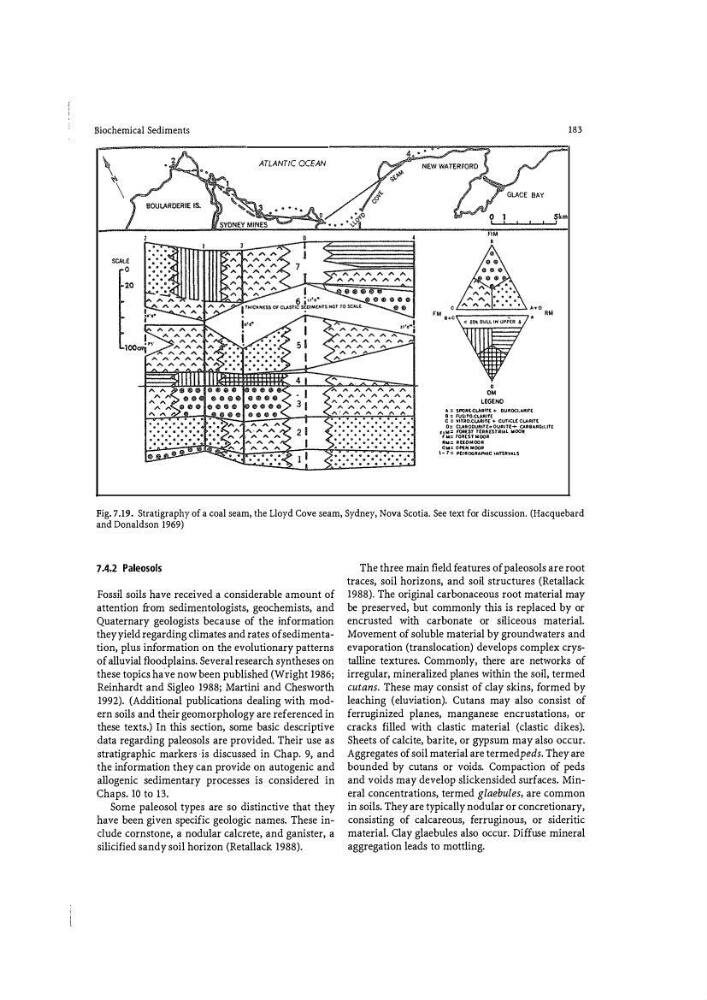
Fig. 7.19. Stratigraphy of a coal seam, the Lloyd Cove seam, Sydney, Nova Scotia. See text for discussion. (Hacquebard
and Donaldson 1969)
7 .4.2 Paleosols
Fossil soils have received a considerable amount of
attention fr om sedimentologists, geochemists, and
Quaternary geologists because of the information
they yield regarding climates and rates of sedimentation, plus information on the evolutionary patterns
of alluvial floodplains. Several research syntheses on
these topics have now been published (Wright 1986;
Reinhardt and Sigleo 1988; Martini and Chesworth
1992). (Additional publications dealing with modern soils and their geomorphology are referenced in
these texts.) In this section, some basic descriptive
data regarding paleosols are provided. Their use as
stratigraphic markers · is discussed in Chap. 9, and
the information they can provide on autogenic and
allogenic sedimentary processes is considered in
Chaps. 10 to 13.
Some paleosol types are so distinctive that they
have been given specific geologic names. These indude cornstone, a nodular calcrete, and ganister, a
silicified sandy soil horizon (Retallack 1988).
The three main fi eld fe atures of paleosols are root
traces, soil horizons, and soil structures (Retallack
1988). The original carbonaceous root material may
be preserved, but commonly this is replaced by or
encrusted with carbonate or siliceous material.
Movement of soluble material by groundwaters and
evaporation (translocation) develops complex crystalline textures. Commonly, there are networks of
irregular, mineralized planes within the soil, termed
cutans. These may consist of clay skins, formed by
leaching ( eluviation). Cutans may also consist of
ferruginized planes, manganese encrustations, or
cracks filled with clastic material (clastic dikes).
Sheets of calcite, barite, or gyp sum may also occur.
Aggregates of soil material are termed peds. They are
bounded by cutans or voids. Compaction of peds
and voids may develop slickensided surfaces. Mineral concentrations, termed glaebules, are common
in soils. They are typically nodular or concretionary,
consisting of calcareous, ferruginous, or sideritic
material. Clay glaebules also occur. Diffuse mineral
aggregation leads to mottling.
ATLANTIC OCEAN
OM
LEGE NO
II: SPQII(.CL.AR!T( + CUIIOCI.A�ITE
B : RJS!TO·Cl.l�IT£
C : YIUO.(:l.A�IT( t CUT!Clt Cl.AAITt
Skm
0: Cl.A�ODU�!Tt+OUR!lt+ C.O.R!IAAOllt.IT£
fl�= fORC!T T(R�UTIIIA� MOOR
f M:: FOUST MOOR
Ru: RUOMOOR
0�:: 01'1;14 MOOR
1-7:: FtTROCRIIPHIC lNT[RVAl$
183
Fig. 7.19. Stratigraphy of a coal seam, the Lloyd Cove seam, Sydney, Nova Scotia. See text for discussion. (Hacquebard
and Donaldson 1969)
7 .4.2 Paleosols
Fossil soils have received a considerable amount of
attention fr om sedimentologists, geochemists, and
Quaternary geologists because of the information
they yield regarding climates and rates of sedimentation, plus information on the evolutionary patterns
of alluvial floodplains. Several research syntheses on
these topics have now been published (Wright 1986;
Reinhardt and Sigleo 1988; Martini and Chesworth
1992). (Additional publications dealing with modern soils and their geomorphology are referenced in
these texts.) In this section, some basic descriptive
data regarding paleosols are provided. Their use as
stratigraphic markers · is discussed in Chap. 9, and
the information they can provide on autogenic and
allogenic sedimentary processes is considered in
Chaps. 10 to 13.
Some paleosol types are so distinctive that they
have been given specific geologic names. These indude cornstone, a nodular calcrete, and ganister, a
silicified sandy soil horizon (Retallack 1988).
The three main fi eld fe atures of paleosols are root
traces, soil horizons, and soil structures (Retallack
1988). The original carbonaceous root material may
be preserved, but commonly this is replaced by or
encrusted with carbonate or siliceous material.
Movement of soluble material by groundwaters and
evaporation (translocation) develops complex crystalline textures. Commonly, there are networks of
irregular, mineralized planes within the soil, termed
cutans. These may consist of clay skins, formed by
leaching ( eluviation). Cutans may also consist of
ferruginized planes, manganese encrustations, or
cracks filled with clastic material (clastic dikes).
Sheets of calcite, barite, or gyp sum may also occur.
Aggregates of soil material are termed peds. They are
bounded by cutans or voids. Compaction of peds
and voids may develop slickensided surfaces. Mineral concentrations, termed glaebules, are common
in soils. They are typically nodular or concretionary,
consisting of calcareous, ferruginous, or sideritic
material. Clay glaebules also occur. Diffuse mineral
aggregation leads to mottling.