

Chapter 7
Archited11ra! !Elements illl f the Overbank IEnvimU'Iment
7.1 Introduction
In contrast to the considerable amount of research
devoted to the study of channel-fill sediments,
overbanl,< deposits have received much less attention, as has been noted by several researchers (e.g.,
Farrell 1987; Kraus 1987; Kraus and Bown 1988). The
main exception to this is a recent focus on paleosols,
stimulated by their use as lithostratigraphic and time
markers (Sects. 7.4.2, 9.5.1, 10.4.3) and as climatic
indicators (Sect. 12.9.2). In the original architectural-element classification (Miall 1985), overbank
deposits were assigned to a single element, designated OF. This is dearly inadequate as many researchers have pointed out. In fact, deposits formed
outside the main fluvial channels can be classified
into three broad classes.
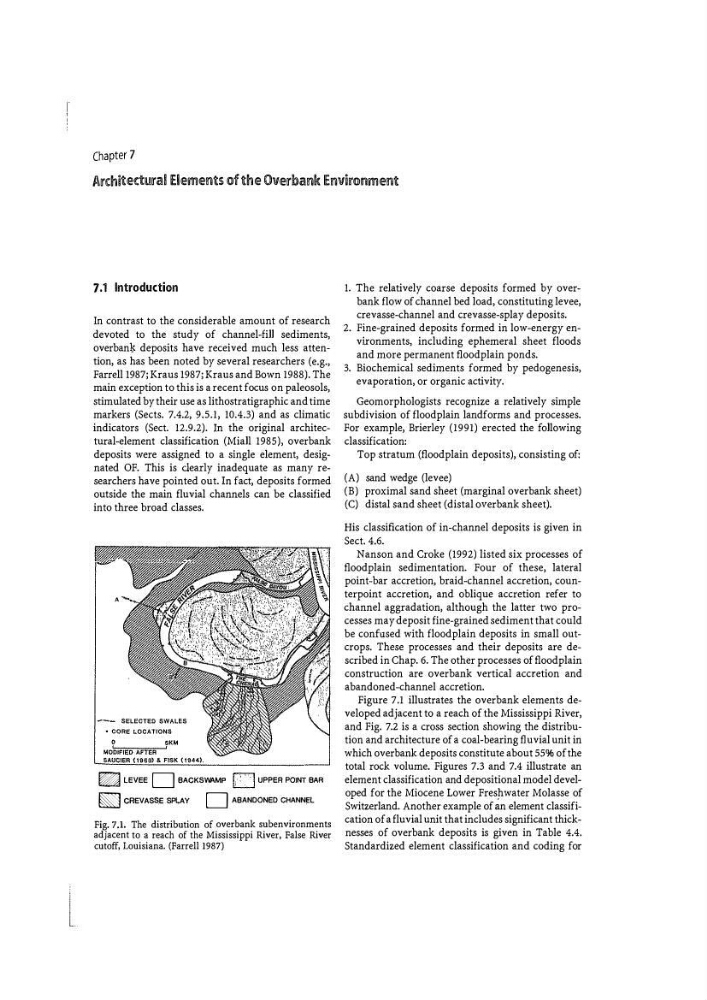
• LEVEE D BACKSWAMP D UPPER POINT BAA
� CREVASS:E SPLAY D ABANDONED CHANN�L
Fig. 7.1. The distribution of overbank subenvironments
adjacent to a reach of the Mississippi River, False River
cutoff, Louisiana. (Farrell 1987)
1. The relatively coarse deposits formed by overbank flow of channel bed load, constituting levee,
crevasse-channel and crevasse-splay deposits.
2. Fine-grained deposits formed in low-energy environments, including ephemeral sheet floods
and more permanent floodplain ponds.
3. Biochemical sediments formed by pedogenesis,
evaporation, or organic activity.
Geomorphologists recognize a relatively simple
subdivision of floodplain landforms and processes.
For example, Brierley (1991) erected the following
classification:
Top stratum (floodplain deposits), consisting of:
(A) sand wedge (levee)
(B) proximal sand sheet (marginal overbank sheet)
(C) distal sand sheet (distal overbank sheet).
His classification of in-channel deposits is given in
Sect. 4.6.
Nanson and Croke (1992) listed six processes of
floodplain sedimentation. Four of these, lateral
point-bar accretion, braid-channel accretion, counterpoint accretion, and oblique accretion refer to
channel aggradation, although the latter two processes may deposit fine-grained sediment that could
be confused with floodplain deposits in small outcrops. These processes and their deposits are described in Chap. 6. The other processes of floodplain
construction are overbank vertical accretion and
abandoned-channel accretion.
Figure 7.1 illustrates the overbank elements developed adjacent to a reach of the Mississippi River,
and Fig. 7.2 is a cross section showing the distribution and architecture of a coal-bearing fl uvial unit in
which overbank deposits constitute about SSo/o of the
total rock volume. Figures 7.3 and 7.4 illustrate an
element classification and depositional model developed for the Miocene Lower Freshwater Molasse of
Switzerland. Another example of � n element classification of a fluvial unit that includes significant thicknesses of overbank deposits is given in Table 4.4.
Standardized element classification and coding for
Archited11ra! !Elements illl f the Overbank IEnvimU'Iment
7.1 Introduction
In contrast to the considerable amount of research
devoted to the study of channel-fill sediments,
overbanl,< deposits have received much less attention, as has been noted by several researchers (e.g.,
Farrell 1987; Kraus 1987; Kraus and Bown 1988). The
main exception to this is a recent focus on paleosols,
stimulated by their use as lithostratigraphic and time
markers (Sects. 7.4.2, 9.5.1, 10.4.3) and as climatic
indicators (Sect. 12.9.2). In the original architectural-element classification (Miall 1985), overbank
deposits were assigned to a single element, designated OF. This is dearly inadequate as many researchers have pointed out. In fact, deposits formed
outside the main fluvial channels can be classified
into three broad classes.
• LEVEE D BACKSWAMP D UPPER POINT BAA
� CREVASS:E SPLAY D ABANDONED CHANN�L
Fig. 7.1. The distribution of overbank subenvironments
adjacent to a reach of the Mississippi River, False River
cutoff, Louisiana. (Farrell 1987)
1. The relatively coarse deposits formed by overbank flow of channel bed load, constituting levee,
crevasse-channel and crevasse-splay deposits.
2. Fine-grained deposits formed in low-energy environments, including ephemeral sheet floods
and more permanent floodplain ponds.
3. Biochemical sediments formed by pedogenesis,
evaporation, or organic activity.
Geomorphologists recognize a relatively simple
subdivision of floodplain landforms and processes.
For example, Brierley (1991) erected the following
classification:
Top stratum (floodplain deposits), consisting of:
(A) sand wedge (levee)
(B) proximal sand sheet (marginal overbank sheet)
(C) distal sand sheet (distal overbank sheet).
His classification of in-channel deposits is given in
Sect. 4.6.
Nanson and Croke (1992) listed six processes of
floodplain sedimentation. Four of these, lateral
point-bar accretion, braid-channel accretion, counterpoint accretion, and oblique accretion refer to
channel aggradation, although the latter two processes may deposit fine-grained sediment that could
be confused with floodplain deposits in small outcrops. These processes and their deposits are described in Chap. 6. The other processes of floodplain
construction are overbank vertical accretion and
abandoned-channel accretion.
Figure 7.1 illustrates the overbank elements developed adjacent to a reach of the Mississippi River,
and Fig. 7.2 is a cross section showing the distribution and architecture of a coal-bearing fl uvial unit in
which overbank deposits constitute about SSo/o of the
total rock volume. Figures 7.3 and 7.4 illustrate an
element classification and depositional model developed for the Miocene Lower Freshwater Molasse of
Switzerland. Another example of � n element classification of a fluvial unit that includes significant thicknesses of overbank deposits is given in Table 4.4.
Standardized element classification and coding for