

Downstream�Accretion Macro forms (Element DA)
SYMMETRICAL
€XAMPLES OF COMPLEX SAND FLATS
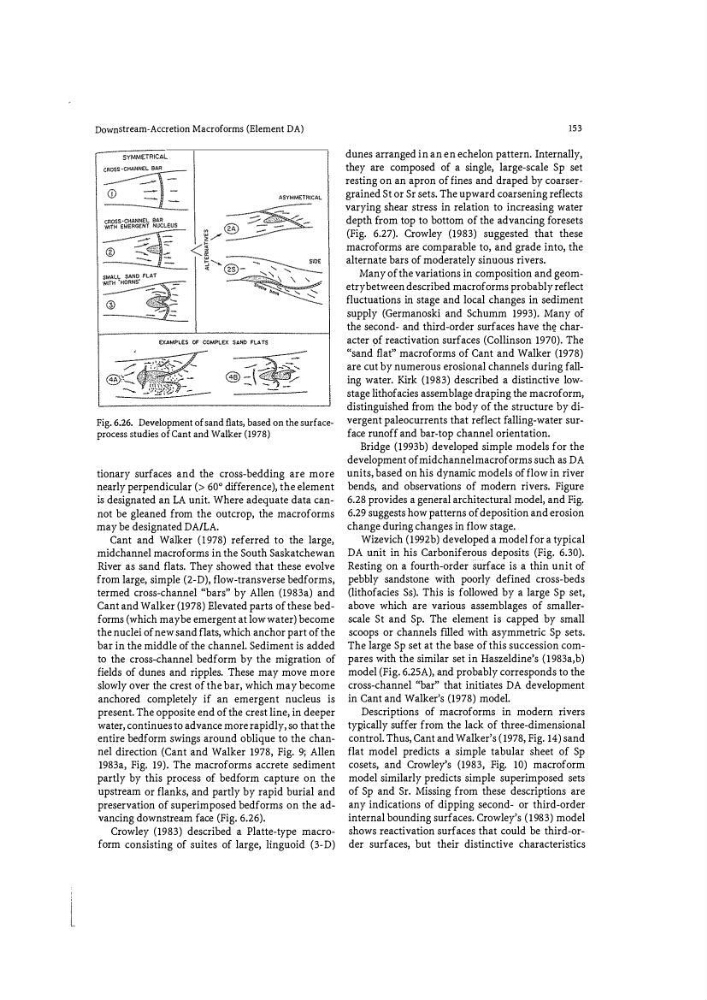
Fig. 6.26. Development of sand flats, based on the surfaceprocess studies of Cant and Walker (1978)
tionary surfaces and the cross-bedding are more
nearly perpendicular (> 60° difference), the element
is designated an LA unit. Where adequate data cannot be gleaned from the outcrop, the macroforms
may be designated DA/LA.
Cant and Walker (!978) referred to the large,
midchannel macroforms in the South Saskatchewan
River as sand flats. They showed that these evolve
from large, simple (2-D), flow-transverse bedforms,
termed cross-channel "bars" by Allen (!983a) and
Cant and Walker (1978) Elevated parts of these bedforms (which maybe emergent at low water) become
the nuclei of new sand flats, which anchor part of the
bar in the middle of the channel. Sediment is added
to the cross-channel bedform by the migration of
fields of dunes and ripples. These may move more
slowly over the crest of the bar, which may become
anchored completely if an emergent nucleus is
present. The opposite end of the crest line, in deeper
water, continues to advance more rapidly, so that the
entire bedform swings around oblique to the channel direction (Cant and Walker 1978, Fig. 9; Allen
1983a, Fig. 19). The macroforms accrete sediment
partly by this process of bedform capture on the
upstream or flanks, and partly by rapid burial and
preservation of superimposed bedforms on the advancing downstream face (Fig. 6.26).
Crowley (1983) described a Platte-type macroform consisting of suites of large, Hnguoid (3-D)
!53
dunes arranged in an en echelon pattern. Internally,
they are composed of a single, large-scale Sp set
resting on an apron of fines and draped by coarsergrained St or Sr sets. The upward coarsening reflects
varying shear stress in relation to increasing water
depth from top to bottom of the advancing fo resets
(Fig. 6.27). Crowley (1983) suggested that these
macroforms are comparable to, and grade into, the
alternate bars of moderately sinuous rivers.
Many of the variations in composition and geom�
etry between described macroforms probably reflect
fluctuations in stage and local changes in sediment
supply (Germanoski and Schumm 1993). Many of
the second� and third-order surfaces have th� character 9f reactivation surfaces (Collinson 1970). The
"sand fl at" macroforms of Cant and Walker (1978)
are cut by numerous erosional channels during falling water. Kirk (1983) described a distinctive lowstage lithofacies assemblage draping the macroform,
distinguished fr om the body of the structure by divergent paleocurrents that reflect falling-water surface runoff and bar-top channel orientation.
Bridge (1993b) developed simple models for the
development of midchannel macroforms such as DA
units, based on his dynamic models of flow in river
bends, and observations of modern rivers. Figure
6.28 provides a general architectural model, and Fig.
6.29 suggests how patterns of deposition and erosion
change during changes in flow stage.
Wizevich (1992b) developed a model for a typical
DA unit in his Carboniferous deposits (Fig. 6.30).
Resting on a fourth-order surface is a thin unit of
pebbly sandstone with poorly defined cross-beds
(lithofacies Ss). This is followed by a large Sp set,
above which are various assemblages of smallerscale St and Sp. The element is capped by small
scoops or channels filled with asymmetric Sp sets.
The large Sp set at the base of this succession compares with the similar set in Haszeldine's (1983a,b)
model (Fig. 6.25A), and probably corresponds to the
cross-channel "bar" that initiates DA development
in Cant and Walker's (1978) model.
Descriptions of macroforms in modern rivers
typically suffer from the lack of three-dimensional
control. Thus, Cant and Walker's (1978, Fig. 14) sand
flat model predicts a simple tabular sheet of Sp
cosets, and Crowley's (1983, Fig. 10) macroform
model similarly predicts simple superimposed sets
of Sp and Sr. Missing from these descriptions are
any indications of dipping second- or third-order
internal bounding surfaces. Crowley's (1983) model
shows reactivation surfaces that could be third-order surfaces, but their distinctive characteristics
SYMMETRICAL
€XAMPLES OF COMPLEX SAND FLATS
Fig. 6.26. Development of sand flats, based on the surfaceprocess studies of Cant and Walker (1978)
tionary surfaces and the cross-bedding are more
nearly perpendicular (> 60° difference), the element
is designated an LA unit. Where adequate data cannot be gleaned from the outcrop, the macroforms
may be designated DA/LA.
Cant and Walker (!978) referred to the large,
midchannel macroforms in the South Saskatchewan
River as sand flats. They showed that these evolve
from large, simple (2-D), flow-transverse bedforms,
termed cross-channel "bars" by Allen (!983a) and
Cant and Walker (1978) Elevated parts of these bedforms (which maybe emergent at low water) become
the nuclei of new sand flats, which anchor part of the
bar in the middle of the channel. Sediment is added
to the cross-channel bedform by the migration of
fields of dunes and ripples. These may move more
slowly over the crest of the bar, which may become
anchored completely if an emergent nucleus is
present. The opposite end of the crest line, in deeper
water, continues to advance more rapidly, so that the
entire bedform swings around oblique to the channel direction (Cant and Walker 1978, Fig. 9; Allen
1983a, Fig. 19). The macroforms accrete sediment
partly by this process of bedform capture on the
upstream or flanks, and partly by rapid burial and
preservation of superimposed bedforms on the advancing downstream face (Fig. 6.26).
Crowley (1983) described a Platte-type macroform consisting of suites of large, Hnguoid (3-D)
!53
dunes arranged in an en echelon pattern. Internally,
they are composed of a single, large-scale Sp set
resting on an apron of fines and draped by coarsergrained St or Sr sets. The upward coarsening reflects
varying shear stress in relation to increasing water
depth from top to bottom of the advancing fo resets
(Fig. 6.27). Crowley (1983) suggested that these
macroforms are comparable to, and grade into, the
alternate bars of moderately sinuous rivers.
Many of the variations in composition and geom�
etry between described macroforms probably reflect
fluctuations in stage and local changes in sediment
supply (Germanoski and Schumm 1993). Many of
the second� and third-order surfaces have th� character 9f reactivation surfaces (Collinson 1970). The
"sand fl at" macroforms of Cant and Walker (1978)
are cut by numerous erosional channels during falling water. Kirk (1983) described a distinctive lowstage lithofacies assemblage draping the macroform,
distinguished fr om the body of the structure by divergent paleocurrents that reflect falling-water surface runoff and bar-top channel orientation.
Bridge (1993b) developed simple models for the
development of midchannel macroforms such as DA
units, based on his dynamic models of flow in river
bends, and observations of modern rivers. Figure
6.28 provides a general architectural model, and Fig.
6.29 suggests how patterns of deposition and erosion
change during changes in flow stage.
Wizevich (1992b) developed a model for a typical
DA unit in his Carboniferous deposits (Fig. 6.30).
Resting on a fourth-order surface is a thin unit of
pebbly sandstone with poorly defined cross-beds
(lithofacies Ss). This is followed by a large Sp set,
above which are various assemblages of smallerscale St and Sp. The element is capped by small
scoops or channels filled with asymmetric Sp sets.
The large Sp set at the base of this succession compares with the similar set in Haszeldine's (1983a,b)
model (Fig. 6.25A), and probably corresponds to the
cross-channel "bar" that initiates DA development
in Cant and Walker's (1978) model.
Descriptions of macroforms in modern rivers
typically suffer from the lack of three-dimensional
control. Thus, Cant and Walker's (1978, Fig. 14) sand
flat model predicts a simple tabular sheet of Sp
cosets, and Crowley's (1983, Fig. 10) macroform
model similarly predicts simple superimposed sets
of Sp and Sr. Missing from these descriptions are
any indications of dipping second- or third-order
internal bounding surfaces. Crowley's (1983) model
shows reactivation surfaces that could be third-order surfaces, but their distinctive characteristics