

Downstream-Accretion Macroforms (Element DA)
this case1 the deposits can be interpreted as alternate
bars, they should be assigned to a category of
macrofonn rather than to element SB (see Sect. 6.7).
6.6 Downstream-Accretion Maw>forms
(EiemeB1t DA)
Downstream-accretion and lateral-accretion deposits are the principal products of accretion within the
bar complexes of major sand-bed channels. Upstream accretion also may occur locally (e.g., Bristow
1987, 1993). The bars are scaled to the size of the
containing channe11 and their height is a rough guide
to minimum channel depth. Three-dimensional ar151
chitectural analysis is essential for complete descrip�
tion of these deposits because, unlike elements GB,
SG and SB, they contain significant internal threedimensional geometrical complexities. Large compound bar forms have been described fr om many
modern rivers (Fig. 6.23 ), including the side bars of
the Tana (Collinson 1970), the sand flats of the South
Saskatchewan (Cant and Walker 1978), and the sand
waves of the Brahmaputra, as reinterpreted by
Bristow (1987, 1993). The bars are characteristically
1-15 m high and 10-1000 m long. The maximum
recorded height and length refer to the bars of the
Brahmaputra. It is only in recent years that such
large-scale deposits have been described in ancient
deposits. Research by the author indicates that DA
and LA elements are very common in braided sheet
5-100 m
(1 ,2) cross-bed set
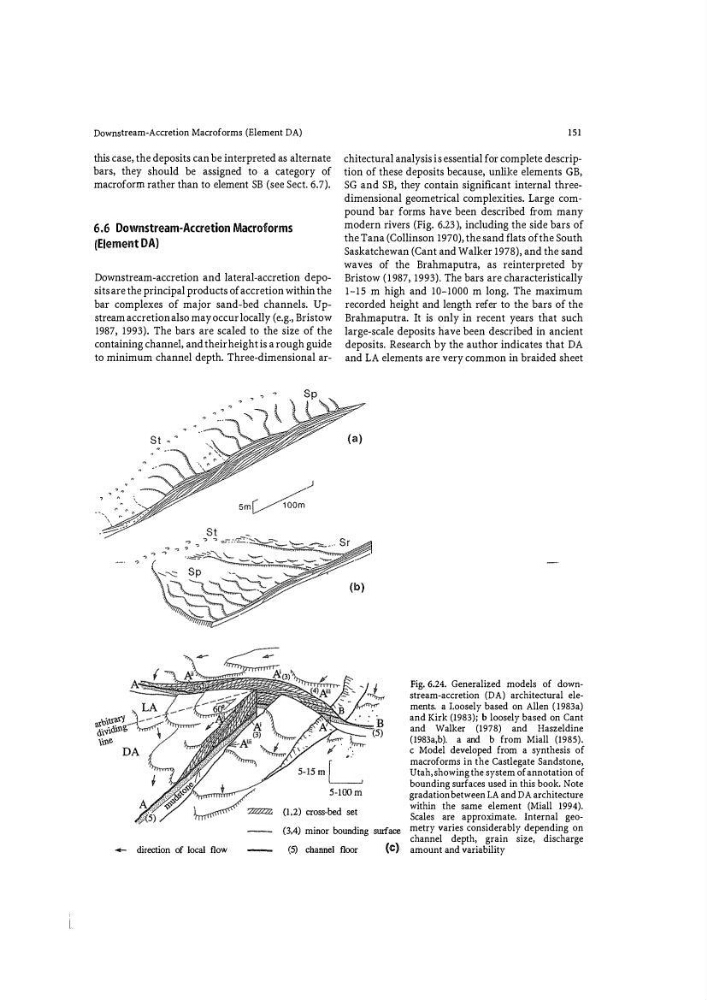
Fig. 6.24. Generalized models of downstream-accretion (DA) architectural elements. a Loosely based on Allen (1983a)
and Kirk (1983); b loosely based on Cant
and Walker (1978) and Haszeldine
(1983a,b). a and b from Miall (1985).
c Model developed from a synthesis of
macroforms in the Castlegate Sandstone,
Utah, showing the system of annotation of
bounding surfaces used in this book. Note
gradation between LA and DA architecture
within the same element (Miall 1994).
Scales are approximate. Internal geometry varies considerably depending on
channel depth, grain size, discharge
amount and variability
-cEdirection of local flow
(3,4) minor bounding surface
(5) channel floor
(C)
this case1 the deposits can be interpreted as alternate
bars, they should be assigned to a category of
macrofonn rather than to element SB (see Sect. 6.7).
6.6 Downstream-Accretion Maw>forms
(EiemeB1t DA)
Downstream-accretion and lateral-accretion deposits are the principal products of accretion within the
bar complexes of major sand-bed channels. Upstream accretion also may occur locally (e.g., Bristow
1987, 1993). The bars are scaled to the size of the
containing channe11 and their height is a rough guide
to minimum channel depth. Three-dimensional ar151
chitectural analysis is essential for complete descrip�
tion of these deposits because, unlike elements GB,
SG and SB, they contain significant internal threedimensional geometrical complexities. Large compound bar forms have been described fr om many
modern rivers (Fig. 6.23 ), including the side bars of
the Tana (Collinson 1970), the sand flats of the South
Saskatchewan (Cant and Walker 1978), and the sand
waves of the Brahmaputra, as reinterpreted by
Bristow (1987, 1993). The bars are characteristically
1-15 m high and 10-1000 m long. The maximum
recorded height and length refer to the bars of the
Brahmaputra. It is only in recent years that such
large-scale deposits have been described in ancient
deposits. Research by the author indicates that DA
and LA elements are very common in braided sheet
5-100 m
(1 ,2) cross-bed set
Fig. 6.24. Generalized models of downstream-accretion (DA) architectural elements. a Loosely based on Allen (1983a)
and Kirk (1983); b loosely based on Cant
and Walker (1978) and Haszeldine
(1983a,b). a and b from Miall (1985).
c Model developed from a synthesis of
macroforms in the Castlegate Sandstone,
Utah, showing the system of annotation of
bounding surfaces used in this book. Note
gradation between LA and DA architecture
within the same element (Miall 1994).
Scales are approximate. Internal geometry varies considerably depending on
channel depth, grain size, discharge
amount and variability
-cEdirection of local flow
(3,4) minor bounding surface
(5) channel floor
(C)