

108
Lithofa cies Gem: Clast-Supported, Massive Gravel.
This lithofacies represents low-strength, pseudoplastic debris flows, deposited from viscous, laminar
or turbulent flows.
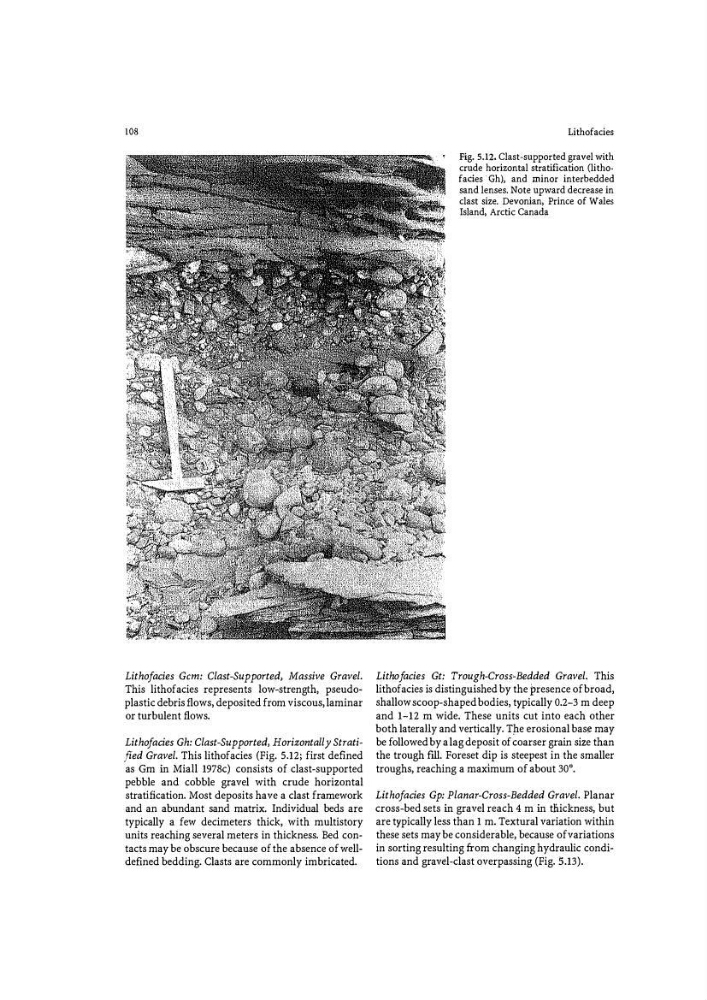
Lithofa cies Gh: Clast-Supported, Horizontally Stratifi ed Gravel. This lithofacies (Fig. 5.12; first defined
as Gm in Miall 1978c) consists of clast-supported
pebble and cobble gravel with crude horizontal
stratification. Most deposits have a clast framework
and an abundant sand matrix. Individual beds are
typically a few decimeters thick, with multistory
units reaching several meters in thickness. Bed contacts may be obscure because of the absence of welldefined bedding. Clasts are commonly imbricated.
Lithofacies
Fig. 5.12. Clast-supported gravel with
crude horizontal stratification (lithofades · Gh), and minor interbedded
sand lenses. Note upward decrease in
clast size. Devonian, Prince of Wales
Island, Arctic Canada
Lithofacies Gt: Trough-Cross-Bedded Gravel. This
lithofacies is distingnlshed by the presence of broad,
shallow scoop-shaped bodies, typically 0.2-3 m deep
and 1-12 m wide. These units cut into each other
both latera!iy and verticaliy. The erosional bas� may
be followed by a lag deposit of coarser grain size than
the trough fill . Forese! dip is steepest in the smaller
troughs, reaching a maximum of about 30°.
Lithofa cies Gp: Planar-Cross-Bedded Gravel. Planar
cross�bed sets in gravel reach 4 m in tllickness, but
are typically less than 1 m. Textural variation within
these sets may be considerable, because of variations
in sorting resulting from changing hydraulic conditions and gravel-clast overpassing (Fig. 5.13).
Lithofa cies Gem: Clast-Supported, Massive Gravel.
This lithofacies represents low-strength, pseudoplastic debris flows, deposited from viscous, laminar
or turbulent flows.
Lithofa cies Gh: Clast-Supported, Horizontally Stratifi ed Gravel. This lithofacies (Fig. 5.12; first defined
as Gm in Miall 1978c) consists of clast-supported
pebble and cobble gravel with crude horizontal
stratification. Most deposits have a clast framework
and an abundant sand matrix. Individual beds are
typically a few decimeters thick, with multistory
units reaching several meters in thickness. Bed contacts may be obscure because of the absence of welldefined bedding. Clasts are commonly imbricated.
Lithofacies
Fig. 5.12. Clast-supported gravel with
crude horizontal stratification (lithofades · Gh), and minor interbedded
sand lenses. Note upward decrease in
clast size. Devonian, Prince of Wales
Island, Arctic Canada
Lithofacies Gt: Trough-Cross-Bedded Gravel. This
lithofacies is distingnlshed by the presence of broad,
shallow scoop-shaped bodies, typically 0.2-3 m deep
and 1-12 m wide. These units cut into each other
both latera!iy and verticaliy. The erosional bas� may
be followed by a lag deposit of coarser grain size than
the trough fill . Forese! dip is steepest in the smaller
troughs, reaching a maximum of about 30°.
Lithofa cies Gp: Planar-Cross-Bedded Gravel. Planar
cross�bed sets in gravel reach 4 m in tllickness, but
are typically less than 1 m. Textural variation within
these sets may be considerable, because of variations
in sorting resulting from changing hydraulic conditions and gravel-clast overpassing (Fig. 5.13).