

Evaluation Models
21
Outliers
An outlier is a member of a population with either a relatively small
or large value in comparison with other members of the same population. Outlier characteristics were described by Neyman and Scott
(1971), who defi ned outlier and outlier proneness and demonstrated that
distributions can be classifi ed according to properties of their tails. If
a population distribution has a long tail for the relatively large values
(i.e., a large variance), then there is a higher probability of there being
one or more outliers contained in the population. Both large and small
outliers are observable in many geological populations, but only large
outliers are discussed here.
Outliers can be recognized by plotting a variable on a box plot with
a logarithmic scale. Box plots show where the median of a sample lies,
and how the outliers relate to the median (Velleman and Hoaglin, 1981).
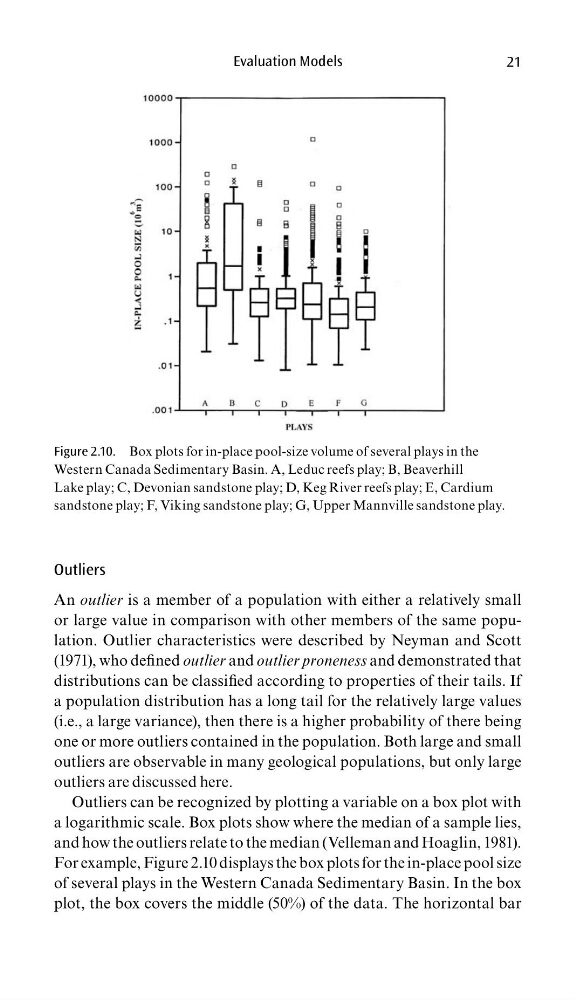
For example, Figure 2.10 displays the box plots for the in-place pool size
of several plays in the Western Canada Sedimentary Basin. In the box
plot, the box covers the middle (50%) of the data. The horizontal bar
Figure 2.10. Box plots for in-place pool-size volume of several plays in the
Western Canada Sedimentary Basin. A, Leduc reefs play; B, Beaverhill
Lake play; C, Devonian sandstone play; D, Keg River reefs play; E, Cardium
sandstone play; F, Viking sandstone play; G, Upper Mannville sandstone play.
21
Outliers
An outlier is a member of a population with either a relatively small
or large value in comparison with other members of the same population. Outlier characteristics were described by Neyman and Scott
(1971), who defi ned outlier and outlier proneness and demonstrated that
distributions can be classifi ed according to properties of their tails. If
a population distribution has a long tail for the relatively large values
(i.e., a large variance), then there is a higher probability of there being
one or more outliers contained in the population. Both large and small
outliers are observable in many geological populations, but only large
outliers are discussed here.
Outliers can be recognized by plotting a variable on a box plot with
a logarithmic scale. Box plots show where the median of a sample lies,
and how the outliers relate to the median (Velleman and Hoaglin, 1981).
For example, Figure 2.10 displays the box plots for the in-place pool size
of several plays in the Western Canada Sedimentary Basin. In the box
plot, the box covers the middle (50%) of the data. The horizontal bar
Figure 2.10. Box plots for in-place pool-size volume of several plays in the
Western Canada Sedimentary Basin. A, Leduc reefs play; B, Beaverhill
Lake play; C, Devonian sandstone play; D, Keg River reefs play; E, Cardium
sandstone play; F, Viking sandstone play; G, Upper Mannville sandstone play.