

Pool Size Conditional on Pool Ranks
209
For
2.
r < r 1 and x 1 < x < ∞,
(
)
( )
( ) ( )
( ) ( )
( )
( )
( )
1
1
1
1
1
1
1
1
1
, ,
h
r
r
k
r
j
H x
H x
H x
r
f x x
x
x
r r
r
H x
G
G
G
− −
−
−
−
=
×
−
!
r
(D.2)
For
3.
r > r k and 0 < x < x k ,
(
)
( )
(
) (
)
( )
( ) ( )
( ) (
)
1
1
1
, ,
1
1
h
P
k
n r
k
r
n r
k
r r
k
n
f x x
x
C
H x
n r
r r
H x H x
x
N n
`
G
G
G
−
=
− −
+
=
−
− +
−
×
−
=
∑
!
(D.3)
where
[
]
1
( 1) 1
( )
P(
)
(
1 )
k
n r
r
k
n r
k
n
C
Hx
N n
n r
−
−
=
+
=
−
=
− +
∑
`
G
G
(D.4)
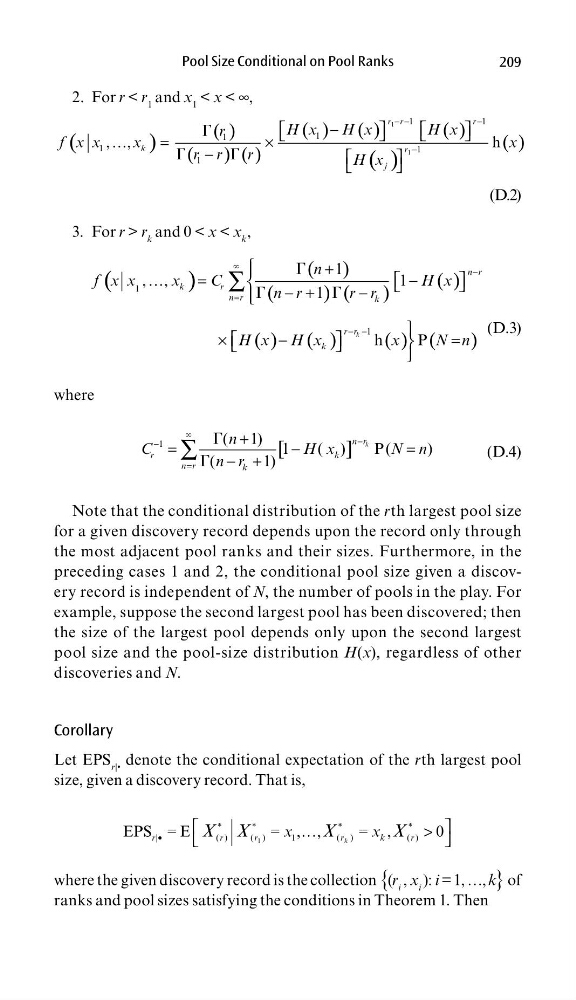
Note that the conditional distribution of the rth largest pool size
for a given discovery record depends upon the record only through
the most adjacent pool ranks and their sizes. Furthermore, in the
preceding cases 1 and 2, the conditional pool size given a discovery record is independent of N, the number of pools in the play. For
example, suppose the second largest pool has been discovered; then
the size of the largest pool depends only upon the second largest
pool size and the pool-size distribution H(x), regardless of other
discoveries and N.
Corollary
Let EPS r|• denote the conditional expectation of the rth largest pool
size, given a discovery record. That is,
|
1
=
= , … ,
= ,
1
*
*
*
*
( )
( )
( )
( )
EPS
E
0
k
r
r
r
r
k
r
x
x
X X
X
X
•
>
where the given discovery record is the collection {(r i , x i ): i = 1, …, k} of
ranks and pool sizes satisfying the conditions in Theorem 1. Then
209
For
2.
r < r 1 and x 1 < x < ∞,
(
)
( )
( ) ( )
( ) ( )
( )
( )
( )
1
1
1
1
1
1
1
1
1
, ,
h
r
r
k
r
j
H x
H x
H x
r
f x x
x
x
r r
r
H x
G
G
G
− −
−
−
−
=
×
−
!
r
(D.2)
For
3.
r > r k and 0 < x < x k ,
(
)
( )
(
) (
)
( )
( ) ( )
( ) (
)
1
1
1
, ,
1
1
h
P
k
n r
k
r
n r
k
r r
k
n
f x x
x
C
H x
n r
r r
H x H x
x
N n
`
G
G
G
−
=
− −
+
=
−
− +
−
×
−
=
∑
!
(D.3)
where
[
]
1
( 1) 1
( )
P(
)
(
1 )
k
n r
r
k
n r
k
n
C
Hx
N n
n r
−
−
=
+
=
−
=
− +
∑
`
G
G
(D.4)
Note that the conditional distribution of the rth largest pool size
for a given discovery record depends upon the record only through
the most adjacent pool ranks and their sizes. Furthermore, in the
preceding cases 1 and 2, the conditional pool size given a discovery record is independent of N, the number of pools in the play. For
example, suppose the second largest pool has been discovered; then
the size of the largest pool depends only upon the second largest
pool size and the pool-size distribution H(x), regardless of other
discoveries and N.
Corollary
Let EPS r|• denote the conditional expectation of the rth largest pool
size, given a discovery record. That is,
|
1
=
= , … ,
= ,
1
*
*
*
*
( )
( )
( )
( )
EPS
E
0
k
r
r
r
r
k
r
x
x
X X
X
X
•
>
where the given discovery record is the collection {(r i , x i ): i = 1, …, k} of
ranks and pool sizes satisfying the conditions in Theorem 1. Then