

Other Assessment Methods—An Overview
161
source beds and the depths of the oil and gas windows. More comprehensive methods are described in Burrus et al. (1996).
Statistical Approaches
The merits of several discovery process methods for petroleum resource
assessment were evaluated using discoveries from the Niagaran
(Silurian) pinnacle reef play of northern Michigan as a benchmark data
set for comparison (Gill, 1994; Lee and Gill, 1999). The tested methods included the USGS log-geometric method; the GSC PETRIMES
methods, including LDSCV, NDSCV–empirical, nonparametric–
lognormal, nonparametric–Pareto, and BDSCV methods; Arps and
Roberts’ method; Bickel, Nair, and Wang’s nonparametric fi nite population; and Kaufman’s anchored and Chen and Sinding–Larsen’s geoanchored methods (Table 7.2). The estimated number of fi elds varied
by a factor of 3.7, but the estimated volume of resources varied by a
factor of 1.6. The estimates are all fairly similar for the large fi eld-size
classes greater than 2 to 4 million barrels of oil equivalent (MMBOE).
The main differences among the estimates are in the small fi elds less
than 2 to 4 MMBOE.
This section reviews the advantages and disadvantages of the
following statistical methods:
The fi nite population approach
•
The superpopulation approach
•
The regression method
•
The fractal method
•
Finite Population Methods
The Arps and Roberts Method
Arps and Roberts (1958) postulated that the probability of fi nding
one more fi eld with an area y in a basin for each additional wildcat
to be drilled is proportional to (1) the magnitude of the area y of such
fi elds and (2) the remaining number of undiscovered fi elds of that
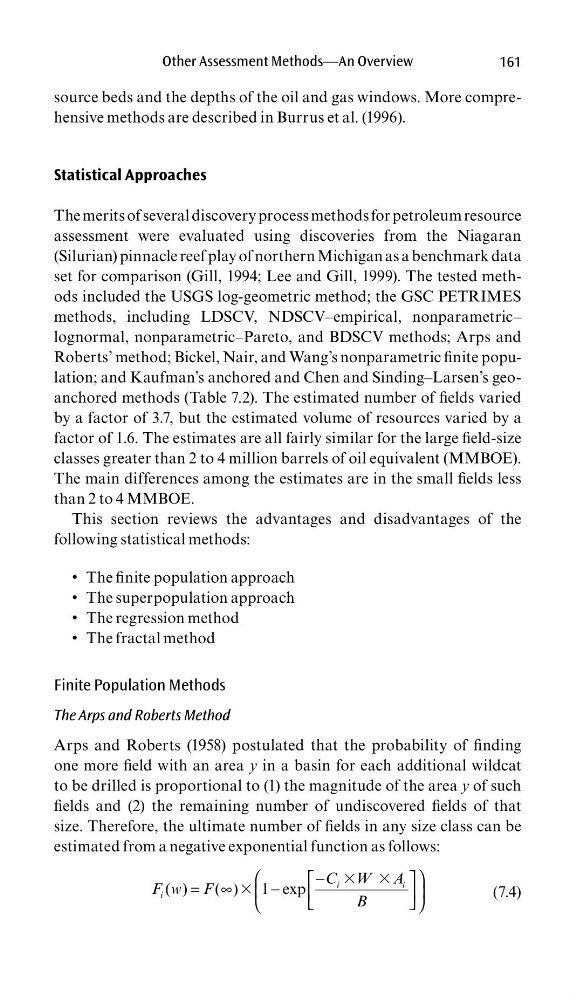
size. Therefore, the ultimate number of fi elds in any size class can be
estimated from a negative exponential function as follows:
( )
( ) 1 exp
i
i
i
C W A
F w F
B
3 3
3
−
= ∞
−
(7.4)
161
source beds and the depths of the oil and gas windows. More comprehensive methods are described in Burrus et al. (1996).
Statistical Approaches
The merits of several discovery process methods for petroleum resource
assessment were evaluated using discoveries from the Niagaran
(Silurian) pinnacle reef play of northern Michigan as a benchmark data
set for comparison (Gill, 1994; Lee and Gill, 1999). The tested methods included the USGS log-geometric method; the GSC PETRIMES
methods, including LDSCV, NDSCV–empirical, nonparametric–
lognormal, nonparametric–Pareto, and BDSCV methods; Arps and
Roberts’ method; Bickel, Nair, and Wang’s nonparametric fi nite population; and Kaufman’s anchored and Chen and Sinding–Larsen’s geoanchored methods (Table 7.2). The estimated number of fi elds varied
by a factor of 3.7, but the estimated volume of resources varied by a
factor of 1.6. The estimates are all fairly similar for the large fi eld-size
classes greater than 2 to 4 million barrels of oil equivalent (MMBOE).
The main differences among the estimates are in the small fi elds less
than 2 to 4 MMBOE.
This section reviews the advantages and disadvantages of the
following statistical methods:
The fi nite population approach
•
The superpopulation approach
•
The regression method
•
The fractal method
•
Finite Population Methods
The Arps and Roberts Method
Arps and Roberts (1958) postulated that the probability of fi nding
one more fi eld with an area y in a basin for each additional wildcat
to be drilled is proportional to (1) the magnitude of the area y of such
fi elds and (2) the remaining number of undiscovered fi elds of that
size. Therefore, the ultimate number of fi elds in any size class can be
estimated from a negative exponential function as follows:
( )
( ) 1 exp
i
i
i
C W A
F w F
B
3 3
3
−
= ∞
−
(7.4)