

82
Z. Yu et al.
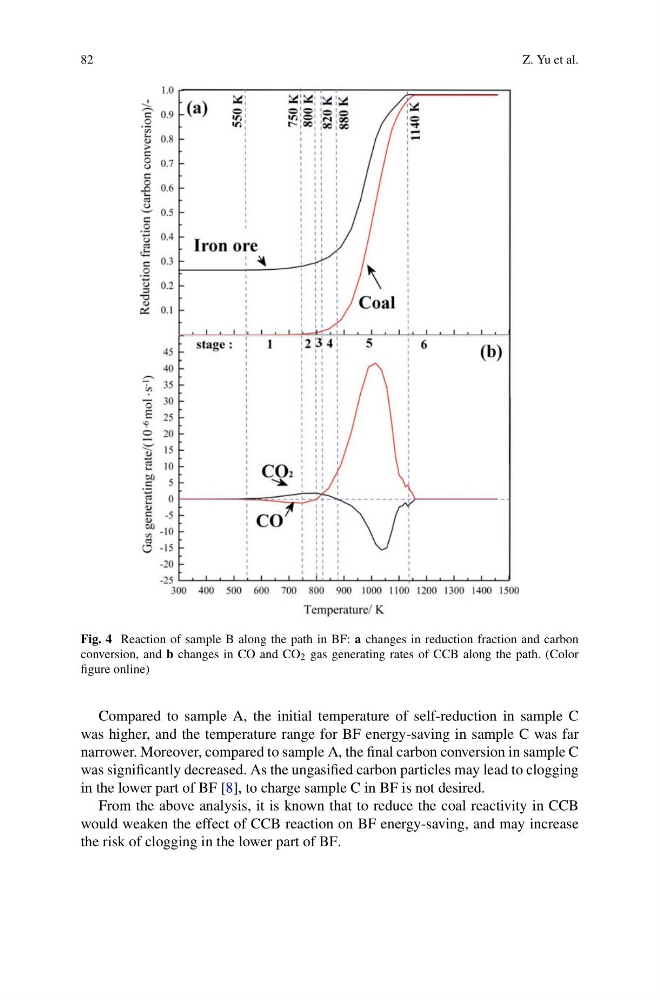
Fig. 4 Reaction of sample B along the path in BF: a changes in reduction fraction and carbon
conversion, and b changes in CO and CO 2 gas generating rates of CCB along the path. (Color
figure online)
Compared to sample A, the initial temperature of self-reduction in sample C
was higher, and the temperature range for BF energy-saving in sample C was far
narrower. Moreover, compared to sample A, the final carbon conversion in sample C
was significantly decreased. As the ungasified carbon particles may lead to clogging
in the lower part of BF [8], to charge sample C in BF is not desired.
From the above analysis, it is known that to reduce the coal reactivity in CCB
would weaken the effect of CCB reaction on BF energy-saving, and may increase
the risk of clogging in the lower part of BF.
Z. Yu et al.
Fig. 4 Reaction of sample B along the path in BF: a changes in reduction fraction and carbon
conversion, and b changes in CO and CO 2 gas generating rates of CCB along the path. (Color
figure online)
Compared to sample A, the initial temperature of self-reduction in sample C
was higher, and the temperature range for BF energy-saving in sample C was far
narrower. Moreover, compared to sample A, the final carbon conversion in sample C
was significantly decreased. As the ungasified carbon particles may lead to clogging
in the lower part of BF [8], to charge sample C in BF is not desired.
From the above analysis, it is known that to reduce the coal reactivity in CCB
would weaken the effect of CCB reaction on BF energy-saving, and may increase
the risk of clogging in the lower part of BF.