

78
Z. Yu et al.
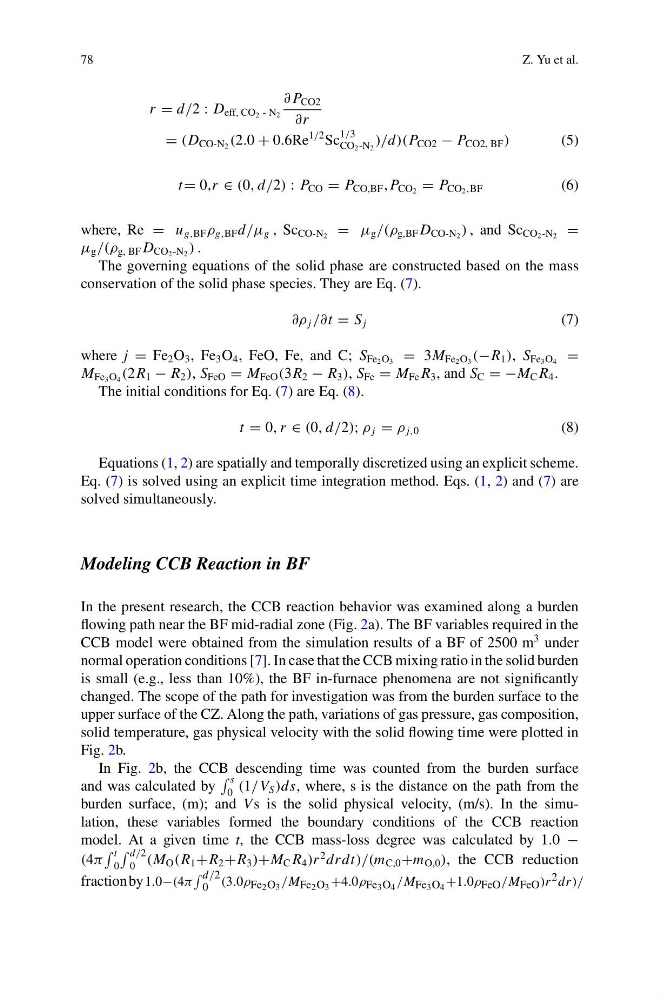
r = d/2 : D eff, CO 2 - N 2
∂ P CO2
∂r
= (D CO-N 2 (2.0 + 0.6Re
1/2 Sc
1/3
CO 2 -N 2
)/d)(P CO2 − P CO2, BF )
(5)
t= 0,r ∈ (0, d/2) : P CO = P CO,BF ,P CO 2 = P CO 2 ,BF
(6)
where, Re = u g,BF ρ g,BF d/μ g , Sc CO-N 2 = μ g /(ρ g,BF D CO-N 2 ) , and Sc CO 2 -N 2 =
μ g /(ρ g, BF D CO 2 -N 2 ) .
The governing equations of the solid phase are constructed based on the mass
conservation of the solid phase species. They are Eq. (7).
∂ρ j /∂t = S j
(7)
where j = Fe 2 O 3 , Fe 3 O 4 , FeO, Fe, and C; S Fe 2 O 3 = 3M Fe 2 O 3 (−R 1 ), S Fe 3 O 4 =
M Fe 3 O 4 (2R 1 − R 2 ), S FeO = M FeO (3R 2 − R 3 ), S Fe = M Fe R 3 , and S C = −M C R 4 .
The initial conditions for Eq. (7) are Eq. (8).
t = 0, r ∈ (0, d/2); ρ j = ρ j,0
(8)
Equations (1, 2) are spatially and temporally discretized using an explicit scheme.
Eq. (7) is solved using an explicit time integration method. Eqs. (1, 2) and (7) are
solved simultaneously.
Modeling CCB Reaction in BF
In the present research, the CCB reaction behavior was examined along a burden
flowing path near the BF mid-radial zone (Fig. 2a). The BF variables required in the
CCB model were obtained from the simulation results of a BF of 2500 m
3 under
normal operation conditions [7]. In case that the CCB mixing ratio in the solid burden
is small (e.g., less than 10%), the BF in-furnace phenomena are not significantly
changed. The scope of the path for investigation was from the burden surface to the
upper surface of the CZ. Along the path, variations of gas pressure, gas composition,
solid temperature, gas physical velocity with the solid flowing time were plotted in
Fig. 2b.
In Fig. 2b, the CCB descending time was counted from the burden surface
and was calculated by
s
0 (1/V S )ds, where, s is the distance on the path from the
burden surface, (m); and V s is the solid physical velocity, (m/s). In the simulation, these variables formed the boundary conditions of the CCB reaction
model. At a given time t, the CCB mass-loss degree was calculated by 1.0 −
(4π
t
0
d/2
0 (M O (R 1 +R 2 +R 3 )+M C R 4 )r
2 drdt)/(m C,0 +m O,0 ), the CCB reduction
fractionby1.0−(4π
d/2
0 (3.0ρ Fe 2 O 3 /M Fe 2 O 3 +4.0ρ Fe 3 O 4 /M Fe 3 O 4 +1.0ρ FeO /M FeO )r 2 dr)/
Z. Yu et al.
r = d/2 : D eff, CO 2 - N 2
∂ P CO2
∂r
= (D CO-N 2 (2.0 + 0.6Re
1/2 Sc
1/3
CO 2 -N 2
)/d)(P CO2 − P CO2, BF )
(5)
t= 0,r ∈ (0, d/2) : P CO = P CO,BF ,P CO 2 = P CO 2 ,BF
(6)
where, Re = u g,BF ρ g,BF d/μ g , Sc CO-N 2 = μ g /(ρ g,BF D CO-N 2 ) , and Sc CO 2 -N 2 =
μ g /(ρ g, BF D CO 2 -N 2 ) .
The governing equations of the solid phase are constructed based on the mass
conservation of the solid phase species. They are Eq. (7).
∂ρ j /∂t = S j
(7)
where j = Fe 2 O 3 , Fe 3 O 4 , FeO, Fe, and C; S Fe 2 O 3 = 3M Fe 2 O 3 (−R 1 ), S Fe 3 O 4 =
M Fe 3 O 4 (2R 1 − R 2 ), S FeO = M FeO (3R 2 − R 3 ), S Fe = M Fe R 3 , and S C = −M C R 4 .
The initial conditions for Eq. (7) are Eq. (8).
t = 0, r ∈ (0, d/2); ρ j = ρ j,0
(8)
Equations (1, 2) are spatially and temporally discretized using an explicit scheme.
Eq. (7) is solved using an explicit time integration method. Eqs. (1, 2) and (7) are
solved simultaneously.
Modeling CCB Reaction in BF
In the present research, the CCB reaction behavior was examined along a burden
flowing path near the BF mid-radial zone (Fig. 2a). The BF variables required in the
CCB model were obtained from the simulation results of a BF of 2500 m
3 under
normal operation conditions [7]. In case that the CCB mixing ratio in the solid burden
is small (e.g., less than 10%), the BF in-furnace phenomena are not significantly
changed. The scope of the path for investigation was from the burden surface to the
upper surface of the CZ. Along the path, variations of gas pressure, gas composition,
solid temperature, gas physical velocity with the solid flowing time were plotted in
Fig. 2b.
In Fig. 2b, the CCB descending time was counted from the burden surface
and was calculated by
s
0 (1/V S )ds, where, s is the distance on the path from the
burden surface, (m); and V s is the solid physical velocity, (m/s). In the simulation, these variables formed the boundary conditions of the CCB reaction
model. At a given time t, the CCB mass-loss degree was calculated by 1.0 −
(4π
t
0
d/2
0 (M O (R 1 +R 2 +R 3 )+M C R 4 )r
2 drdt)/(m C,0 +m O,0 ), the CCB reduction
fractionby1.0−(4π
d/2
0 (3.0ρ Fe 2 O 3 /M Fe 2 O 3 +4.0ρ Fe 3 O 4 /M Fe 3 O 4 +1.0ρ FeO /M FeO )r 2 dr)/