

4
J. Zhao et al.
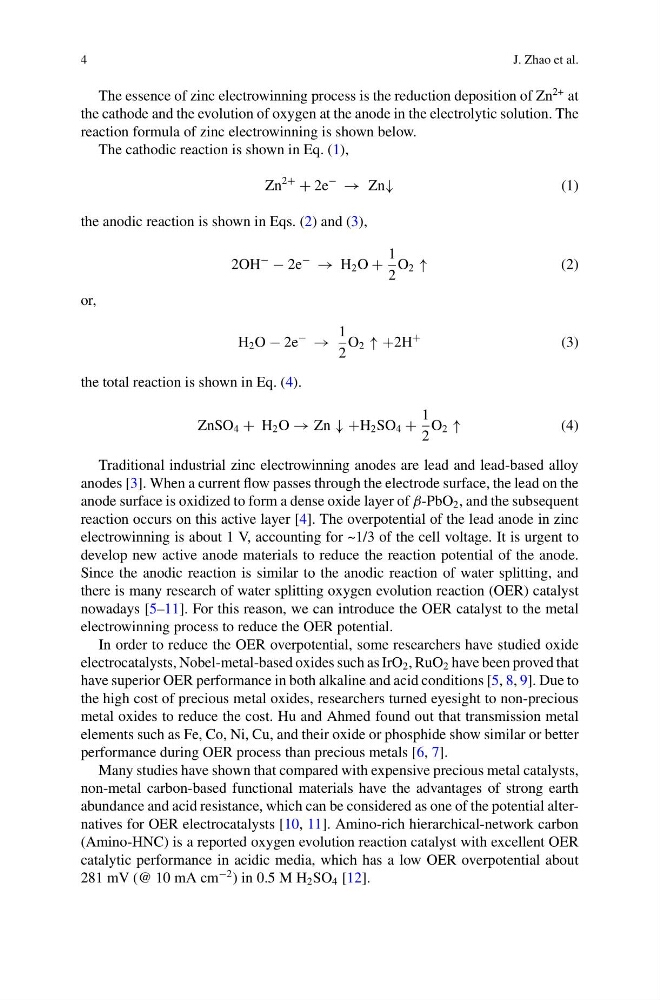
The essence of zinc electrowinning process is the reduction deposition of Zn
2+ at
the cathode and the evolution of oxygen at the anode in the electrolytic solution. The
reaction formula of zinc electrowinning is shown below.
The cathodic reaction is shown in Eq. (1),
Zn
2+
+ 2e
−
→ Zn↓
(1)
the anodic reaction is shown in Eqs. (2) and (3),
2OH
−
− 2e
−
→ H 2 O +
1
2
O 2 ↑
(2)
or,
H 2 O − 2e
−
→
1
2
O 2 ↑ +2H
+
(3)
the total reaction is shown in Eq. (4).
ZnSO 4 + H 2 O → Zn ↓ +H 2 SO 4 +
1
2
O 2 ↑
(4)
Traditional industrial zinc electrowinning anodes are lead and lead-based alloy
anodes [3]. When a current flow passes through the electrode surface, the lead on the
anode surface is oxidized to form a dense oxide layer of β-PbO 2 , and the subsequent
reaction occurs on this active layer [4]. The overpotential of the lead anode in zinc
electrowinning is about 1 V, accounting for ~1/3 of the cell voltage. It is urgent to
develop new active anode materials to reduce the reaction potential of the anode.
Since the anodic reaction is similar to the anodic reaction of water splitting, and
there is many research of water splitting oxygen evolution reaction (OER) catalyst
nowadays [5–11]. For this reason, we can introduce the OER catalyst to the metal
electrowinning process to reduce the OER potential.
In order to reduce the OER overpotential, some researchers have studied oxide
electrocatalysts, Nobel-metal-based oxides such as IrO 2 , RuO 2 have been proved that
have superior OER performance in both alkaline and acid conditions [5, 8, 9]. Due to
the high cost of precious metal oxides, researchers turned eyesight to non-precious
metal oxides to reduce the cost. Hu and Ahmed found out that transmission metal
elements such as Fe, Co, Ni, Cu, and their oxide or phosphide show similar or better
performance during OER process than precious metals [6, 7].
Many studies have shown that compared with expensive precious metal catalysts,
non-metal carbon-based functional materials have the advantages of strong earth
abundance and acid resistance, which can be considered as one of the potential alternatives for OER electrocatalysts [10, 11]. Amino-rich hierarchical-network carbon
(Amino-HNC) is a reported oxygen evolution reaction catalyst with excellent OER
catalytic performance in acidic media, which has a low OER overpotential about
281 mV (@ 10 mA cm
−2 ) in 0.5 M H 2 SO 4 [12].
J. Zhao et al.
The essence of zinc electrowinning process is the reduction deposition of Zn
2+ at
the cathode and the evolution of oxygen at the anode in the electrolytic solution. The
reaction formula of zinc electrowinning is shown below.
The cathodic reaction is shown in Eq. (1),
Zn
2+
+ 2e
−
→ Zn↓
(1)
the anodic reaction is shown in Eqs. (2) and (3),
2OH
−
− 2e
−
→ H 2 O +
1
2
O 2 ↑
(2)
or,
H 2 O − 2e
−
→
1
2
O 2 ↑ +2H
+
(3)
the total reaction is shown in Eq. (4).
ZnSO 4 + H 2 O → Zn ↓ +H 2 SO 4 +
1
2
O 2 ↑
(4)
Traditional industrial zinc electrowinning anodes are lead and lead-based alloy
anodes [3]. When a current flow passes through the electrode surface, the lead on the
anode surface is oxidized to form a dense oxide layer of β-PbO 2 , and the subsequent
reaction occurs on this active layer [4]. The overpotential of the lead anode in zinc
electrowinning is about 1 V, accounting for ~1/3 of the cell voltage. It is urgent to
develop new active anode materials to reduce the reaction potential of the anode.
Since the anodic reaction is similar to the anodic reaction of water splitting, and
there is many research of water splitting oxygen evolution reaction (OER) catalyst
nowadays [5–11]. For this reason, we can introduce the OER catalyst to the metal
electrowinning process to reduce the OER potential.
In order to reduce the OER overpotential, some researchers have studied oxide
electrocatalysts, Nobel-metal-based oxides such as IrO 2 , RuO 2 have been proved that
have superior OER performance in both alkaline and acid conditions [5, 8, 9]. Due to
the high cost of precious metal oxides, researchers turned eyesight to non-precious
metal oxides to reduce the cost. Hu and Ahmed found out that transmission metal
elements such as Fe, Co, Ni, Cu, and their oxide or phosphide show similar or better
performance during OER process than precious metals [6, 7].
Many studies have shown that compared with expensive precious metal catalysts,
non-metal carbon-based functional materials have the advantages of strong earth
abundance and acid resistance, which can be considered as one of the potential alternatives for OER electrocatalysts [10, 11]. Amino-rich hierarchical-network carbon
(Amino-HNC) is a reported oxygen evolution reaction catalyst with excellent OER
catalytic performance in acidic media, which has a low OER overpotential about
281 mV (@ 10 mA cm
−2 ) in 0.5 M H 2 SO 4 [12].