

Simulation and Optimization of Defluorination and Desulfurization …
131
Bauer ring are relatively large. This is because the small Bauer ring has greater filling
density, porosity, and better hydrodynamic performance under the same humidity
so that CO 2 gas and NaOH liquid can be separated in the small Bauer ring. It has the
advantages of uniform distribution effect, longer residence time, and greater mass
transfer driving force, which is favorable for gas–liquid two-phase mass transfer
absorption and higher gas–liquid mass transfer efficiency. The experiment can be
carried out by using the Bauer ring with the diameter of 16 mm.
Defluorination and Desulfurization Rate
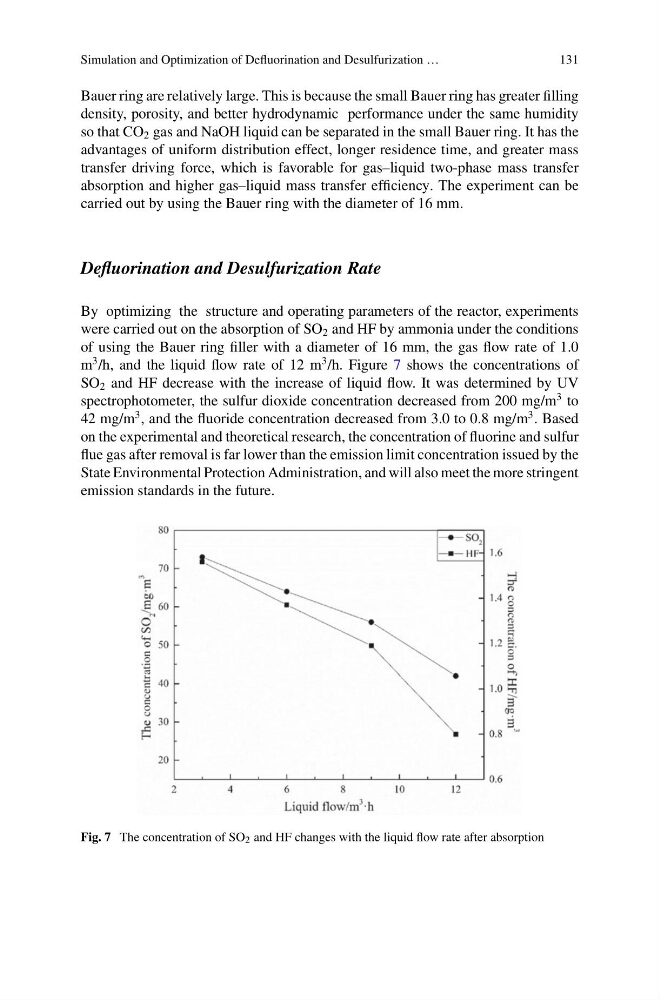
By optimizing the structure and operating parameters of the reactor, experiments
were carried out on the absorption of SO 2 and HF by ammonia under the conditions
of using the Bauer ring filler with a diameter of 16 mm, the gas flow rate of 1.0
m
3 /h, and the liquid flow rate of 12 m
3 /h. Figure 7 shows the concentrations of
SO 2 and HF decrease with the increase of liquid flow. It was determined by UV
spectrophotometer, the sulfur dioxide concentration decreased from 200 mg/m
3 to
42 mg/m
3 , and the fluoride concentration decreased from 3.0 to 0.8 mg/m
3 . Based
on the experimental and theoretical research, the concentration of fluorine and sulfur
flue gas after removal is far lower than the emission limit concentration issued by the
State Environmental Protection Administration, and will also meet the more stringent
emission standards in the future.
Fig. 7 The concentration of SO 2 and HF changes with the liquid flow rate after absorption
131
Bauer ring are relatively large. This is because the small Bauer ring has greater filling
density, porosity, and better hydrodynamic performance under the same humidity
so that CO 2 gas and NaOH liquid can be separated in the small Bauer ring. It has the
advantages of uniform distribution effect, longer residence time, and greater mass
transfer driving force, which is favorable for gas–liquid two-phase mass transfer
absorption and higher gas–liquid mass transfer efficiency. The experiment can be
carried out by using the Bauer ring with the diameter of 16 mm.
Defluorination and Desulfurization Rate
By optimizing the structure and operating parameters of the reactor, experiments
were carried out on the absorption of SO 2 and HF by ammonia under the conditions
of using the Bauer ring filler with a diameter of 16 mm, the gas flow rate of 1.0
m
3 /h, and the liquid flow rate of 12 m
3 /h. Figure 7 shows the concentrations of
SO 2 and HF decrease with the increase of liquid flow. It was determined by UV
spectrophotometer, the sulfur dioxide concentration decreased from 200 mg/m
3 to
42 mg/m
3 , and the fluoride concentration decreased from 3.0 to 0.8 mg/m
3 . Based
on the experimental and theoretical research, the concentration of fluorine and sulfur
flue gas after removal is far lower than the emission limit concentration issued by the
State Environmental Protection Administration, and will also meet the more stringent
emission standards in the future.
Fig. 7 The concentration of SO 2 and HF changes with the liquid flow rate after absorption