

xii
About the Editors
Dr. Neelameggham holds 16 patents and patent applications and has published several technical papers.
He has served in the Magnesium Committee of the
TMS Light Metals Division (LMD) since its inception in 2000, chaired in 2005, and since 2007 has been
a permanent co-organizer for the Magnesium Technology Symposium. He has been a member of the Reactive Metals Committee, Recycling Committee, Titanium
Committee, and Program Committee for LMD and LMD
council.
Dr. Neelameggham was the Inaugural Chair, when
in 2008, LMD and the TMS Extraction and Processing
Division (EPD) created the Energy Committee, and has
been a Co-Editor of the Energy Technology Symposium
through the present. He received the LMD Distinguished
Service Award in 2010. As Chair of the Hydrometallurgy and Electrometallurgy Committee, he initiated the
Rare Metal Technology Symposium in 2014 and was a
co-organizer for it through 2021. He organized the 2018
TMS Symposium on Stored Renewable Energy in Coal.
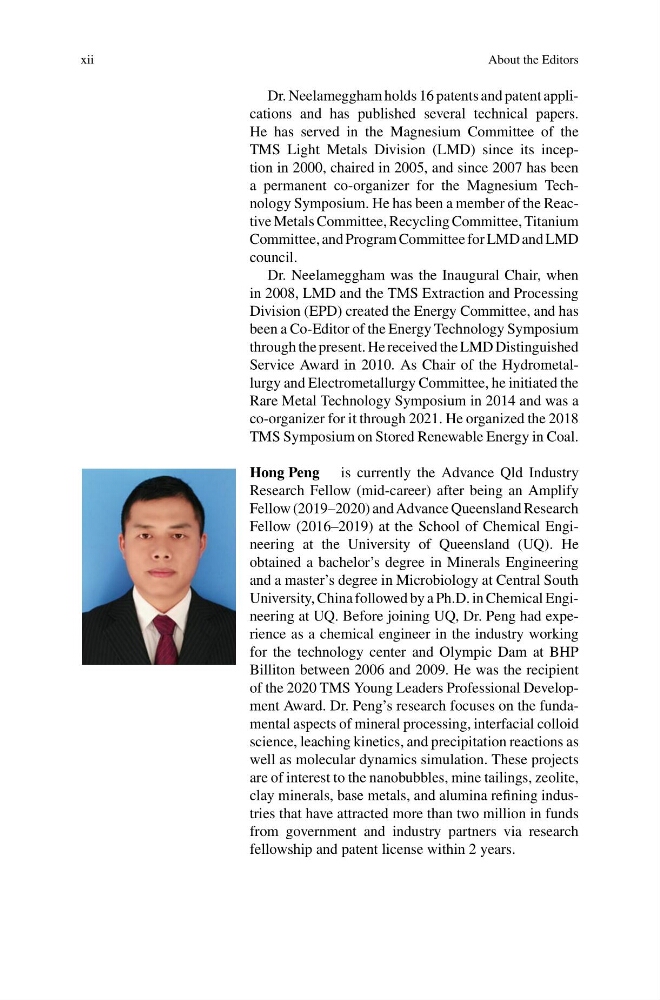
Hong Peng is currently the Advance Qld Industry
Research Fellow (mid-career) after being an Amplify
Fellow (2019–2020) and Advance Queensland Research
Fellow (2016–2019) at the School of Chemical Engineering at the University of Queensland (UQ). He
obtained a bachelor’s degree in Minerals Engineering
and a master’s degree in Microbiology at Central South
University, China followed by a Ph.D. in Chemical Engineering at UQ. Before joining UQ, Dr. Peng had experience as a chemical engineer in the industry working
for the technology center and Olympic Dam at BHP
Billiton between 2006 and 2009. He was the recipient
of the 2020 TMS Young Leaders Professional Development Award. Dr. Peng’s research focuses on the fundamental aspects of mineral processing, interfacial colloid
science, leaching kinetics, and precipitation reactions as
well as molecular dynamics simulation. These projects
are of interest to the nanobubbles, mine tailings, zeolite,
clay minerals, base metals, and alumina refining industries that have attracted more than two million in funds
from government and industry partners via research
fellowship and patent license within 2 years.
About the Editors
Dr. Neelameggham holds 16 patents and patent applications and has published several technical papers.
He has served in the Magnesium Committee of the
TMS Light Metals Division (LMD) since its inception in 2000, chaired in 2005, and since 2007 has been
a permanent co-organizer for the Magnesium Technology Symposium. He has been a member of the Reactive Metals Committee, Recycling Committee, Titanium
Committee, and Program Committee for LMD and LMD
council.
Dr. Neelameggham was the Inaugural Chair, when
in 2008, LMD and the TMS Extraction and Processing
Division (EPD) created the Energy Committee, and has
been a Co-Editor of the Energy Technology Symposium
through the present. He received the LMD Distinguished
Service Award in 2010. As Chair of the Hydrometallurgy and Electrometallurgy Committee, he initiated the
Rare Metal Technology Symposium in 2014 and was a
co-organizer for it through 2021. He organized the 2018
TMS Symposium on Stored Renewable Energy in Coal.
Hong Peng is currently the Advance Qld Industry
Research Fellow (mid-career) after being an Amplify
Fellow (2019–2020) and Advance Queensland Research
Fellow (2016–2019) at the School of Chemical Engineering at the University of Queensland (UQ). He
obtained a bachelor’s degree in Minerals Engineering
and a master’s degree in Microbiology at Central South
University, China followed by a Ph.D. in Chemical Engineering at UQ. Before joining UQ, Dr. Peng had experience as a chemical engineer in the industry working
for the technology center and Olympic Dam at BHP
Billiton between 2006 and 2009. He was the recipient
of the 2020 TMS Young Leaders Professional Development Award. Dr. Peng’s research focuses on the fundamental aspects of mineral processing, interfacial colloid
science, leaching kinetics, and precipitation reactions as
well as molecular dynamics simulation. These projects
are of interest to the nanobubbles, mine tailings, zeolite,
clay minerals, base metals, and alumina refining industries that have attracted more than two million in funds
from government and industry partners via research
fellowship and patent license within 2 years.