

4.2 The Review of Hydrogen Production Processes
35
(i.e. water electrolysis and reverse water electrolysis). It is therefore very flexible.
However, it operates at higher temperatures than the AEC and PEMEC which
creates opadvanced wear and tear of expensive equipment.
In a cost and performance elicitation study of the water electrolysis, the
PEMEC technology is considered as the leading technology in the mid-term
due to its superior characteristics for intermittent operations, consistent with the
renewable electricity energy supply (Schmidt et al. 2017).
A PEMEC electrolyser is constituted of cells that kept together in a stack.
Water is pumped through the stack. Direct current is circulated through the system. The electrolytic process splits the water H 2 O into O 2 and H 2 at the anode. As
ionised H + migrates through the membrane, it recombines into H 2 with electrons
at the cathode. O 2 and H 2 are then collected out of the stack. Depending on the
power-to-gas plant configuration and the end-user requirements, a compressor and
a storage system may be required. The system will be equipped with a balance-ofplant. Transportation and distribution systems complete the power-to-gas system.
The main feedstocks for a PEMEC electrolyser are water and electricity (van
Leeuwen and Mulder 2018).
Additional technical information is discussed in the chapter “Empirical research for establishing the potential of renewable hydrogen for decarbonising the
industrial sectors using fossil fuel-based hydrogen within the APAC markets”.
The Power-to-Gas Economics
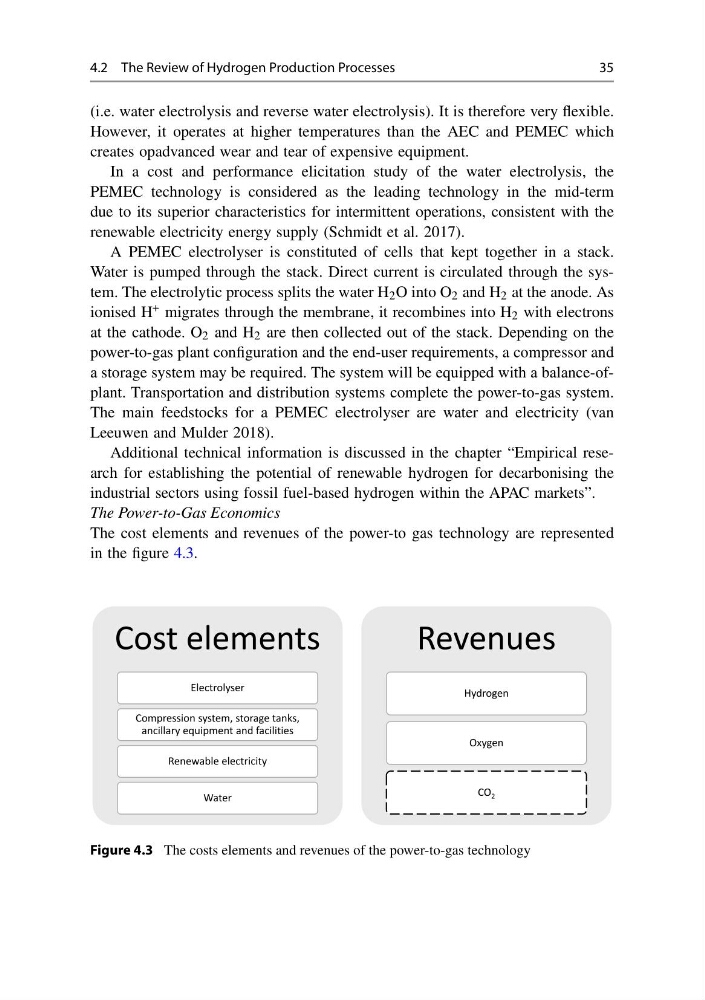
The cost elements and revenues of the power-to gas technology are represented
in the figure 4.3.
Figure 4.3 The costs elements and revenues of the power-to-gas technology
35
(i.e. water electrolysis and reverse water electrolysis). It is therefore very flexible.
However, it operates at higher temperatures than the AEC and PEMEC which
creates opadvanced wear and tear of expensive equipment.
In a cost and performance elicitation study of the water electrolysis, the
PEMEC technology is considered as the leading technology in the mid-term
due to its superior characteristics for intermittent operations, consistent with the
renewable electricity energy supply (Schmidt et al. 2017).
A PEMEC electrolyser is constituted of cells that kept together in a stack.
Water is pumped through the stack. Direct current is circulated through the system. The electrolytic process splits the water H 2 O into O 2 and H 2 at the anode. As
ionised H + migrates through the membrane, it recombines into H 2 with electrons
at the cathode. O 2 and H 2 are then collected out of the stack. Depending on the
power-to-gas plant configuration and the end-user requirements, a compressor and
a storage system may be required. The system will be equipped with a balance-ofplant. Transportation and distribution systems complete the power-to-gas system.
The main feedstocks for a PEMEC electrolyser are water and electricity (van
Leeuwen and Mulder 2018).
Additional technical information is discussed in the chapter “Empirical research for establishing the potential of renewable hydrogen for decarbonising the
industrial sectors using fossil fuel-based hydrogen within the APAC markets”.
The Power-to-Gas Economics
The cost elements and revenues of the power-to gas technology are represented
in the figure 4.3.
Figure 4.3 The costs elements and revenues of the power-to-gas technology