

64
3 Energy
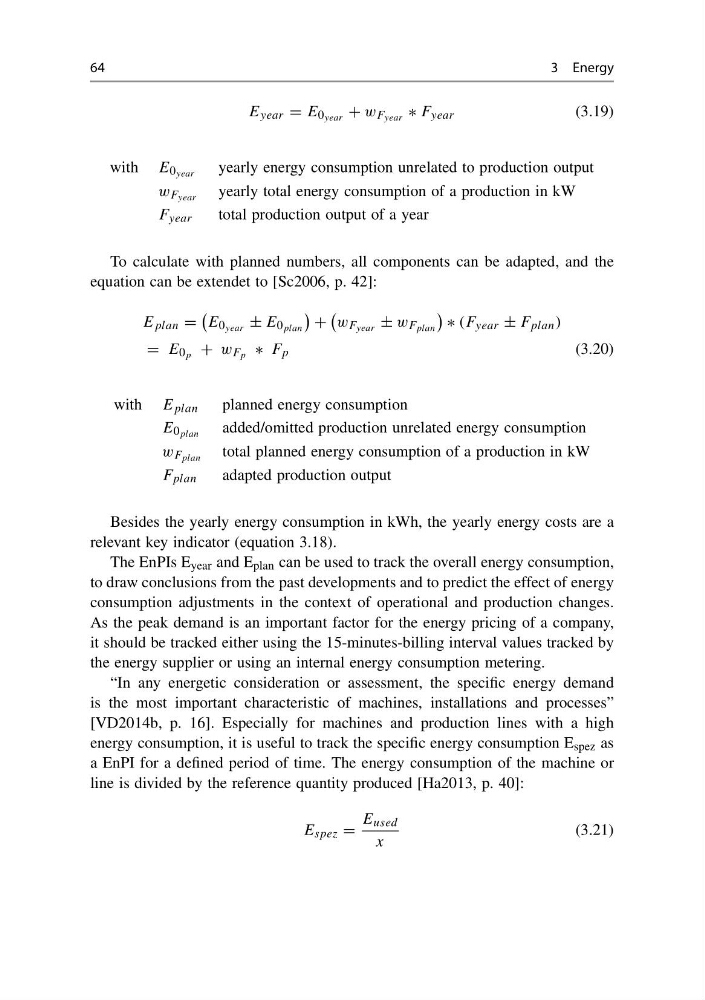
E year = E 0 year + w F year ∗ F year
(3.19)
with E 0 year
yearly energy consumption unrelated to production output
w F year yearly total energy consumption of a production in kW
F year
total production output of a year
To calculate with planned numbers, all components can be adapted, and the
equation can be extendet to [Sc2006, p. 42]:
E plan =
E 0 year ± E 0 plan
+
w F year ± w F plan
∗ (F year ± F plan )
= E 0 p + w F p ∗ F p
(3.20)
with E plan
planned energy consumption
E 0 plan added/omitted production unrelated energy consumption
w F plan total planned energy consumption of a production in kW
F plan
adapted production output
Besides the yearly energy consumption in kWh, the yearly energy costs are a
relevant key indicator (equation 3.18).
The EnPIs E year and E plan can be used to track the overall energy consumption,
to draw conclusions from the past developments and to predict the effect of energy
consumption adjustments in the context of operational and production changes.
As the peak demand is an important factor for the energy pricing of a company,
it should be tracked either using the 15-minutes-billing interval values tracked by
the energy supplier or using an internal energy consumption metering.
“In any energetic consideration or assessment, the specific energy demand
is the most important characteristic of machines, installations and processes”
[VD2014b, p. 16]. Especially for machines and production lines with a high
energy consumption, it is useful to track the specific energy consumption E spez as
a EnPI for a defined period of time. The energy consumption of the machine or
line is divided by the reference quantity produced [Ha2013, p. 40]:
E spez =
E used
x
(3.21)
3 Energy
E year = E 0 year + w F year ∗ F year
(3.19)
with E 0 year
yearly energy consumption unrelated to production output
w F year yearly total energy consumption of a production in kW
F year
total production output of a year
To calculate with planned numbers, all components can be adapted, and the
equation can be extendet to [Sc2006, p. 42]:
E plan =
E 0 year ± E 0 plan
+
w F year ± w F plan
∗ (F year ± F plan )
= E 0 p + w F p ∗ F p
(3.20)
with E plan
planned energy consumption
E 0 plan added/omitted production unrelated energy consumption
w F plan total planned energy consumption of a production in kW
F plan
adapted production output
Besides the yearly energy consumption in kWh, the yearly energy costs are a
relevant key indicator (equation 3.18).
The EnPIs E year and E plan can be used to track the overall energy consumption,
to draw conclusions from the past developments and to predict the effect of energy
consumption adjustments in the context of operational and production changes.
As the peak demand is an important factor for the energy pricing of a company,
it should be tracked either using the 15-minutes-billing interval values tracked by
the energy supplier or using an internal energy consumption metering.
“In any energetic consideration or assessment, the specific energy demand
is the most important characteristic of machines, installations and processes”
[VD2014b, p. 16]. Especially for machines and production lines with a high
energy consumption, it is useful to track the specific energy consumption E spez as
a EnPI for a defined period of time. The energy consumption of the machine or
line is divided by the reference quantity produced [Ha2013, p. 40]:
E spez =
E used
x
(3.21)