

56
3 Energy
In combination with the definition of work as the power consumption over a
certain period of time, the following equation for the energy consumption for an
entire production can be defined with the state-based power demand P, a cycle
time t and the production volume n [Mü+2009, p. 137]:
W = P ∗ t cycle ∗ n +
t total −
n ∗ t cycle
∗ P I DL E
(3.17)
The equation depicts the significant impact of the idle-state on the total energy
consumption, underlining the relevance of non-productive machine times for
the total energy consumption of a production. As the mathematical calculation
of energy consumption values is quite complex, it is more common to work
with measured electrical load profiles of production machines when it comes to
improvements of production systems in the context of energy efficiency. For the
load profile analysis, power consumption profiles and—parallel to the measuring
period—machine scheduling data, such as exact product arrivals at each machine
and produced quantities are required. The assignment of the measured, time-based
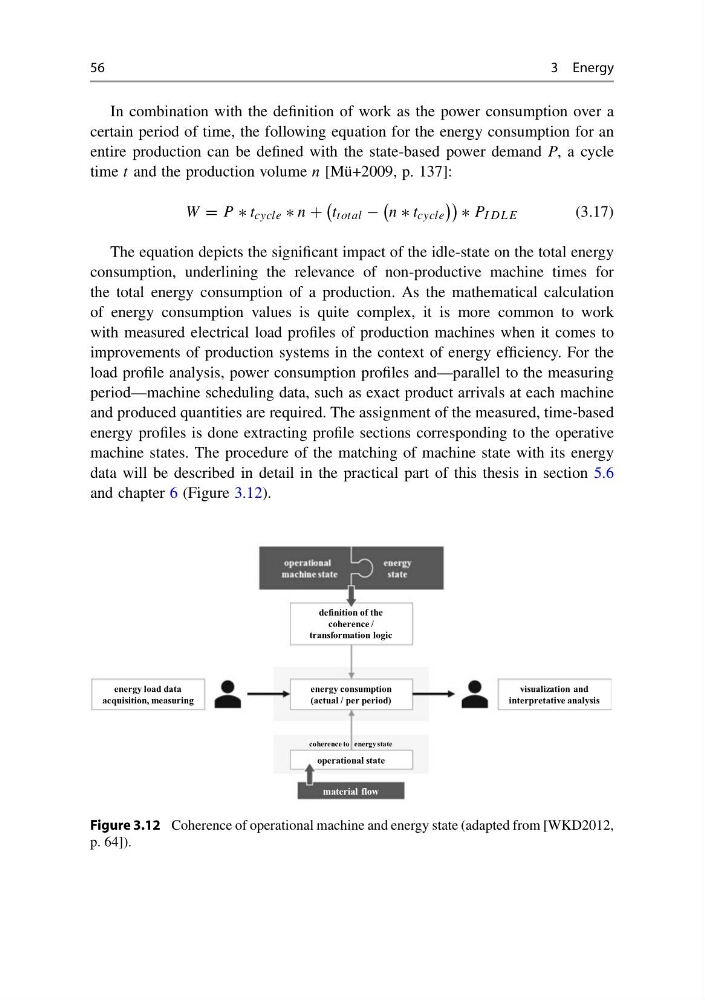
energy profiles is done extracting profile sections corresponding to the operative
machine states. The procedure of the matching of machine state with its energy
data will be described in detail in the practical part of this thesis in section 5.6
and chapter 6 (Figure 3.12).
coherence to energy state
energy consumption
(actual / per period)
operational state
energy load data
acquisition, measuring
visualization and
interpretative analysis
definition of the
coherence /
transformation logic
material flow
Figure 3.12 Coherence of operational machine and energy state (adapted from [WKD2012,
p. 64]).
3 Energy
In combination with the definition of work as the power consumption over a
certain period of time, the following equation for the energy consumption for an
entire production can be defined with the state-based power demand P, a cycle
time t and the production volume n [Mü+2009, p. 137]:
W = P ∗ t cycle ∗ n +
t total −
n ∗ t cycle
∗ P I DL E
(3.17)
The equation depicts the significant impact of the idle-state on the total energy
consumption, underlining the relevance of non-productive machine times for
the total energy consumption of a production. As the mathematical calculation
of energy consumption values is quite complex, it is more common to work
with measured electrical load profiles of production machines when it comes to
improvements of production systems in the context of energy efficiency. For the
load profile analysis, power consumption profiles and—parallel to the measuring
period—machine scheduling data, such as exact product arrivals at each machine
and produced quantities are required. The assignment of the measured, time-based
energy profiles is done extracting profile sections corresponding to the operative
machine states. The procedure of the matching of machine state with its energy
data will be described in detail in the practical part of this thesis in section 5.6
and chapter 6 (Figure 3.12).
coherence to energy state
energy consumption
(actual / per period)
operational state
energy load data
acquisition, measuring
visualization and
interpretative analysis
definition of the
coherence /
transformation logic
material flow
Figure 3.12 Coherence of operational machine and energy state (adapted from [WKD2012,
p. 64]).