

48
3 Energy
P = U × I
(3.11)
with U voltage in [V]
I
electric current in [A]
Therefore, the electrical work can be written as:
W =
t 2
t 1
U × I dt
(3.12)
W = U × I × t
The power in the alternating current circuit can be calculated in the same
way as the power in the direct current circuit for values that coincide in time,
since current and voltage have the same phase position at the effective resistance
[Bö2013, p. 311]. Thus, the current power p is:
p = u × i
(3.13)
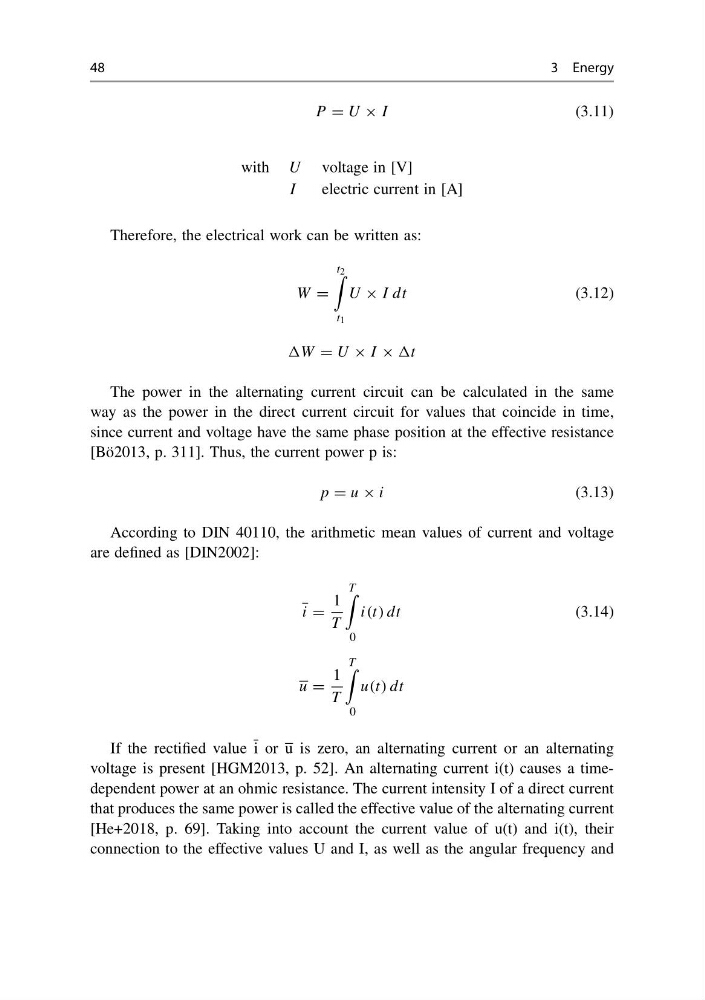
According to DIN 40110, the arithmetic mean values of current and voltage
are defined as [DIN2002]:
i =
1
T
T
0
i(t) dt
(3.14)
u =
1
T
T
0
u(t) dt
If the rectified value i or u is zero, an alternating current or an alternating
voltage is present [HGM2013, p. 52]. An alternating current i(t) causes a timedependent power at an ohmic resistance. The current intensity I of a direct current
that produces the same power is called the effective value of the alternating current
[He+2018, p. 69]. Taking into account the current value of u(t) and i(t), their
connection to the effective values U and I, as well as the angular frequency and
3 Energy
P = U × I
(3.11)
with U voltage in [V]
I
electric current in [A]
Therefore, the electrical work can be written as:
W =
t 2
t 1
U × I dt
(3.12)
W = U × I × t
The power in the alternating current circuit can be calculated in the same
way as the power in the direct current circuit for values that coincide in time,
since current and voltage have the same phase position at the effective resistance
[Bö2013, p. 311]. Thus, the current power p is:
p = u × i
(3.13)
According to DIN 40110, the arithmetic mean values of current and voltage
are defined as [DIN2002]:
i =
1
T
T
0
i(t) dt
(3.14)
u =
1
T
T
0
u(t) dt
If the rectified value i or u is zero, an alternating current or an alternating
voltage is present [HGM2013, p. 52]. An alternating current i(t) causes a timedependent power at an ohmic resistance. The current intensity I of a direct current
that produces the same power is called the effective value of the alternating current
[He+2018, p. 69]. Taking into account the current value of u(t) and i(t), their
connection to the effective values U and I, as well as the angular frequency and