

46
3 Energy
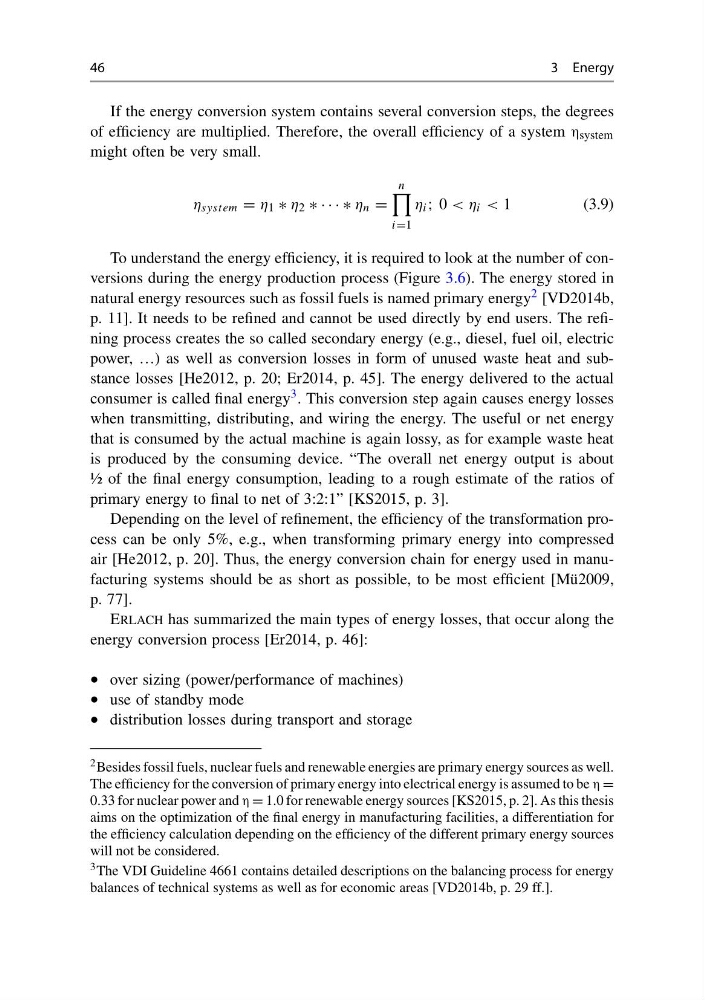
If the energy conversion system contains several conversion steps, the degrees
of efficiency are multiplied. Therefore, the overall efficiency of a system η system
might often be very small.
η system = η 1 ∗ η 2 ∗ · · · ∗ η n =
n
i=1
η i ; 0 < η i < 1
(3.9)
To understand the energy efficiency, it is required to look at the number of conversions during the energy production process (Figure 3.6). The energy stored in
natural energy resources such as fossil fuels is named primary energy 2 [VD2014b,
p. 11]. It needs to be refined and cannot be used directly by end users. The refining process creates the so called secondary energy (e.g., diesel, fuel oil, electric
power, …) as well as conversion losses in form of unused waste heat and substance losses [He2012, p. 20; Er2014, p. 45]. The energy delivered to the actual
consumer is called final energy 3 . This conversion step again causes energy losses
when transmitting, distributing, and wiring the energy. The useful or net energy
that is consumed by the actual machine is again lossy, as for example waste heat
is produced by the consuming device. “The overall net energy output is about
½ of the final energy consumption, leading to a rough estimate of the ratios of
primary energy to final to net of 3:2:1” [KS2015, p. 3].
Depending on the level of refinement, the efficiency of the transformation process can be only 5%, e.g., when transforming primary energy into compressed
air [He2012, p. 20]. Thus, the energy conversion chain for energy used in manufacturing systems should be as short as possible, to be most efficient [Mü2009,
p. 77].
Erlach has summarized the main types of energy losses, that occur along the
energy conversion process [Er2014, p. 46]:
• over sizing (power/performance of machines)
• use of standby mode
• distribution losses during transport and storage
2 Besides fossil fuels, nuclear fuels and renewable energies are primary energy sources as well.
The efficiency for the conversion of primary energy into electrical energy is assumed to be η =
0.33 for nuclear power and η = 1.0 for renewable energy sources [KS2015, p. 2]. As this thesis
aims on the optimization of the final energy in manufacturing facilities, a differentiation for
the efficiency calculation depending on the efficiency of the different primary energy sources
will not be considered.
3 The VDI Guideline 4661 contains detailed descriptions on the balancing process for energy
balances of technical systems as well as for economic areas [VD2014b, p. 29 ff.].
3 Energy
If the energy conversion system contains several conversion steps, the degrees
of efficiency are multiplied. Therefore, the overall efficiency of a system η system
might often be very small.
η system = η 1 ∗ η 2 ∗ · · · ∗ η n =
n
i=1
η i ; 0 < η i < 1
(3.9)
To understand the energy efficiency, it is required to look at the number of conversions during the energy production process (Figure 3.6). The energy stored in
natural energy resources such as fossil fuels is named primary energy 2 [VD2014b,
p. 11]. It needs to be refined and cannot be used directly by end users. The refining process creates the so called secondary energy (e.g., diesel, fuel oil, electric
power, …) as well as conversion losses in form of unused waste heat and substance losses [He2012, p. 20; Er2014, p. 45]. The energy delivered to the actual
consumer is called final energy 3 . This conversion step again causes energy losses
when transmitting, distributing, and wiring the energy. The useful or net energy
that is consumed by the actual machine is again lossy, as for example waste heat
is produced by the consuming device. “The overall net energy output is about
½ of the final energy consumption, leading to a rough estimate of the ratios of
primary energy to final to net of 3:2:1” [KS2015, p. 3].
Depending on the level of refinement, the efficiency of the transformation process can be only 5%, e.g., when transforming primary energy into compressed
air [He2012, p. 20]. Thus, the energy conversion chain for energy used in manufacturing systems should be as short as possible, to be most efficient [Mü2009,
p. 77].
Erlach has summarized the main types of energy losses, that occur along the
energy conversion process [Er2014, p. 46]:
• over sizing (power/performance of machines)
• use of standby mode
• distribution losses during transport and storage
2 Besides fossil fuels, nuclear fuels and renewable energies are primary energy sources as well.
The efficiency for the conversion of primary energy into electrical energy is assumed to be η =
0.33 for nuclear power and η = 1.0 for renewable energy sources [KS2015, p. 2]. As this thesis
aims on the optimization of the final energy in manufacturing facilities, a differentiation for
the efficiency calculation depending on the efficiency of the different primary energy sources
will not be considered.
3 The VDI Guideline 4661 contains detailed descriptions on the balancing process for energy
balances of technical systems as well as for economic areas [VD2014b, p. 29 ff.].