

26
2 Simulation-Based Optimization
minimization and maximization tasks, therefore a minimization problem can be
transformed into a maximization problem [GB2018, p. 3]:
max f = −min(− f ) and min f = −max(− f )
(2.4)
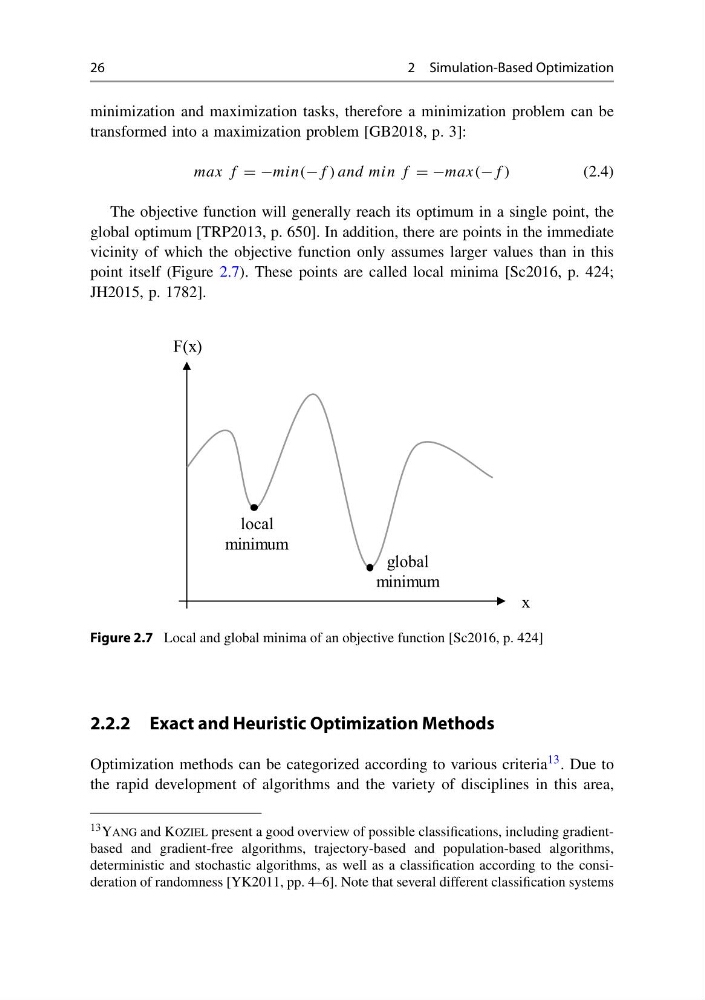
The objective function will generally reach its optimum in a single point, the
global optimum [TRP2013, p. 650]. In addition, there are points in the immediate
vicinity of which the objective function only assumes larger values than in this
point itself (Figure 2.7). These points are called local minima [Sc2016, p. 424;
JH2015, p. 1782].
F(x)
x
local
minimum
global
minimum
Figure 2.7 Local and global minima of an objective function [Sc2016, p. 424]
2.2.2 Exact and Heuristic Optimization Methods
Optimization methods can be categorized according to various criteria 13 . Due to
the rapid development of algorithms and the variety of disciplines in this area,
13 Yang and Koziel present a good overview of possible classifications, including gradientbased and gradient-free algorithms, trajectory-based and population-based algorithms,
deterministic and stochastic algorithms, as well as a classification according to the consideration of randomness [YK2011, pp. 4–6]. Note that several different classification systems
2 Simulation-Based Optimization
minimization and maximization tasks, therefore a minimization problem can be
transformed into a maximization problem [GB2018, p. 3]:
max f = −min(− f ) and min f = −max(− f )
(2.4)
The objective function will generally reach its optimum in a single point, the
global optimum [TRP2013, p. 650]. In addition, there are points in the immediate
vicinity of which the objective function only assumes larger values than in this
point itself (Figure 2.7). These points are called local minima [Sc2016, p. 424;
JH2015, p. 1782].
F(x)
x
local
minimum
global
minimum
Figure 2.7 Local and global minima of an objective function [Sc2016, p. 424]
2.2.2 Exact and Heuristic Optimization Methods
Optimization methods can be categorized according to various criteria 13 . Due to
the rapid development of algorithms and the variety of disciplines in this area,
13 Yang and Koziel present a good overview of possible classifications, including gradientbased and gradient-free algorithms, trajectory-based and population-based algorithms,
deterministic and stochastic algorithms, as well as a classification according to the consideration of randomness [YK2011, pp. 4–6]. Note that several different classification systems