

22
2 Simulation-Based Optimization
Independently of the naming of the combination of different simulation paradigms, the way information is exchanged over time progress between sub-models
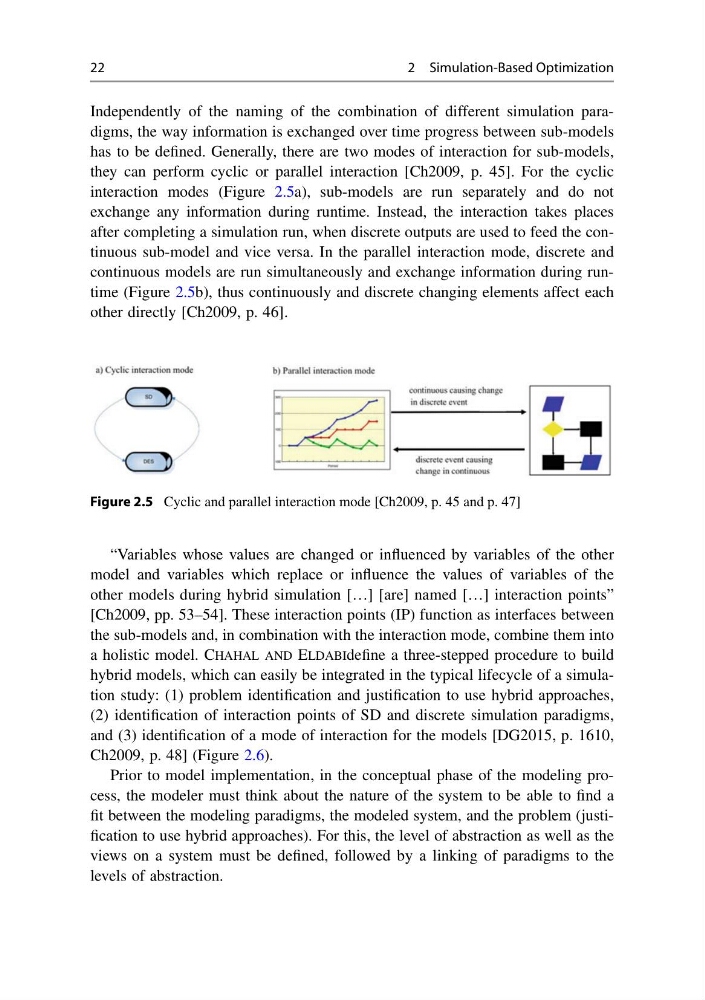
has to be defined. Generally, there are two modes of interaction for sub-models,
they can perform cyclic or parallel interaction [Ch2009, p. 45]. For the cyclic
interaction modes (Figure 2.5a), sub-models are run separately and do not
exchange any information during runtime. Instead, the interaction takes places
after completing a simulation run, when discrete outputs are used to feed the continuous sub-model and vice versa. In the parallel interaction mode, discrete and
continuous models are run simultaneously and exchange information during runtime (Figure 2.5b), thus continuously and discrete changing elements affect each
other directly [Ch2009, p. 46].
Figure 2.5 Cyclic and parallel interaction mode [Ch2009, p. 45 and p. 47]
“Variables whose values are changed or influenced by variables of the other
model and variables which replace or influence the values of variables of the
other models during hybrid simulation […] [are] named […] interaction points”
[Ch2009, pp. 53–54]. These interaction points (IP) function as interfaces between
the sub-models and, in combination with the interaction mode, combine them into
a holistic model. Chahal and Eldabidefine a three-stepped procedure to build
hybrid models, which can easily be integrated in the typical lifecycle of a simulation study: (1) problem identification and justification to use hybrid approaches,
(2) identification of interaction points of SD and discrete simulation paradigms,
and (3) identification of a mode of interaction for the models [DG2015, p. 1610,
Ch2009, p. 48] (Figure 2.6).
Prior to model implementation, in the conceptual phase of the modeling process, the modeler must think about the nature of the system to be able to find a
fit between the modeling paradigms, the modeled system, and the problem (justification to use hybrid approaches). For this, the level of abstraction as well as the
views on a system must be defined, followed by a linking of paradigms to the
levels of abstraction.
2 Simulation-Based Optimization
Independently of the naming of the combination of different simulation paradigms, the way information is exchanged over time progress between sub-models
has to be defined. Generally, there are two modes of interaction for sub-models,
they can perform cyclic or parallel interaction [Ch2009, p. 45]. For the cyclic
interaction modes (Figure 2.5a), sub-models are run separately and do not
exchange any information during runtime. Instead, the interaction takes places
after completing a simulation run, when discrete outputs are used to feed the continuous sub-model and vice versa. In the parallel interaction mode, discrete and
continuous models are run simultaneously and exchange information during runtime (Figure 2.5b), thus continuously and discrete changing elements affect each
other directly [Ch2009, p. 46].
Figure 2.5 Cyclic and parallel interaction mode [Ch2009, p. 45 and p. 47]
“Variables whose values are changed or influenced by variables of the other
model and variables which replace or influence the values of variables of the
other models during hybrid simulation […] [are] named […] interaction points”
[Ch2009, pp. 53–54]. These interaction points (IP) function as interfaces between
the sub-models and, in combination with the interaction mode, combine them into
a holistic model. Chahal and Eldabidefine a three-stepped procedure to build
hybrid models, which can easily be integrated in the typical lifecycle of a simulation study: (1) problem identification and justification to use hybrid approaches,
(2) identification of interaction points of SD and discrete simulation paradigms,
and (3) identification of a mode of interaction for the models [DG2015, p. 1610,
Ch2009, p. 48] (Figure 2.6).
Prior to model implementation, in the conceptual phase of the modeling process, the modeler must think about the nature of the system to be able to find a
fit between the modeling paradigms, the modeled system, and the problem (justification to use hybrid approaches). For this, the level of abstraction as well as the
views on a system must be defined, followed by a linking of paradigms to the
levels of abstraction.