

14
2 Simulation-Based Optimization
character of systems combining those two system dynamics will be focused on in
section 2.1.2.
2.1.1 Continuous and Discrete Simulation
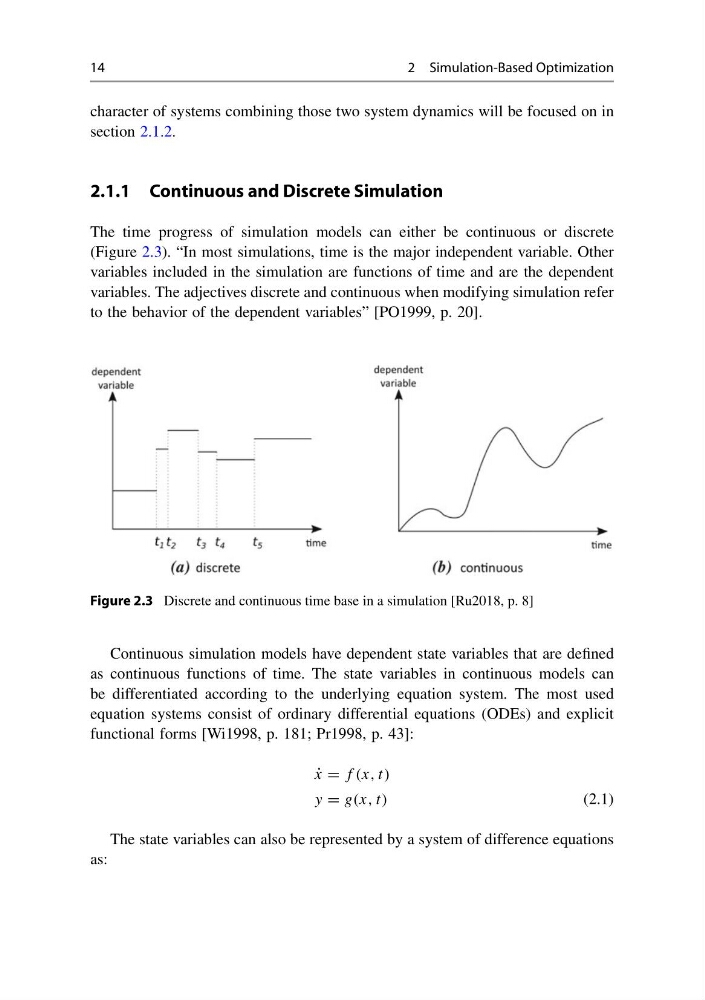
The time progress of simulation models can either be continuous or discrete
(Figure 2.3). “In most simulations, time is the major independent variable. Other
variables included in the simulation are functions of time and are the dependent
variables. The adjectives discrete and continuous when modifying simulation refer
to the behavior of the dependent variables” [PO1999, p. 20].
Figure 2.3 Discrete and continuous time base in a simulation [Ru2018, p. 8]
Continuous simulation models have dependent state variables that are defined
as continuous functions of time. The state variables in continuous models can
be differentiated according to the underlying equation system. The most used
equation systems consist of ordinary differential equations (ODEs) and explicit
functional forms [Wi1998, p. 181; Pr1998, p. 43]:
˙
x = f (x, t)
y = g(x, t)
(2.1)
The state variables can also be represented by a system of difference equations
as:
2 Simulation-Based Optimization
character of systems combining those two system dynamics will be focused on in
section 2.1.2.
2.1.1 Continuous and Discrete Simulation
The time progress of simulation models can either be continuous or discrete
(Figure 2.3). “In most simulations, time is the major independent variable. Other
variables included in the simulation are functions of time and are the dependent
variables. The adjectives discrete and continuous when modifying simulation refer
to the behavior of the dependent variables” [PO1999, p. 20].
Figure 2.3 Discrete and continuous time base in a simulation [Ru2018, p. 8]
Continuous simulation models have dependent state variables that are defined
as continuous functions of time. The state variables in continuous models can
be differentiated according to the underlying equation system. The most used
equation systems consist of ordinary differential equations (ODEs) and explicit
functional forms [Wi1998, p. 181; Pr1998, p. 43]:
˙
x = f (x, t)
y = g(x, t)
(2.1)
The state variables can also be represented by a system of difference equations
as: