

12
2 Simulation-Based Optimization
and the practical use case, but will not be described in detail at this point. The
reader is referred to further literature 2 .
Solutions/
understanding
Real world
problem
Computer
model
Modelling and general
project objectives
Model content:
scope and level of detail
Experimental
factors
Responses
provides
accepts
Conceptual Model
Conceptual Model
Validation
Model
Verification
Scenario
Verification
Operational
Validation
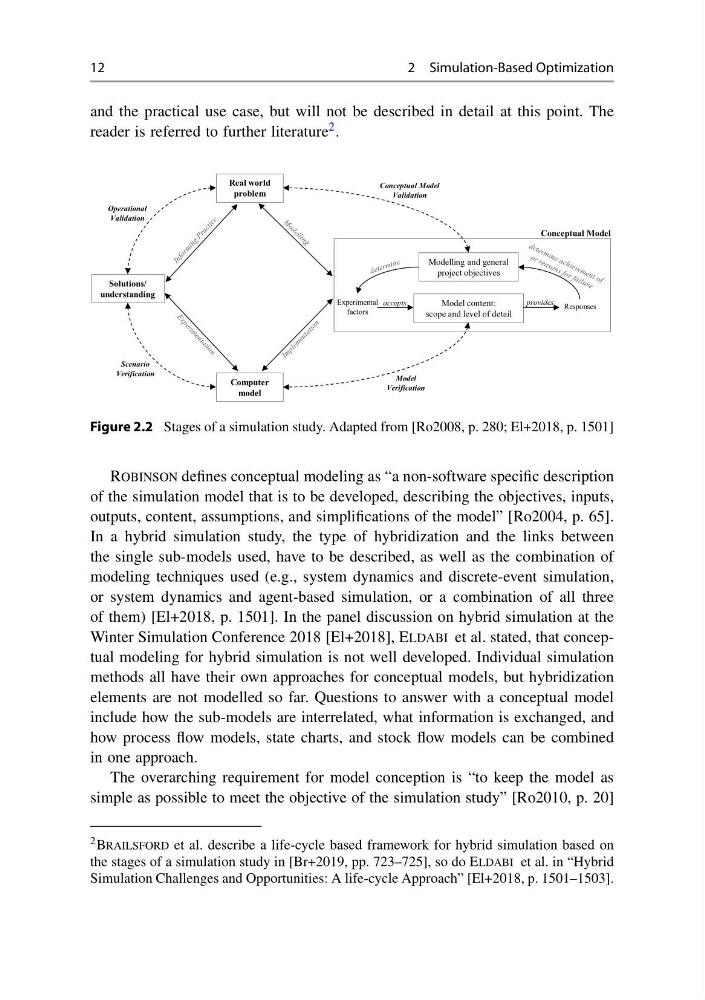
Figure 2.2 Stages of a simulation study. Adapted from [Ro2008, p. 280; El+2018, p. 1501]
Robinson defines conceptual modeling as “a non-software specific description
of the simulation model that is to be developed, describing the objectives, inputs,
outputs, content, assumptions, and simplifications of the model” [Ro2004, p. 65].
In a hybrid simulation study, the type of hybridization and the links between
the single sub-models used, have to be described, as well as the combination of
modeling techniques used (e.g., system dynamics and discrete-event simulation,
or system dynamics and agent-based simulation, or a combination of all three
of them) [El+2018, p. 1501]. In the panel discussion on hybrid simulation at the
Winter Simulation Conference 2018 [El+2018], Eldabi et al. stated, that conceptual modeling for hybrid simulation is not well developed. Individual simulation
methods all have their own approaches for conceptual models, but hybridization
elements are not modelled so far. Questions to answer with a conceptual model
include how the sub-models are interrelated, what information is exchanged, and
how process flow models, state charts, and stock flow models can be combined
in one approach.
The overarching requirement for model conception is “to keep the model as
simple as possible to meet the objective of the simulation study” [Ro2010, p. 20]
2 Brailsford et al. describe a life-cycle based framework for hybrid simulation based on
the stages of a simulation study in [Br+2019, pp. 723–725], so do Eldabi et al. in “Hybrid
Simulation Challenges and Opportunities: A life-cycle Approach” [El+2018, p. 1501–1503].
2 Simulation-Based Optimization
and the practical use case, but will not be described in detail at this point. The
reader is referred to further literature 2 .
Solutions/
understanding
Real world
problem
Computer
model
Modelling and general
project objectives
Model content:
scope and level of detail
Experimental
factors
Responses
provides
accepts
Conceptual Model
Conceptual Model
Validation
Model
Verification
Scenario
Verification
Operational
Validation
Figure 2.2 Stages of a simulation study. Adapted from [Ro2008, p. 280; El+2018, p. 1501]
Robinson defines conceptual modeling as “a non-software specific description
of the simulation model that is to be developed, describing the objectives, inputs,
outputs, content, assumptions, and simplifications of the model” [Ro2004, p. 65].
In a hybrid simulation study, the type of hybridization and the links between
the single sub-models used, have to be described, as well as the combination of
modeling techniques used (e.g., system dynamics and discrete-event simulation,
or system dynamics and agent-based simulation, or a combination of all three
of them) [El+2018, p. 1501]. In the panel discussion on hybrid simulation at the
Winter Simulation Conference 2018 [El+2018], Eldabi et al. stated, that conceptual modeling for hybrid simulation is not well developed. Individual simulation
methods all have their own approaches for conceptual models, but hybridization
elements are not modelled so far. Questions to answer with a conceptual model
include how the sub-models are interrelated, what information is exchanged, and
how process flow models, state charts, and stock flow models can be combined
in one approach.
The overarching requirement for model conception is “to keep the model as
simple as possible to meet the objective of the simulation study” [Ro2010, p. 20]
2 Brailsford et al. describe a life-cycle based framework for hybrid simulation based on
the stages of a simulation study in [Br+2019, pp. 723–725], so do Eldabi et al. in “Hybrid
Simulation Challenges and Opportunities: A life-cycle Approach” [El+2018, p. 1501–1503].