

5.6 Prototypical Implementation
133
causes a change of the output, delays are permitted only within a time frame of
six minutes.
The optimization of the production line requires the consideration of restrictions imposed by the production scenario. The CNC1 and CNC2 machines as
well as the drilling machine need to stay in off mode for a fixed period of time
before they can be restarted again. This defined time is technically required to
shut down the machine completely, to empty all compressed air connections and
to allow technical components to fully cool down. Since this restriction directly
influences the course of the machine logic, it makes sense to incorporate it here
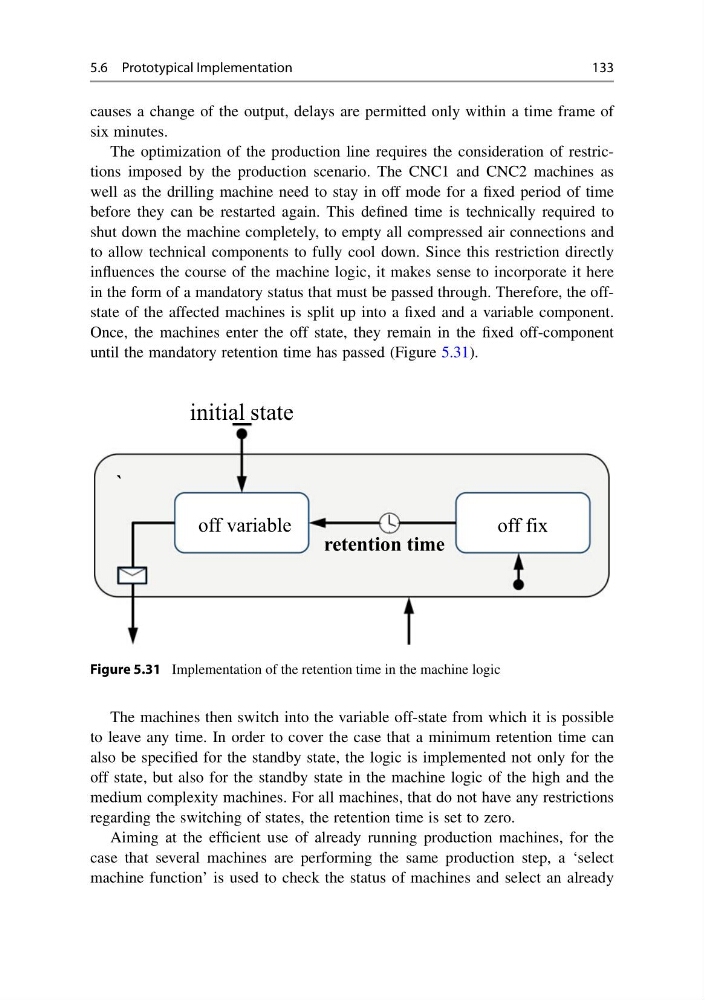
in the form of a mandatory status that must be passed through. Therefore, the offstate of the affected machines is split up into a fixed and a variable component.
Once, the machines enter the off state, they remain in the fixed off-component
until the mandatory retention time has passed (Figure 5.31).
`
off variable
off fix
initial state
retention time
Figure 5.31 Implementation of the retention time in the machine logic
The machines then switch into the variable off-state from which it is possible
to leave any time. In order to cover the case that a minimum retention time can
also be specified for the standby state, the logic is implemented not only for the
off state, but also for the standby state in the machine logic of the high and the
medium complexity machines. For all machines, that do not have any restrictions
regarding the switching of states, the retention time is set to zero.
Aiming at the efficient use of already running production machines, for the
case that several machines are performing the same production step, a ‘select
machine function’ is used to check the status of machines and select an already
133
causes a change of the output, delays are permitted only within a time frame of
six minutes.
The optimization of the production line requires the consideration of restrictions imposed by the production scenario. The CNC1 and CNC2 machines as
well as the drilling machine need to stay in off mode for a fixed period of time
before they can be restarted again. This defined time is technically required to
shut down the machine completely, to empty all compressed air connections and
to allow technical components to fully cool down. Since this restriction directly
influences the course of the machine logic, it makes sense to incorporate it here
in the form of a mandatory status that must be passed through. Therefore, the offstate of the affected machines is split up into a fixed and a variable component.
Once, the machines enter the off state, they remain in the fixed off-component
until the mandatory retention time has passed (Figure 5.31).
`
off variable
off fix
initial state
retention time
Figure 5.31 Implementation of the retention time in the machine logic
The machines then switch into the variable off-state from which it is possible
to leave any time. In order to cover the case that a minimum retention time can
also be specified for the standby state, the logic is implemented not only for the
off state, but also for the standby state in the machine logic of the high and the
medium complexity machines. For all machines, that do not have any restrictions
regarding the switching of states, the retention time is set to zero.
Aiming at the efficient use of already running production machines, for the
case that several machines are performing the same production step, a ‘select
machine function’ is used to check the status of machines and select an already