

5.4 Description of the Optimization Approach
119
example as the non-case-related description is tedious and not goal-oriented. The
parameters will be defined according to the optimization goals. For an optimization of the total energy consumption, parameters are needed that offer starting
points for changing the machine behavior to a more efficient manner, whereas for
a peak optimization, parameters are needed that influence the occurrence of load
peaks of individual machines and can delay them for instance.
5.4.4 Interdependencies between the Simulation Model
and the Optimization Process
The general interdependencies between the simulation model and the optimization
methodology have been described in theory in section 2.3.2 of this book. By simulating different system configurations, the optimization methodology searches for
the most influential process inputs and their ideal input values to optimize the
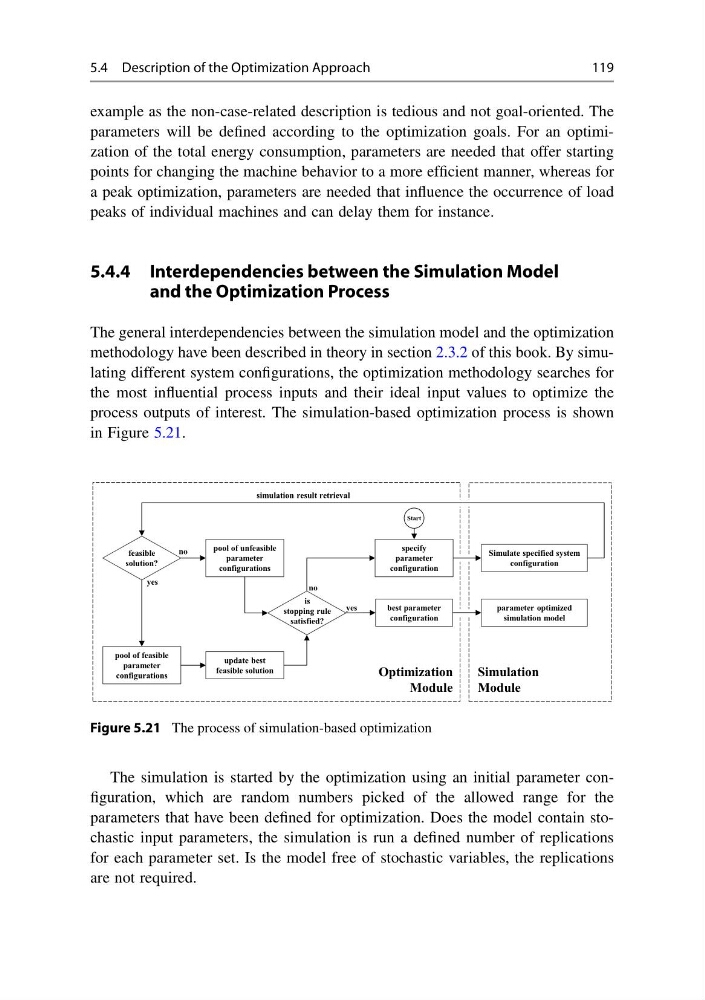
process outputs of interest. The simulation-based optimization process is shown
in Figure 5.21.
Optimization
Module
Simulation
Module
Simulate specified system
configuration
specify
parameter
configuration
pool of unfeasible
parameter
configurations
Start
simulation result retrieval
best parameter
configuration
pool of feasible
parameter
configurations
update best
feasible solution
parameter optimized
simulation model
yes
feasible
solution?
no
yes
is
stopping rule
satisfied?
no
Figure 5.21 The process of simulation-based optimization
The simulation is started by the optimization using an initial parameter configuration, which are random numbers picked of the allowed range for the
parameters that have been defined for optimization. Does the model contain stochastic input parameters, the simulation is run a defined number of replications
for each parameter set. Is the model free of stochastic variables, the replications
are not required.
119
example as the non-case-related description is tedious and not goal-oriented. The
parameters will be defined according to the optimization goals. For an optimization of the total energy consumption, parameters are needed that offer starting
points for changing the machine behavior to a more efficient manner, whereas for
a peak optimization, parameters are needed that influence the occurrence of load
peaks of individual machines and can delay them for instance.
5.4.4 Interdependencies between the Simulation Model
and the Optimization Process
The general interdependencies between the simulation model and the optimization
methodology have been described in theory in section 2.3.2 of this book. By simulating different system configurations, the optimization methodology searches for
the most influential process inputs and their ideal input values to optimize the
process outputs of interest. The simulation-based optimization process is shown
in Figure 5.21.
Optimization
Module
Simulation
Module
Simulate specified system
configuration
specify
parameter
configuration
pool of unfeasible
parameter
configurations
Start
simulation result retrieval
best parameter
configuration
pool of feasible
parameter
configurations
update best
feasible solution
parameter optimized
simulation model
yes
feasible
solution?
no
yes
is
stopping rule
satisfied?
no
Figure 5.21 The process of simulation-based optimization
The simulation is started by the optimization using an initial parameter configuration, which are random numbers picked of the allowed range for the
parameters that have been defined for optimization. Does the model contain stochastic input parameters, the simulation is run a defined number of replications
for each parameter set. Is the model free of stochastic variables, the replications
are not required.