

5.4 Description of the Optimization Approach
115
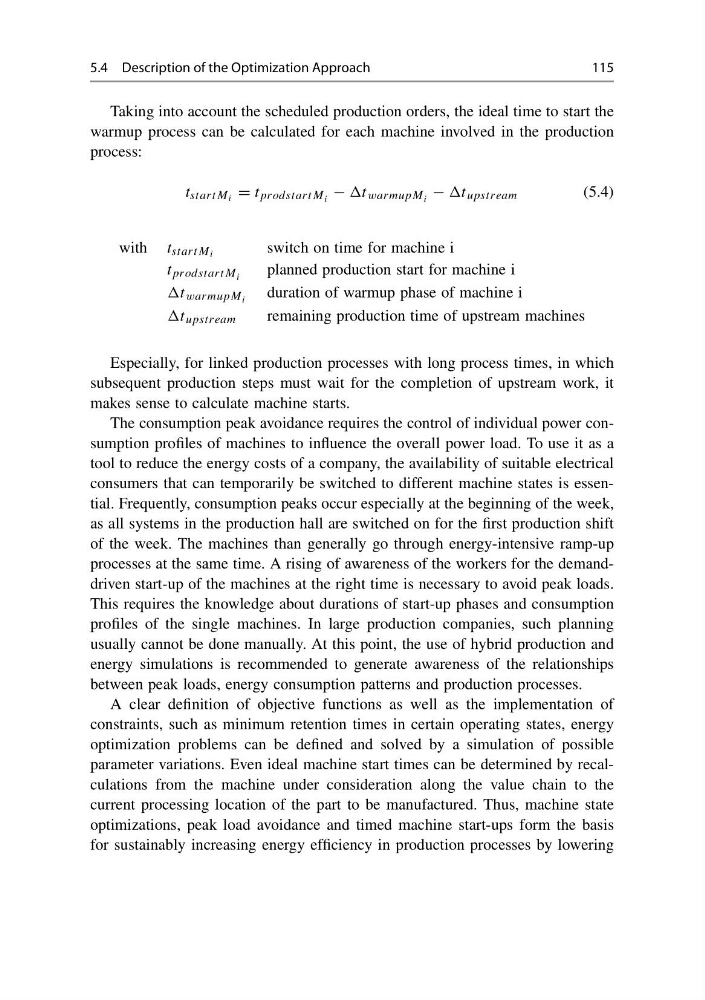
Taking into account the scheduled production orders, the ideal time to start the
warmup process can be calculated for each machine involved in the production
process:
t start M i = t pr odstar t M i − t warmupM i − t upstream
(5.4)
with t start M i
switch on time for machine i
t pr odstar t M i
planned production start for machine i
t warmupM i duration of warmup phase of machine i
t upstream
remaining production time of upstream machines
Especially, for linked production processes with long process times, in which
subsequent production steps must wait for the completion of upstream work, it
makes sense to calculate machine starts.
The consumption peak avoidance requires the control of individual power consumption profiles of machines to influence the overall power load. To use it as a
tool to reduce the energy costs of a company, the availability of suitable electrical
consumers that can temporarily be switched to different machine states is essential. Frequently, consumption peaks occur especially at the beginning of the week,
as all systems in the production hall are switched on for the first production shift
of the week. The machines than generally go through energy-intensive ramp-up
processes at the same time. A rising of awareness of the workers for the demanddriven start-up of the machines at the right time is necessary to avoid peak loads.
This requires the knowledge about durations of start-up phases and consumption
profiles of the single machines. In large production companies, such planning
usually cannot be done manually. At this point, the use of hybrid production and
energy simulations is recommended to generate awareness of the relationships
between peak loads, energy consumption patterns and production processes.
A clear definition of objective functions as well as the implementation of
constraints, such as minimum retention times in certain operating states, energy
optimization problems can be defined and solved by a simulation of possible
parameter variations. Even ideal machine start times can be determined by recalculations from the machine under consideration along the value chain to the
current processing location of the part to be manufactured. Thus, machine state
optimizations, peak load avoidance and timed machine start-ups form the basis
for sustainably increasing energy efficiency in production processes by lowering
115
Taking into account the scheduled production orders, the ideal time to start the
warmup process can be calculated for each machine involved in the production
process:
t start M i = t pr odstar t M i − t warmupM i − t upstream
(5.4)
with t start M i
switch on time for machine i
t pr odstar t M i
planned production start for machine i
t warmupM i duration of warmup phase of machine i
t upstream
remaining production time of upstream machines
Especially, for linked production processes with long process times, in which
subsequent production steps must wait for the completion of upstream work, it
makes sense to calculate machine starts.
The consumption peak avoidance requires the control of individual power consumption profiles of machines to influence the overall power load. To use it as a
tool to reduce the energy costs of a company, the availability of suitable electrical
consumers that can temporarily be switched to different machine states is essential. Frequently, consumption peaks occur especially at the beginning of the week,
as all systems in the production hall are switched on for the first production shift
of the week. The machines than generally go through energy-intensive ramp-up
processes at the same time. A rising of awareness of the workers for the demanddriven start-up of the machines at the right time is necessary to avoid peak loads.
This requires the knowledge about durations of start-up phases and consumption
profiles of the single machines. In large production companies, such planning
usually cannot be done manually. At this point, the use of hybrid production and
energy simulations is recommended to generate awareness of the relationships
between peak loads, energy consumption patterns and production processes.
A clear definition of objective functions as well as the implementation of
constraints, such as minimum retention times in certain operating states, energy
optimization problems can be defined and solved by a simulation of possible
parameter variations. Even ideal machine start times can be determined by recalculations from the machine under consideration along the value chain to the
current processing location of the part to be manufactured. Thus, machine state
optimizations, peak load avoidance and timed machine start-ups form the basis
for sustainably increasing energy efficiency in production processes by lowering