

8.5 Summary
125
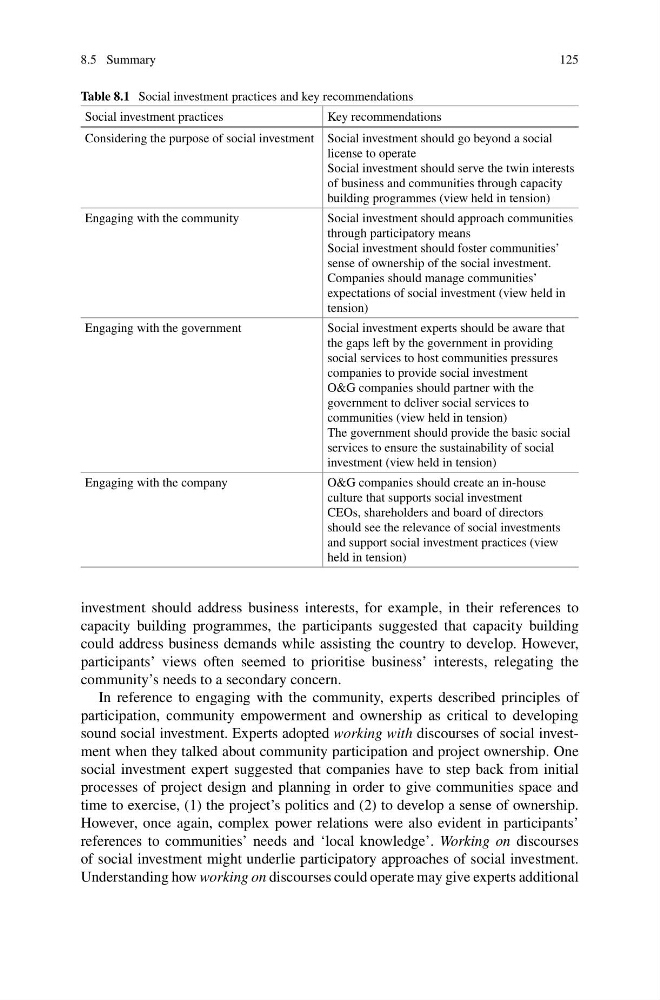
Table 8.1 Social investment practices and key recommendations
Social investment practices
Key recommendations
Considering the purpose of social investment Social investment should go beyond a social
license to operate
Social investment should serve the twin interests
of business and communities through capacity
building programmes (view held in tension)
Engaging with the community
Social investment should approach communities
through participatory means
Social investment should foster communities’
sense of ownership of the social investment.
Companies should manage communities’
expectations of social investment (view held in
tension)
Engaging with the government
Social investment experts should be aware that
the gaps left by the government in providing
social services to host communities pressures
companies to provide social investment
O&G companies should partner with the
government to deliver social services to
communities (view held in tension)
The government should provide the basic social
services to ensure the sustainability of social
investment (view held in tension)
Engaging with the company
O&G companies should create an in-house
culture that supports social investment
CEOs, shareholders and board of directors
should see the relevance of social investments
and support social investment practices (view
held in tension)
investment should address business interests, for example, in their references to
capacity building programmes, the participants suggested that capacity building
could address business demands while assisting the country to develop. However,
participants’ views often seemed to prioritise business’ interests, relegating the
community’s needs to a secondary concern.
In reference to engaging with the community, experts described principles of
participation, community empowerment and ownership as critical to developing
sound social investment. Experts adopted working with discourses of social investment when they talked about community participation and project ownership. One
social investment expert suggested that companies have to step back from initial
processes of project design and planning in order to give communities space and
time to exercise, (1) the project’s politics and (2) to develop a sense of ownership.
However, once again, complex power relations were also evident in participants’
references to communities’ needs and ‘local knowledge’. Working on discourses
of social investment might underlie participatory approaches of social investment.
Understanding how working on discourses could operate may give experts additional
125
Table 8.1 Social investment practices and key recommendations
Social investment practices
Key recommendations
Considering the purpose of social investment Social investment should go beyond a social
license to operate
Social investment should serve the twin interests
of business and communities through capacity
building programmes (view held in tension)
Engaging with the community
Social investment should approach communities
through participatory means
Social investment should foster communities’
sense of ownership of the social investment.
Companies should manage communities’
expectations of social investment (view held in
tension)
Engaging with the government
Social investment experts should be aware that
the gaps left by the government in providing
social services to host communities pressures
companies to provide social investment
O&G companies should partner with the
government to deliver social services to
communities (view held in tension)
The government should provide the basic social
services to ensure the sustainability of social
investment (view held in tension)
Engaging with the company
O&G companies should create an in-house
culture that supports social investment
CEOs, shareholders and board of directors
should see the relevance of social investments
and support social investment practices (view
held in tension)
investment should address business interests, for example, in their references to
capacity building programmes, the participants suggested that capacity building
could address business demands while assisting the country to develop. However,
participants’ views often seemed to prioritise business’ interests, relegating the
community’s needs to a secondary concern.
In reference to engaging with the community, experts described principles of
participation, community empowerment and ownership as critical to developing
sound social investment. Experts adopted working with discourses of social investment when they talked about community participation and project ownership. One
social investment expert suggested that companies have to step back from initial
processes of project design and planning in order to give communities space and
time to exercise, (1) the project’s politics and (2) to develop a sense of ownership.
However, once again, complex power relations were also evident in participants’
references to communities’ needs and ‘local knowledge’. Working on discourses
of social investment might underlie participatory approaches of social investment.
Understanding how working on discourses could operate may give experts additional