

response of materials in the X-ray region are very different from those for UV-visible
and infrared light. This makes lenses impractical in most cases and forces one to use
mirrors and gratings at glancing angles or nearly perfect crystals. Furthermore, the
short wavelengths of X-rays and the high brightness of synchrotron sources necessitate exquisitely fine tolerances in the figure and finish of X-ray optics. As we shall
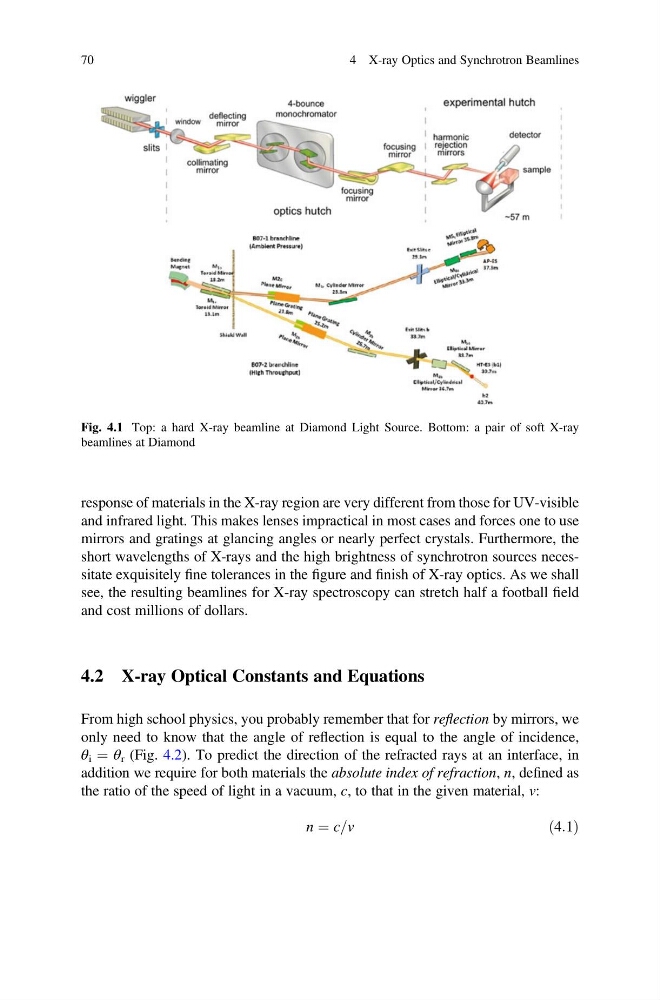
see, the resulting beamlines for X-ray spectroscopy can stretch half a football field
and cost millions of dollars.
4.2 X-ray Optical Constants and Equations
From high school physics, you probably remember that for reflection by mirrors, we
only need to know that the angle of reflection is equal to the angle of incidence,
θ i ¼ θ r (Fig. 4.2). To predict the direction of the refracted rays at an interface, in
addition we require for both materials the absolute index of refraction, n, defined as
the ratio of the speed of light in a vacuum, c, to that in the given material, v:
n ¼ c=v
ð4:1Þ
Fig. 4.1 Top: a hard X-ray beamline at Diamond Light Source. Bottom: a pair of soft X-ray
beamlines at Diamond
70
4 X-ray Optics and Synchrotron Beamlines
and infrared light. This makes lenses impractical in most cases and forces one to use
mirrors and gratings at glancing angles or nearly perfect crystals. Furthermore, the
short wavelengths of X-rays and the high brightness of synchrotron sources necessitate exquisitely fine tolerances in the figure and finish of X-ray optics. As we shall
see, the resulting beamlines for X-ray spectroscopy can stretch half a football field
and cost millions of dollars.
4.2 X-ray Optical Constants and Equations
From high school physics, you probably remember that for reflection by mirrors, we
only need to know that the angle of reflection is equal to the angle of incidence,
θ i ¼ θ r (Fig. 4.2). To predict the direction of the refracted rays at an interface, in
addition we require for both materials the absolute index of refraction, n, defined as
the ratio of the speed of light in a vacuum, c, to that in the given material, v:
n ¼ c=v
ð4:1Þ
Fig. 4.1 Top: a hard X-ray beamline at Diamond Light Source. Bottom: a pair of soft X-ray
beamlines at Diamond
70
4 X-ray Optics and Synchrotron Beamlines